We read your photo as:

Problem 42: The diagram shows a triangle LMN inscribed in a circle with center O. LN is the diameter. If LNM = (x+15)^ and NLM = (x−5)^, find x. Problem 43: Given vectors a = (3, 2) and b = (-1, 4), f

Mathematics

ScanSolve AI Answer

Answer

B

Step-by-step solution

6 steps

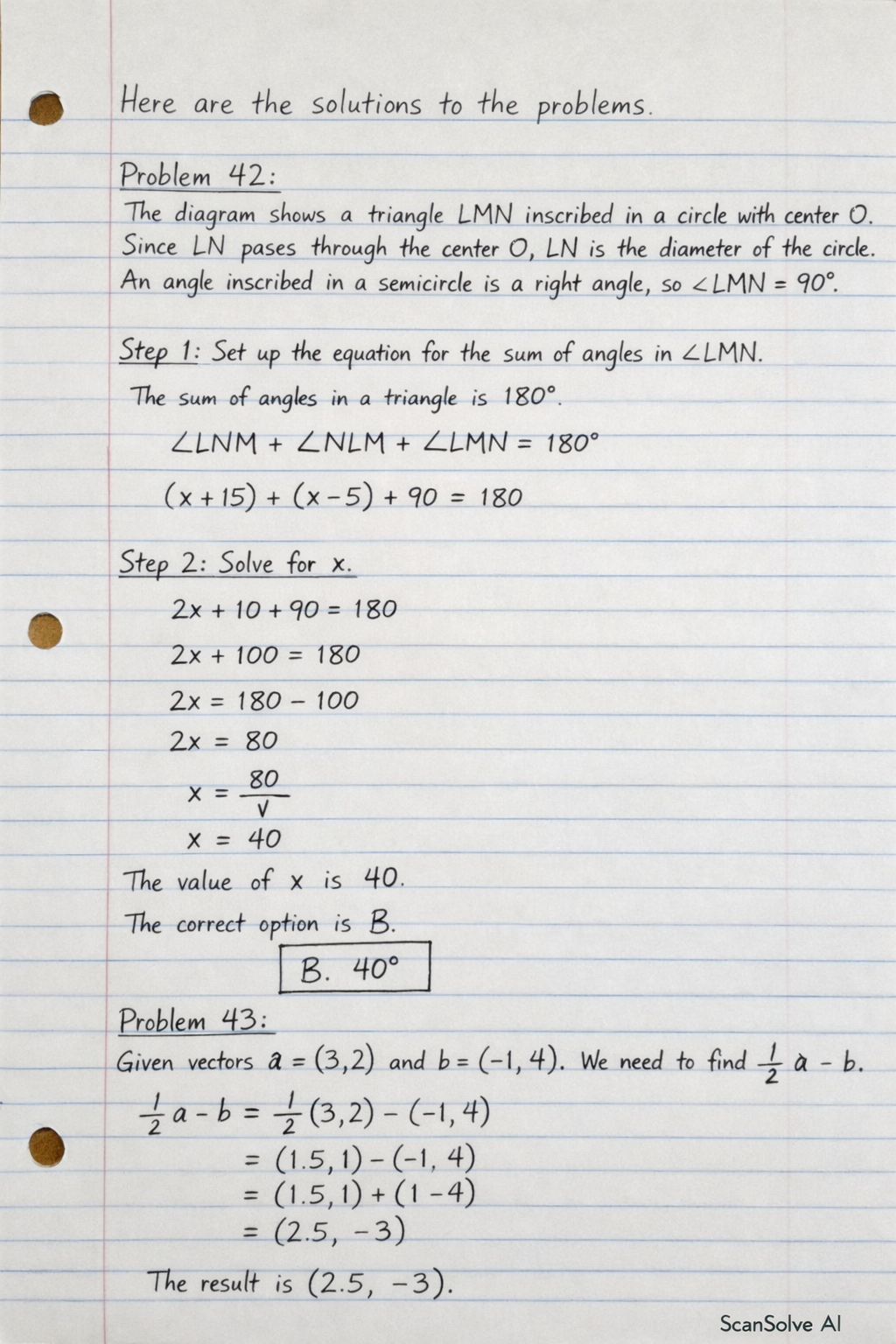
Here are the solutions to the problems.

:
The diagram shows a triangle LMN inscribed in a circle with center O. Since LN passes through the center O, LN is the diameter of the circle. An angle inscribed in a semicircle is a right angle, so ∠LMN=90∘\angle LMN = 90^\circ.

  1. Set up the equation for the sum of angles in △LMN\triangle LMN.

    The sum of angles in a triangle is 180∘180^\circ.

    ∠LNM+∠NLM+∠LMN=180∘\angle LNM + \angle NLM + \angle LMN = 180^\circ

    Substitute the given values: ∠LNM=(x+15)∘\angle LNM = (x+15)^\circ, ∠NLM=(x−5)∘\angle NLM = (x-5)^\circ, and ∠LMN=90∘\angle LMN = 90^\circ.

    (x+15)+(x−5)+90=180(x+15) + (x-5) + 90 = 180
  2. Solve for xx.

    2x+10+90=1802x + 10 + 90 = 180 2x+100=1802x + 100 = 180 2x=180−1002x = 180 - 100 2x=802x = 80 x=802x = \frac{80}{2} x=40x = 40

    The value of xx is 40.

    The correct option is B.

    B. 40∘\boxed{\text{B. } 40^\circ}

    :
    Given vectors a=(32)\mathbf{a} = \begin{pmatrix} 3 \\ 2 \end{pmatrix} and b=(−14)\mathbf{b} = \begin{pmatrix} -1 \\ 4 \end{pmatrix}. We need to find 12a−b\frac{1}{2}\mathbf{a} - \mathbf{b}.

  3. Calculate 12a\frac{1}{2}\mathbf{a}.

    12a=12(32)=(3222)=(1.51)\frac{1}{2}\mathbf{a} = \frac{1}{2} \begin{pmatrix} 3 \\ 2 \end{pmatrix} = \begin{pmatrix} \frac{3}{2} \\ \frac{2}{2} \end{pmatrix} = \begin{pmatrix} 1.5 \\ 1 \end{pmatrix}
  4. Calculate 12a−b\frac{1}{2}\mathbf{a} - \mathbf{b}.

    12a−b=(1.51)−(−14)\frac{1}{2}\mathbf{a} - \mathbf{b} = \begin{pmatrix} 1.5 \\ 1 \end{pmatrix} - \begin{pmatrix} -1 \\ 4 \end{pmatrix} =(1.5−(−1)1−4)= \begin{pmatrix} 1.5 - (-1) \\ 1 - 4 \end{pmatrix} =(1.5+1−3)= \begin{pmatrix} 1.5 + 1 \\ -3 \end{pmatrix} =(2.5−3)= \begin{pmatrix} 2.5 \\ -3 \end{pmatrix}

    The correct option is A.

    A. (2.5−3)\boxed{\text{A. } \begin{pmatrix} 2.5 \\ -3 \end{pmatrix}}

    :
    Calculate the magnitude of the vector 2i−3j2\mathbf{i} - 3\mathbf{j}.

  5. Identify the components of the vector.

    A vector v=xi+yj\mathbf{v} = x\mathbf{i} + y\mathbf{j} has components xx and yy.
    For the vector 2i−3j2\mathbf{i} - 3\mathbf{j}, we have x=2x = 2 and y=−3y = -3.

  6. Calculate the magnitude using the formula ∣v∣=x2+y2|\mathbf{v}| = \sqrt{x^2 + y^2}.

    ∣2i−3j∣=(2)2+(−3)2|2\mathbf{i} - 3\mathbf{j}| = \sqrt{(2)^2 + (-3)^2} =4+9= \sqrt{4 + 9} =13= \sqrt{13}

    The magnitude of the vector 2i−3j2\mathbf{i} - 3\mathbf{j} is 13\sqrt{13}.

    13\boxed{\sqrt{13}}
Was this helpful?

Try one yourself

A new problem that tests the same skill.

Still stuck on this one?

Ask a follow-up, and the answer starts from this question.

Got a different question?Ask your own question
Handwritten step-by-step solution preview

Handwritten Step-by-Step Solution

Get this as a handwritten image on WhatsApp — like a tutor wrote it for you.

Try on WhatsApp