
We read your photo as:
Problems on sets: counting elements and comparing sets. Specifically, find n(N) for N = 11, 12, 13, 14, n(S) for S = 1, 4, 9, ..., 49, and determine if A = e, f, g, h equals B = g, f, h, e, and if X =
ScanSolve AI Answer
Step-by-step solution
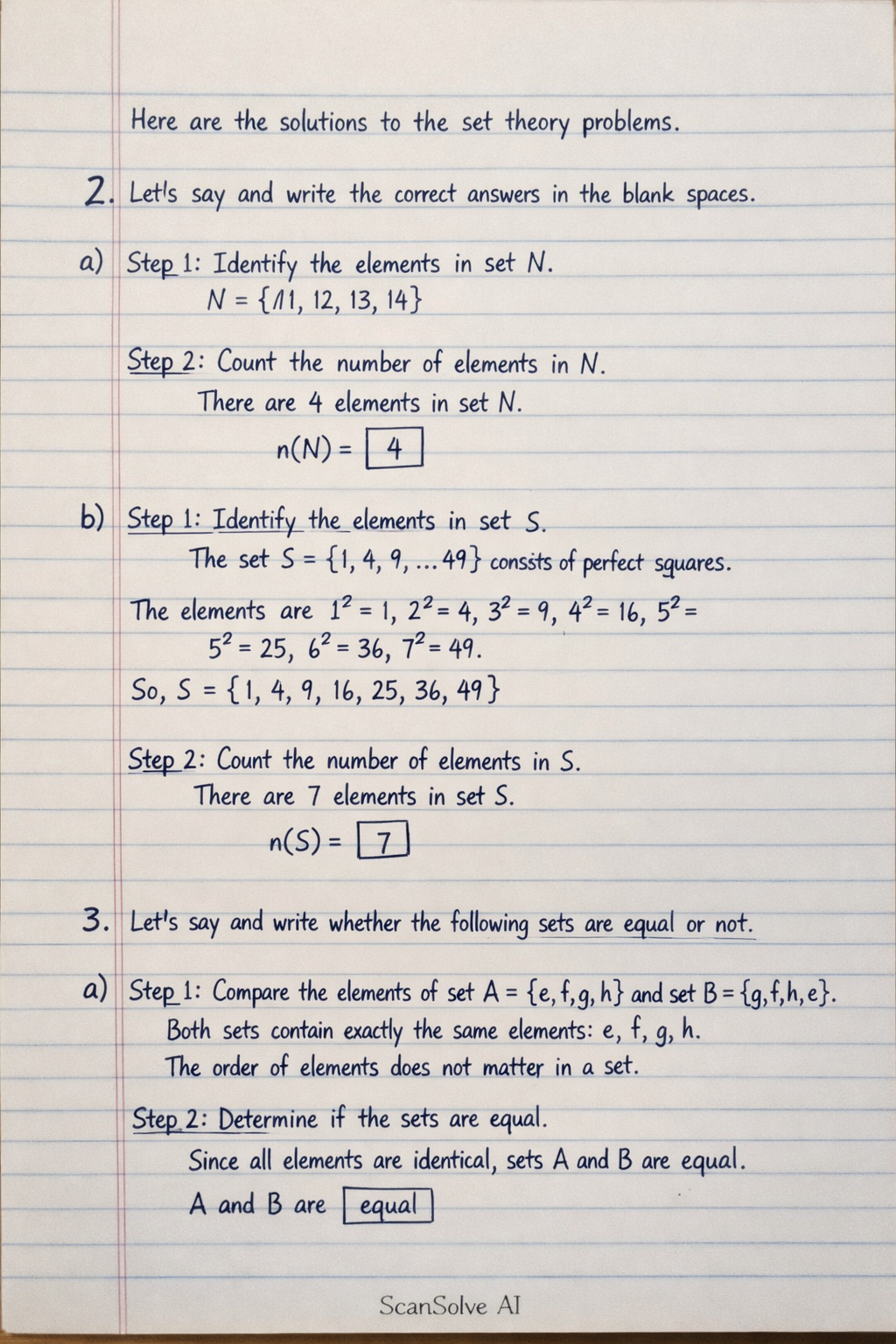
14 stepsHere are the solutions to the set theory problems.
2. Let's say and write the correct answers in the blank spaces.
a)
Identify the elements in set .
Count the number of elements in .
There are 4 elements in set .
b)
Identify the elements in set .
The set consists of perfect squares.
The elements are , , , , , , .
So, .Count the number of elements in .
There are 7 elements in set .
3. Let's say and write whether the following sets are equal or not.
a)
Compare the elements of set and set .
Both sets contain exactly the same elements: $e, f, g, h$. The order of elements does not matter in a set.
Determine if the sets are equal.
Since all elements are identical, sets A and B are equal.
A and B areb)
Compare the elements of set and set .
Set X contains elements $3, 6, 9, 12$. Set Y contains elements $1, 3, 5, 7$.
Determine if the sets are equal.
The sets do not contain exactly the same elements (e.g., 6, 9, 12 are in X but not Y; 1, 5, 7 are in Y but not X).
X and Y are4. Let's say and write whether the following sets are overlapping or disjoint.
a)
Identify the elements in set and set .
Check for common elements between P and Q.
There are no elements that are present in both set P and set Q.
Determine if the sets are overlapping or disjoint.
Since they have no common elements, P and Q are disjoint.
P and Q areb)
Identify the elements in set and set .
Check for common elements between A and B.
The element 20 is present in both set A and set B.
Determine if the sets are overlapping or disjoint.
Since they have at least one common element (20), A and B are overlapping.
A and B are
Still stuck on this one?
Ask a follow-up, and the answer starts from this question.
More Mathematics Questions
Handwritten Step-by-Step Solution
Get this as a handwritten image on WhatsApp — like a tutor wrote it for you.
Try on WhatsApp