
دطاقت قوانین په انګلیسی راته تشریح کړه ولی نه پوهیږی
ScanSolve AI Answer
Here are the Laws of Exponents explained in English:
The Laws of Exponents are a set of rules that govern how to handle exponents in algebraic expressions. These rules simplify calculations and help in solving equations.
Here are some fundamental rules:
-
Product Rule: When multiplying powers with the same base, add the exponents.
Example:
-
Quotient Rule: When dividing powers with the same base, subtract the exponents.
Example:
-
Power of a Power Rule: When raising a power to another power, multiply the exponents.
Example:
-
Power of a Product Rule: When raising a product to a power, raise each factor to that power.
Example:
-
Power of a Quotient Rule: When raising a quotient to a power, raise both the numerator and the denominator to that power.
Example:
-
Zero Exponent Rule: Any non-zero number raised to the power of zero is 1.
Example:
-
Negative Exponent Rule: A negative exponent means the reciprocal of the base raised to the positive exponent.
Example:
-
Fractional Exponent Rule: Fractional exponents represent roots.
Example: Example:
Still stuck on this one?
Ask a follow-up, and the answer starts from this question.
More Mathematics Questions
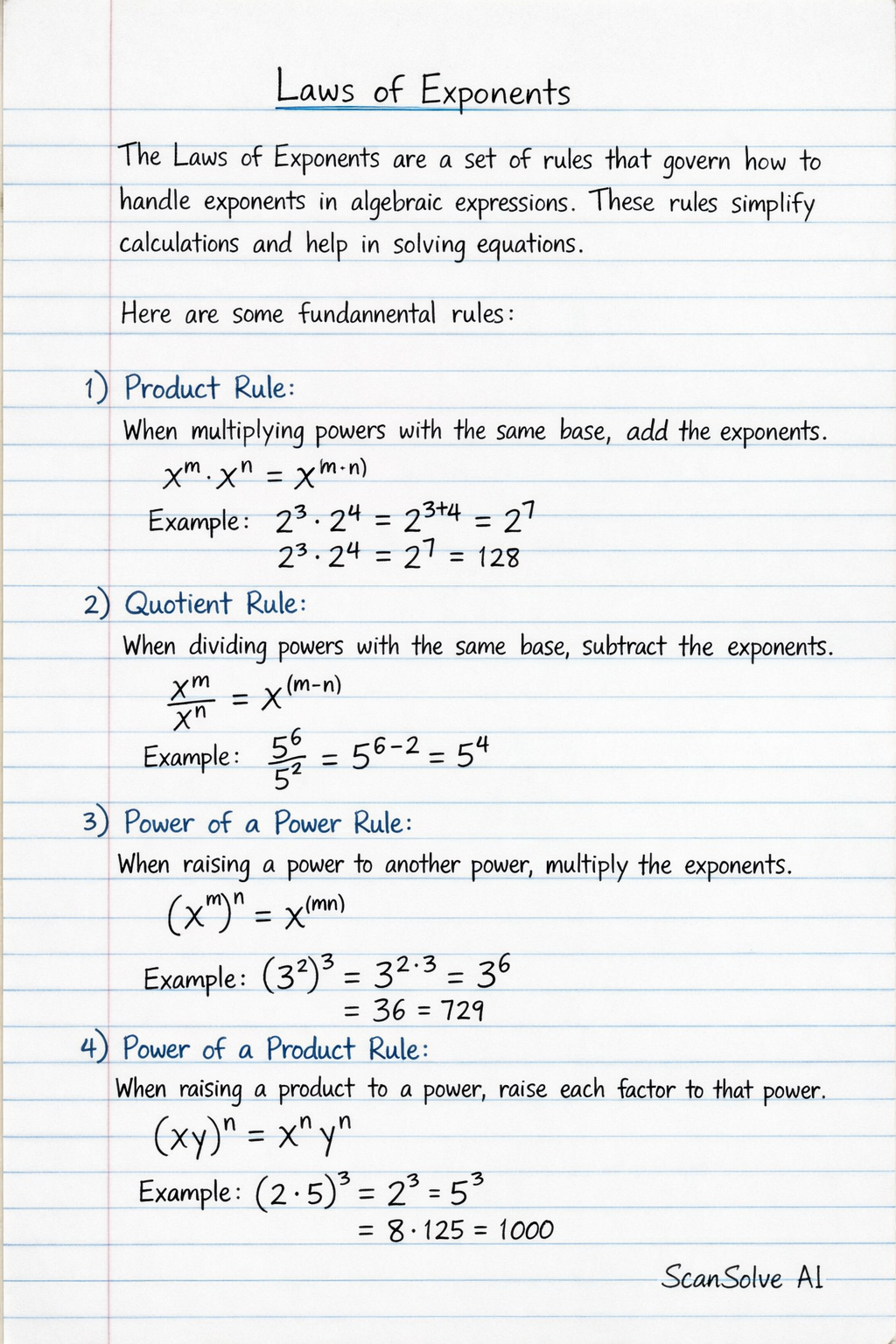
Handwritten Step-by-Step Solution
Get this as a handwritten image on WhatsApp — like a tutor wrote it for you.
Try on WhatsApp