Question Arthur and Henry are rolling a fair six sided die and the winner of their game will be the first person to get a "six". Arthur rolls the die first. Determine the probability that ... a) Arthur wins on his second throw. b) Arthur wins on his third throw. c) Arthur wins the game.

Mathematics

ScanSolve AI Answer

Answers

3 parts
a

25216\frac{25}{216}

b

6257776\frac{625}{7776}

c

611\frac{6}{11}

Step-by-step solution

5 steps

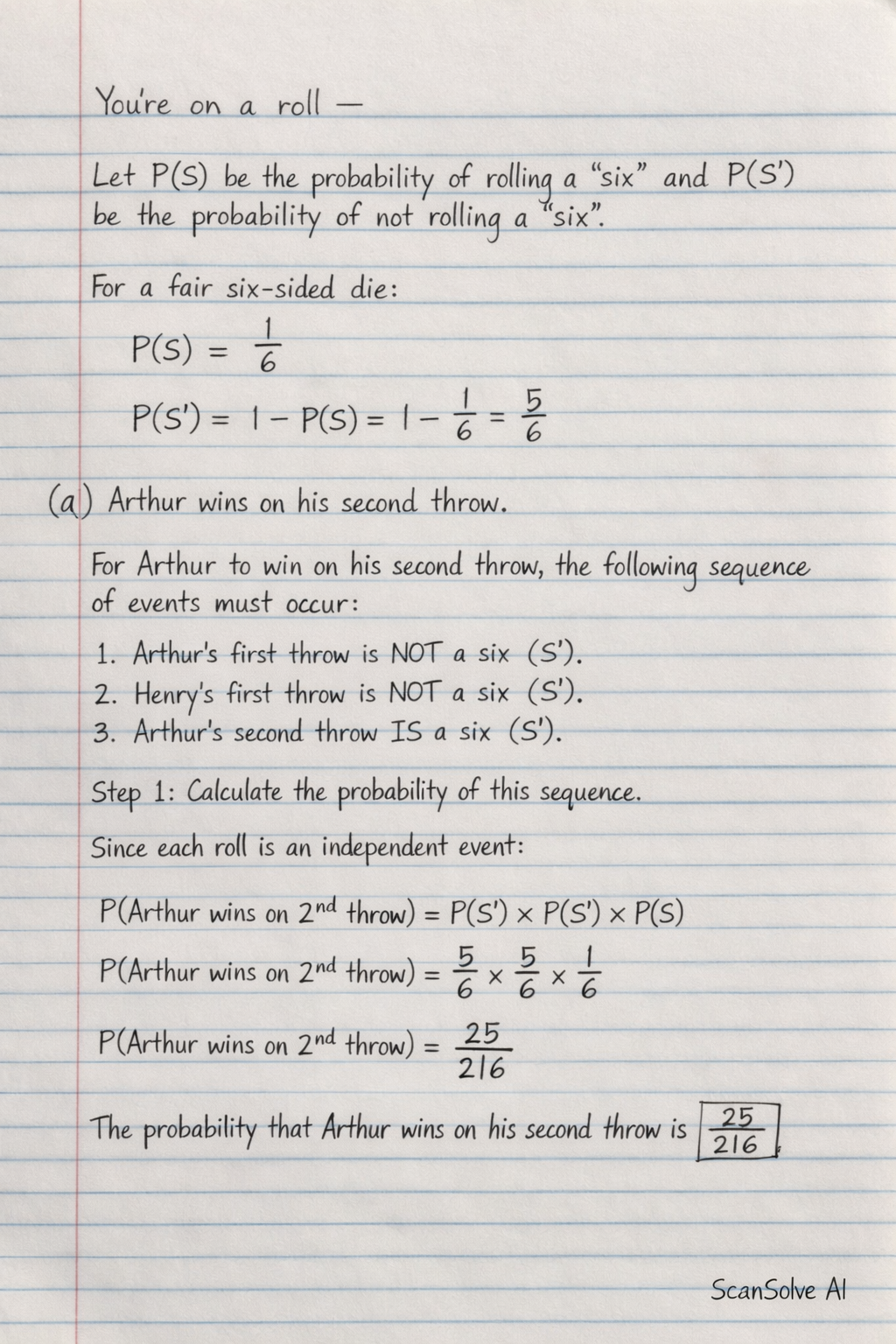
Let P(S)P(S) be the probability of rolling a "six" and P(S′)P(S') be the probability of not rolling a "six".
For a fair six-sided die:

P(S)=16P(S) = \frac{1}{6} P(S′)=1−P(S)=1−16=56P(S') = 1 - P(S) = 1 - \frac{1}{6} = \frac{5}{6}

Part a· 1 step

Arthur wins on his second throw.

For Arthur to win on his second throw, the following sequence of events must occur:

  1. Arthur's first throw is NOT a six (S′S').
  2. Henry's first throw is NOT a six (S′S').
  3. Arthur's second throw IS a six (SS).
  1. Calculate the probability of this sequence.

    Since each roll is an independent event:

    P(Arthur wins on 2nd throw)=P(S′)×P(S′)×P(S)P(\text{Arthur wins on 2nd throw}) = P(S') \times P(S') \times P(S) P(Arthur wins on 2nd throw)=56×56×16P(\text{Arthur wins on 2nd throw}) = \frac{5}{6} \times \frac{5}{6} \times \frac{1}{6} P(Arthur wins on 2nd throw)=25216P(\text{Arthur wins on 2nd throw}) = \frac{25}{216}

    The probability that Arthur wins on his second throw is 25216\boxed{\frac{25}{216}}.

Part b

6257776\frac{625}{7776}

Arthur wins on his third throw.

For Arthur to win on his third throw, the following sequence of events must occur:

  1. Arthur's first throw is NOT a six (S′S').
  2. Henry's first throw is NOT a six (S′S').
  3. Arthur's second throw is NOT a six (S′S').
  4. Henry's second throw is NOT a six (S′S').
  5. Arthur's third throw IS a six (SS).
  1. Calculate the probability of this sequence.

    P(Arthur wins on 3rd throw)=P(S′)×P(S′)×P(S′)×P(S′)×P(S)P(\text{Arthur wins on 3rd throw}) = P(S') \times P(S') \times P(S') \times P(S') \times P(S) P(Arthur wins on 3rd throw)=(56)4×16P(\text{Arthur wins on 3rd throw}) = \left(\frac{5}{6}\right)^4 \times \frac{1}{6} P(Arthur wins on 3rd throw)=6251296×16P(\text{Arthur wins on 3rd throw}) = \frac{625}{1296} \times \frac{1}{6} P(Arthur wins on 3rd throw)=6257776P(\text{Arthur wins on 3rd throw}) = \frac{625}{7776}

    The probability that Arthur wins on his third throw is 6257776\boxed{\frac{625}{7776}}.

Part c

611\frac{6}{11}

Arthur wins the game.

Arthur can win on his first throw, or his second throw, or his third throw, and so on. This forms an infinite geometric series.

  1. Identify the probabilities for Arthur winning on each turn.

    • Arthur wins on 1st throw: P(S)=16P(S) = \frac{1}{6}
    • Arthur wins on 2nd throw: P(S′)×P(S′)×P(S)=(56)2×16P(S') \times P(S') \times P(S) = \left(\frac{5}{6}\right)^2 \times \frac{1}{6}
    • Arthur wins on 3rd throw: P(S′)×P(S′)×P(S′)×P(S′)×P(S)=(56)4×16P(S') \times P(S') \times P(S') \times P(S') \times P(S) = \left(\frac{5}{6}\right)^4 \times \frac{1}{6}
    • And so on...
  2. Formulate the sum of the infinite geometric series.

    The series is:

    P(Arthur wins)=16+(56)216+(56)416+…P(\text{Arthur wins}) = \frac{1}{6} + \left(\frac{5}{6}\right)^2 \frac{1}{6} + \left(\frac{5}{6}\right)^4 \frac{1}{6} + \dots

    This is a geometric series with:
    First term, a=16a = \frac{1}{6}
    Common ratio, r=(56)2=2536r = \left(\frac{5}{6}\right)^2 = \frac{25}{36}

  3. Calculate the sum of the infinite geometric series.

    The sum of an infinite geometric series is given by S=a1−rS = \frac{a}{1-r}, provided ∣r∣<1|r| < 1.

    P(Arthur wins)=161−2536P(\text{Arthur wins}) = \frac{\frac{1}{6}}{1 - \frac{25}{36}} P(Arthur wins)=163636−2536P(\text{Arthur wins}) = \frac{\frac{1}{6}}{\frac{36}{36} - \frac{25}{36}} P(Arthur wins)=161136P(\text{Arthur wins}) = \frac{\frac{1}{6}}{\frac{11}{36}} P(Arthur wins)=16×3611P(\text{Arthur wins}) = \frac{1}{6} \times \frac{36}{11} P(Arthur wins)=611P(\text{Arthur wins}) = \frac{6}{11}

    The probability that Arthur wins the game is 611\boxed{\frac{6}{11}}.

Was this helpful?

Try one yourself

A new problem that tests the same skill.

Still stuck on this one?

Ask a follow-up, and the answer starts from this question.

Got a different question?Ask your own question
Handwritten step-by-step solution preview

Handwritten Step-by-Step Solution

Get this as a handwritten image on WhatsApp — like a tutor wrote it for you.

Try on WhatsApp