
We read your photo as:
Define range and calculate the mean deviation for scores 2, 5, 6, 4, 5. Also, calculate the correlation coefficient for X and Y
ScanSolve AI Answer
This answer stops before the end.
It was cut off when it was first written. Ask ScanSolve this question again for the full working.
1. a)
Range is a measure of dispersion in statistics that represents the difference between the highest and lowest values in a dataset. It provides a quick, but often crude, indication of the spread of data. While easy to calculate, it is highly sensitive to outliers and does not provide information about the distribution of values between the extremes.
1. b)
The scores are .
Step 1: Calculate the mean ().
Step 2: Calculate the absolute deviations from the mean ().
Step 3: Calculate the sum of the absolute deviations.
Step 4: Calculate the mean deviation.
The mean deviation is .
1. c)
Given data:
X: 4, 8, 9, 6, 2
Y: 3, 7, 6, 9, 2
Number of observations, .
Step 1: Create a table to calculate necessary sums.
| 4 | 3 | 12 | 16 | 9 |
| 8 | 7 | 56 | 64 | 49 |
| 9 | 6 | 54 | 81 | 36 |
| 6 | 9 | 54 | 36 | 81 |
| 2 | 2 | 4 | 4 | 4 |
| ----- | ----- | ------ | ------- | ------- |
Step 2: Apply Pearson's correlation coefficient formula.
The coefficient of correlation is .
1. d)
When a fair die is tossed twice, the total number of possible outcomes is .
The outcomes that result in a total of 5 are:
There are 4 favorable outcomes.
The probability of obtaining a total of 5 is:
The probability is .
2.
Given data:
X: 1, 2, 4, 5, 8, 10, 12, 14, 16
Y: 9, 8, 10, 12, 14, 15, 16, 18, 15
Number of observations, .
Step 1: Create a table to calculate necessary sums.
| 1 | 9 | 9 | 1 |
| 2 | 8 | 16 | 4 |
| 4 | 10 | 40 | 16 |
| 5 | 12 | 60 | 25 |
| 8 | 14 | 112 | 64 |
| 10 | 15 | 150 | 100 |
| 12 | 16 | 192 | 144 |
| 14 | 18 | 252 | 196 |
| 16 | 15 | 240 | 256 |
| ----- | ----- | ------ | ------- |
Step 2: Calculate the slope () of the regression line .
Step 3: Calculate the means and .
Step 4: Calculate the Y-intercept ().
Step 5: Write the regression equation.
The line of regression of Y on X is .
3.
In a single toss of a die, the sample space is . The total number of outcomes is 6.
Step 1: Identify even numbers.
Even numbers are .
Step 2: Identify composite numbers.
A composite number is a positive integer that has at least one divisor other than 1 and itself.
From the sample space:
- 1 is neither prime nor composite.
- 2 is prime.
- 3 is prime.
- 4 is composite (divisors: 1, 2, 4).
- 5 is prime.
- 6 is composite (divisors: 1, 2, 3, 6). So, composite numbers are .
Step 3: Identify numbers that are even OR composite ().
Still stuck on this one?
Ask a follow-up, and the answer starts from this question.
More Mathematics Questions
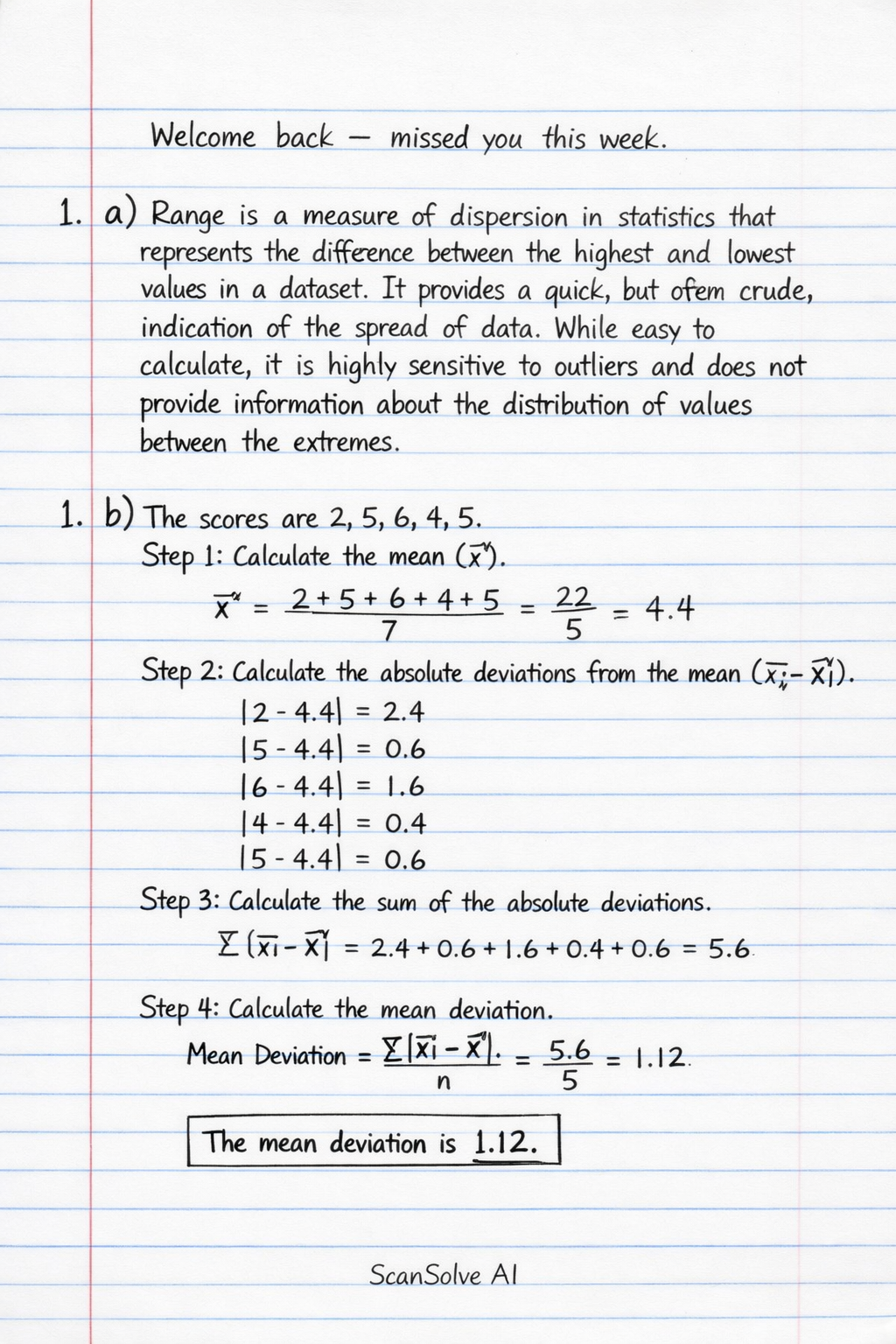
Handwritten Step-by-Step Solution
Get this as a handwritten image on WhatsApp — like a tutor wrote it for you.
Try on WhatsApp