

This mathematics problem involves applying core mathematical principles and formulas. Below you will find a complete step-by-step solution with detailed explanations for each step, helping you understand not just the answer but the method behind it.
ScanSolve AI Answer
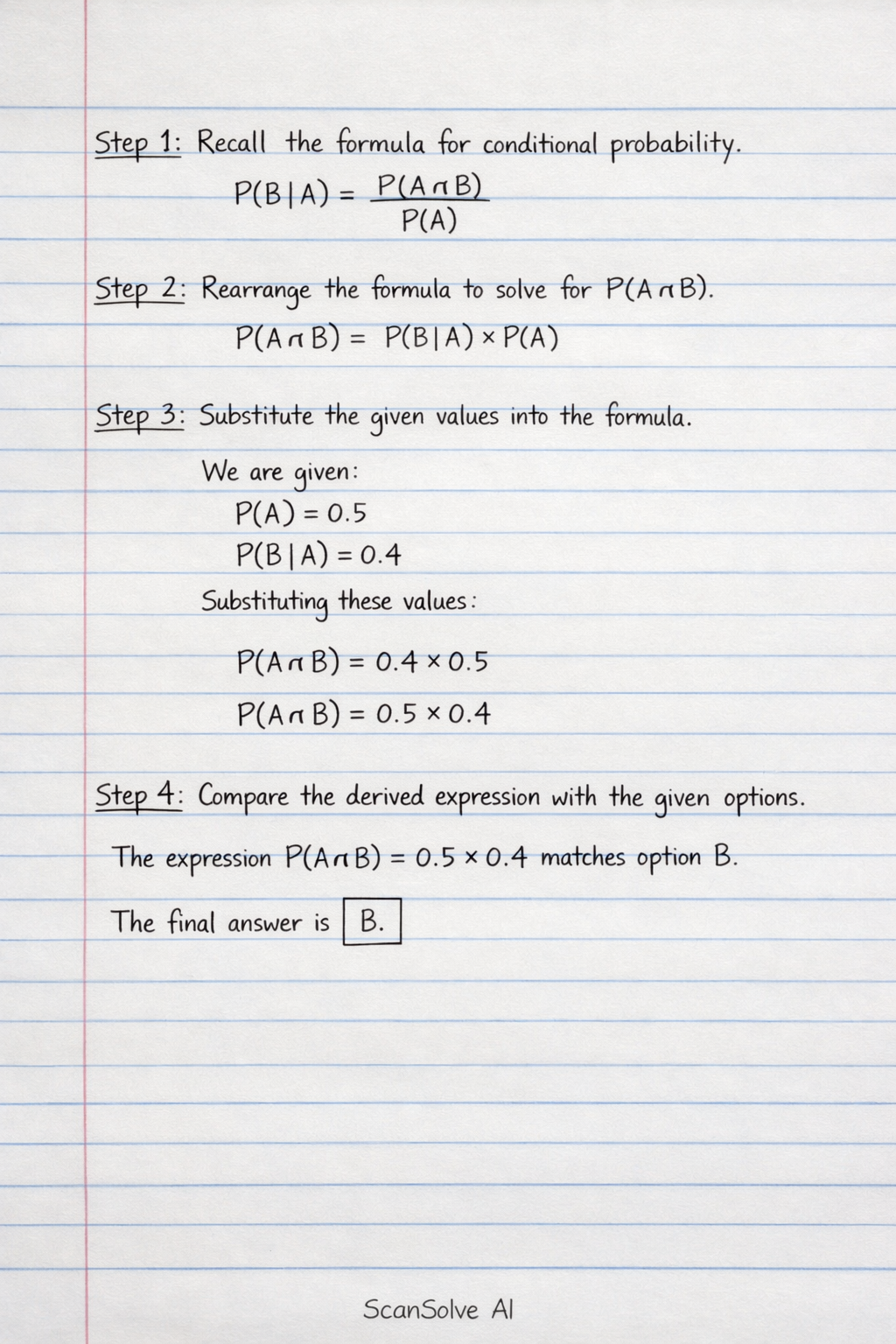
Step 1: Recall the formula for conditional probability. The conditional probability of event B given event A is defined as: P(B|A) = (P(A B))/(P(A)) Step 2: Rearrange the formula to solve for P(A B). To find P(A B), multiply both sides of the equation by P(A): P(A B) = P(B|A) × P(A) Step 3: Substitute the given values into the formula. We are given: P(A) = 0.5 P(B|A) = 0.4 Substituting these values: P(A B) = 0.4 × 0.5 Or, equivalently: P(A B) = 0.5 × 0.4 Step 4: Compare the derived expression with the given options. The expression P(A B) = 0.5 × 0.4 matches option B. The final answer is B Last free one today — make it count tomorrow, or type /upgrade for unlimited.