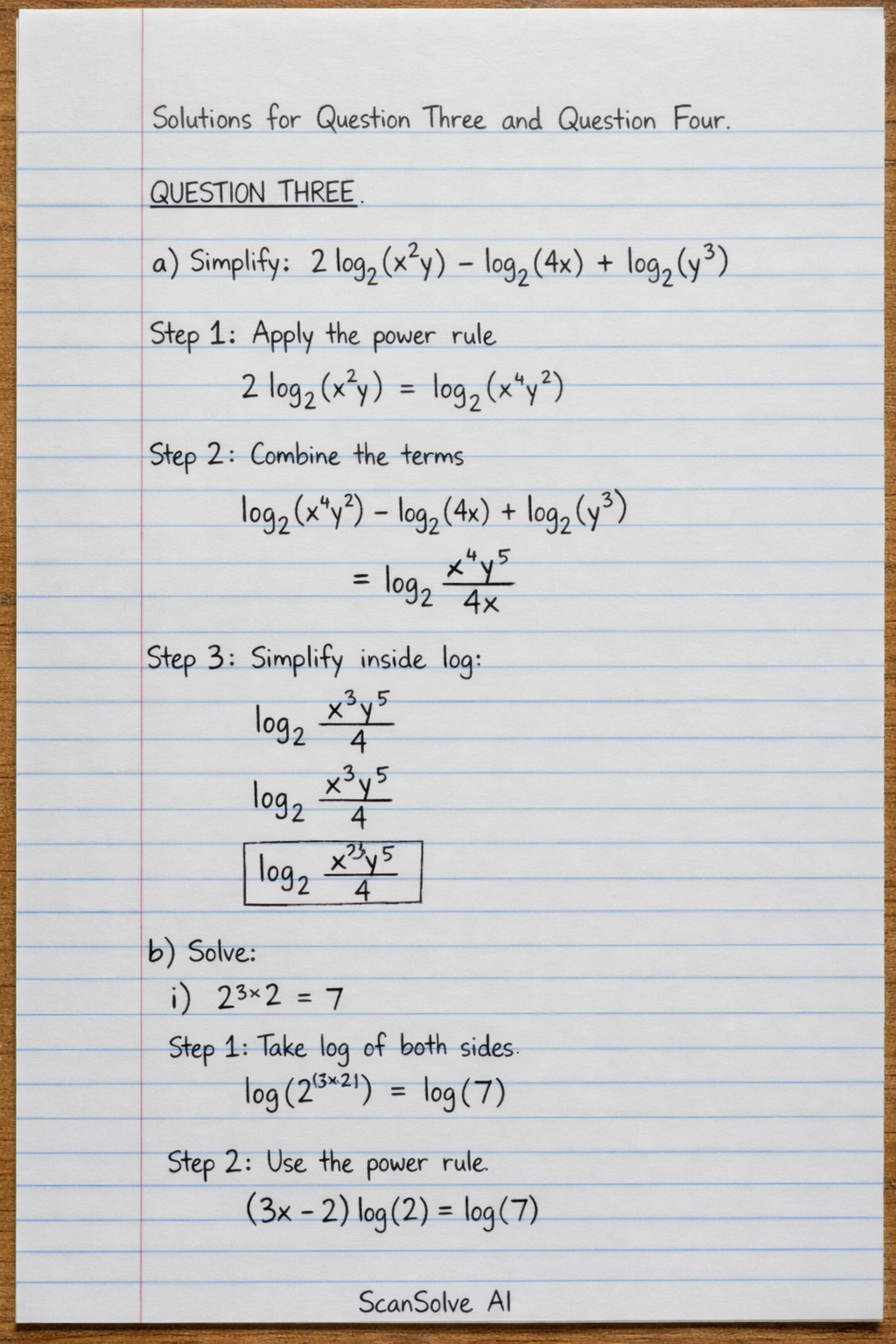
We read your photo as:

Simplify: 2log2(x²y) - log2(4x) + log2(y³)

Mathematics

ScanSolve AI Answer

Step-by-step solution

26 steps

Here are the solutions for Question Three and Question Four.

QUESTION THREE

a) Simplify: 2log⁡2(x2y)−log⁡2(4x)+log⁡2(y3)2\log_{2}(x^2y) - \log_{2}(4x) + \log_{2}(y^3)

  1. Apply the power rule of logarithms, nlog⁡bM=log⁡bMnn\log_b M = \log_b M^n.

    2log⁡2(x2y)=log⁡2((x2y)2)=log⁡2(x4y2)2\log_{2}(x^2y) = \log_{2}((x^2y)^2) = \log_{2}(x^4y^2)
  2. Combine the terms using the product and quotient rules of logarithms.

    The product rule is log⁡bM+log⁡bN=log⁡b(MN)\log_b M + \log_b N = \log_b(MN).
    The quotient rule is log⁡bM−log⁡bN=log⁡b(MN)\log_b M - \log_b N = \log_b(\frac{M}{N}).

    log⁡2(x4y2)−log⁡2(4x)+log⁡2(y3)=log⁡2(x4y2⋅y34x)\log_{2}(x^4y^2) - \log_{2}(4x) + \log_{2}(y^3) = \log_{2}\left(\frac{x^4y^2 \cdot y^3}{4x}\right)
  3. Simplify the expression inside the logarithm.

    log⁡2(x4y54x)=log⁡2(x4−1y54)\log_{2}\left(\frac{x^4y^5}{4x}\right) = \log_{2}\left(\frac{x^{4-1}y^5}{4}\right) log⁡2(x3y54)\log_{2}\left(\frac{x^3y^5}{4}\right)

    log⁡2(x3y54)\boxed{\log_{2}\left(\frac{x^3y^5}{4}\right)}

    b) Solve:

    i) 23x−2=72^{3x-2} = 7

  4. Take the logarithm of both sides (using base 10 or natural log).

    log⁡(23x−2)=log⁡(7)\log(2^{3x-2}) = \log(7)
  5. Apply the power rule of logarithms, log⁡(Mn)=nlog⁡(M)\log(M^n) = n\log(M).

    (3x−2)log⁡(2)=log⁡(7)(3x-2)\log(2) = \log(7)
  6. Isolate xx.

    3x−2=log⁡(7)log⁡(2)3x-2 = \frac{\log(7)}{\log(2)} 3x=2+log⁡(7)log⁡(2)3x = 2 + \frac{\log(7)}{\log(2)} x=13(2+log⁡(7)log⁡(2))x = \frac{1}{3}\left(2 + \frac{\log(7)}{\log(2)}\right)

    Using log⁡(7)≈0.8451\log(7) \approx 0.8451 and log⁡(2)≈0.3010\log(2) \approx 0.3010:

    x≈13(2+0.84510.3010)x \approx \frac{1}{3}\left(2 + \frac{0.8451}{0.3010}\right) x≈13(2+2.8076)x \approx \frac{1}{3}(2 + 2.8076) x≈13(4.8076)x \approx \frac{1}{3}(4.8076) x≈1.6025x \approx 1.6025

    x=13(2+log⁡(7)log⁡(2))≈1.6025\boxed{x = \frac{1}{3}\left(2 + \frac{\log(7)}{\log(2)}\right) \approx 1.6025}

    ii) log⁡3(2x+14)−log⁡3x=2\log_{3}(2x+14) - \log_{3}x = 2

  7. Apply the quotient rule of logarithms.

    log⁡3(2x+14x)=2\log_{3}\left(\frac{2x+14}{x}\right) = 2
  8. Convert the logarithmic equation to an exponential equation.

    If log⁡bM=N\log_b M = N, then M=bNM = b^N.

    2x+14x=32\frac{2x+14}{x} = 3^2 2x+14x=9\frac{2x+14}{x} = 9
  9. Solve for xx.

    2x+14=9x2x+14 = 9x 14=9x−2x14 = 9x - 2x 14=7x14 = 7x x=147x = \frac{14}{7} x=2x = 2

    Check for valid domain: 2x+14>0  ⟹  2(2)+14=18>02x+14 > 0 \implies 2(2)+14 = 18 > 0. x>0  ⟹  2>0x > 0 \implies 2 > 0. Both conditions are met.
    x=2\boxed{x = 2}

    iii) 4y−6(2y)−16=04^y - 6(2^y) - 16 = 0

  10. Rewrite 4y4^y as (22)y=(2y)2(2^2)^y = (2^y)^2.

    (2y)2−6(2y)−16=0(2^y)^2 - 6(2^y) - 16 = 0
  11. Let u=2yu = 2^y.

    Substitute uu into the equation.

    u2−6u−16=0u^2 - 6u - 16 = 0
  12. Solve the quadratic equation for uu.

    Factor the quadratic:

    (u−8)(u+2)=0(u-8)(u+2) = 0

    This gives two possible solutions for uu:

    u=8oru=−2u = 8 \quad \text{or} \quad u = -2
  13. Substitute back u=2yu = 2^y and solve for yy.

    Case 1: 2y=82^y = 8

    2y=232^y = 2^3 y=3y = 3

    Case 2: 2y=−22^y = -2
    There is no real solution for yy since 2y2^y must always be positive.
    y=3\boxed{y = 3}

    QUESTION FOUR

    a) Solve the following equations for values

    i) 4cos⁡θ=cot⁡θ4 \cos \theta = \cot \theta

  14. Rewrite cot⁡θ\cot \theta in terms of sin⁡θ\sin \theta and cos⁡θ\cos \theta.

    4cos⁡θ=cos⁡θsin⁡θ4 \cos \theta = \frac{\cos \theta}{\sin \theta}
  15. Rearrange the equation to solve for θ\theta.

    4cos⁡θ−cos⁡θsin⁡θ=04 \cos \theta - \frac{\cos \theta}{\sin \theta} = 0

    Factor out cos⁡θ\cos \theta:

    cos⁡θ(4−1sin⁡θ)=0\cos \theta \left(4 - \frac{1}{\sin \theta}\right) = 0

    This gives two possibilities:
    Possibility 1: cos⁡θ=0\cos \theta = 0
    Possibility 2: 4−1sin⁡θ=04 - \frac{1}{\sin \theta} = 0

  16. Solve for θ\theta in each possibility.

    For cos⁡θ=0\cos \theta = 0:
    θ=90∘+180∘n\theta = 90^\circ + 180^\circ n, where nn is an integer.
    In the range 0∘≤θ<360∘0^\circ \le \theta < 360^\circ, θ=90∘,270∘\theta = 90^\circ, 270^\circ.

    For 4−1sin⁡θ=04 - \frac{1}{\sin \theta} = 0:

    4=1sin⁡θ4 = \frac{1}{\sin \theta} sin⁡θ=14\sin \theta = \frac{1}{4}

    Using a calculator, the principal value is θ1=arcsin⁡(14)≈14.48∘\theta_1 = \arcsin\left(\frac{1}{4}\right) \approx 14.48^\circ.
    Since sin⁡θ\sin \theta is positive, θ\theta is in the first or second quadrant.
    θ2=180∘−θ1≈180∘−14.48∘=165.52∘\theta_2 = 180^\circ - \theta_1 \approx 180^\circ - 14.48^\circ = 165.52^\circ.
    General solutions:
    θ=14.48∘+360∘n\theta = 14.48^\circ + 360^\circ n
    θ=165.52∘+360∘n\theta = 165.52^\circ + 360^\circ n
    In the range 0∘≤θ<360∘0^\circ \le \theta < 360^\circ, θ≈14.48∘,165.52∘\theta \approx 14.48^\circ, 165.52^\circ.

    Combining all solutions:
    θ=90∘,270∘,arcsin⁡(14),180∘−arcsin⁡(14) (and their co-terminal angles)\boxed{\theta = 90^\circ, 270^\circ, \arcsin\left(\frac{1}{4}\right), 180^\circ - \arcsin\left(\frac{1}{4}\right) \text{ (and their co-terminal angles)}}
    θ≈90∘,270∘,14.48∘,165.52∘\boxed{\theta \approx 90^\circ, 270^\circ, 14.48^\circ, 165.52^\circ}

    ii) tan⁡2θ−1=23\tan^2 \theta - 1 = \frac{2}{3}

  17. Isolate tan⁡2θ\tan^2 \theta.

    tan⁡2θ=1+23\tan^2 \theta = 1 + \frac{2}{3} tan⁡2θ=33+23\tan^2 \theta = \frac{3}{3} + \frac{2}{3} tan⁡2θ=53\tan^2 \theta = \frac{5}{3}
  18. Solve for tan⁡θ\tan \theta.

    tan⁡θ=±53\tan \theta = \pm\sqrt{\frac{5}{3}} tan⁡θ=±153\tan \theta = \pm\frac{\sqrt{15}}{3}
  19. Find the values of θ\theta.

    For tan⁡θ=53≈1.291\tan \theta = \sqrt{\frac{5}{3}} \approx 1.291:
    The principal value is θ1=arctan⁡(53)≈52.24∘\theta_1 = \arctan\left(\sqrt{\frac{5}{3}}\right) \approx 52.24^\circ.
    Since tan⁡θ\tan \theta has a period of 180∘180^\circ, the general solution is θ=52.24∘+180∘n\theta = 52.24^\circ + 180^\circ n.
    In the range 0∘≤θ<360∘0^\circ \le \theta < 360^\circ, θ≈52.24∘,232.24∘\theta \approx 52.24^\circ, 232.24^\circ.

    For tan⁡θ=−53≈−1.291\tan \theta = -\sqrt{\frac{5}{3}} \approx -1.291:
    The principal value is θ2=arctan⁡(−53)≈−52.24∘\theta_2 = \arctan\left(-\sqrt{\frac{5}{3}}\right) \approx -52.24^\circ.
    The general solution is θ=−52.24∘+180∘n\theta = -52.24^\circ + 180^\circ n.
    In the range 0∘≤θ<360∘0^\circ \le \theta < 360^\circ, θ≈180∘−52.24∘=127.76∘\theta \approx 180^\circ - 52.24^\circ = 127.76^\circ and θ≈360∘−52.24∘=307.76∘\theta \approx 360^\circ - 52.24^\circ = 307.76^\circ.

    θ=arctan⁡(±53)+180∘n (where n is an integer)\boxed{\theta = \arctan\left(\pm\sqrt{\frac{5}{3}}\right) + 180^\circ n \text{ (where } n \text{ is an integer)}}
    θ≈52.24∘,127.76∘,232.24∘,307.76∘\boxed{\theta \approx 52.24^\circ, 127.76^\circ, 232.24^\circ, 307.76^\circ}

    b) Prove the following trigonometric identities

    i) sin⁡xsec⁡x≡tan⁡x\sin x \sec x \equiv \tan x

  20. Start with the Left Hand Side (LHS).

    LHS=sin⁡xsec⁡x\text{LHS} = \sin x \sec x
  21. Rewrite sec⁡x\sec x in terms of cos⁡x\cos x.

    Recall that sec⁡x=1cos⁡x\sec x = \frac{1}{\cos x}.

    LHS=sin⁡x⋅1cos⁡x\text{LHS} = \sin x \cdot \frac{1}{\cos x}
  22. Simplify the expression.

    LHS=sin⁡xcos⁡x\text{LHS} = \frac{\sin x}{\cos x}

    Recall that tan⁡x=sin⁡xcos⁡x\tan x = \frac{\sin x}{\cos x}.

    LHS=tan⁡x\text{LHS} = \tan x

    This matches the Right Hand Side (RHS).

    LHS≡RHS\text{LHS} \equiv \text{RHS}

    The identity is proven.

    ii) 11−sin⁡θ+11+sin⁡θ≡2sec⁡2θ\frac{1}{1-\sin \theta} + \frac{1}{1+\sin \theta} \equiv 2\sec^2 \theta

  23. Start with the Left Hand Side (LHS).

    LHS=11−sin⁡θ+11+sin⁡θ\text{LHS} = \frac{1}{1-\sin \theta} + \frac{1}{1+\sin \theta}
  24. Find a common denominator and combine the fractions.

    The common denominator is (1−sin⁡θ)(1+sin⁡θ)(1-\sin \theta)(1+\sin \theta).

    LHS=1(1+sin⁡θ)(1−sin⁡θ)(1+sin⁡θ)+1(1−sin⁡θ)(1−sin⁡θ)(1+sin⁡θ)\text{LHS} = \frac{1(1+\sin \theta)}{(1-\sin \theta)(1+\sin \theta)} + \frac{1(1-\sin \theta)}{(1-\sin \theta)(1+\sin \theta)} LHS=(1+sin⁡θ)+(1−sin⁡θ)(1−sin⁡θ)(1+sin⁡θ)\text{LHS} = \frac{(1+\sin \theta) + (1-\sin \theta)}{(1-\sin \theta)(1+\sin \theta)}
  25. Simplify the numerator and the denominator.

    Numerator: (1+sin⁡θ)+(1−sin⁡θ)=1+sin⁡θ+1−sin⁡θ=2(1+\sin \theta) + (1-\sin \theta) = 1 + \sin \theta + 1 - \sin \theta = 2.
    Denominator: (1−sin⁡θ)(1+sin⁡θ)(1-\sin \theta)(1+\sin \theta) is a difference of squares, which is 12−sin⁡2θ=1−sin⁡2θ1^2 - \sin^2 \theta = 1 - \sin^2 \theta.
    Recall the Pythagorean identity sin⁡2θ+cos⁡2θ=1\sin^2 \theta + \cos^2 \theta = 1, so 1−sin⁡2θ=cos⁡2θ1 - \sin^2 \theta = \cos^2 \theta.

    LHS=2cos⁡2θ\text{LHS} = \frac{2}{\cos^2 \theta}
  26. Rewrite in terms of sec⁡θ\sec \theta.

    Recall that sec⁡θ=1cos⁡θ\sec \theta = \frac{1}{\cos \theta}, so sec⁡2θ=1cos⁡2θ\sec^2 \theta = \frac{1}{\cos^2 \theta}.

    LHS=2⋅1cos⁡2θ\text{LHS} = 2 \cdot \frac{1}{\cos^2 \theta} LHS=2sec⁡2θ\text{LHS} = 2\sec^2 \theta

    This matches the Right Hand Side (RHS).

    LHS≡RHS\text{LHS} \equiv \text{RHS}

    The identity is proven.

Was this helpful?

Still stuck on this one?

Ask a follow-up, and the answer starts from this question.

Got a different question?Ask your own question
Handwritten step-by-step solution preview

Handwritten Step-by-Step Solution

Get this as a handwritten image on WhatsApp — like a tutor wrote it for you.

Try on WhatsApp