
We read your photo as:
Using the quadratic formula, solve 2z² − 6z + 7 = 0. Given that z = -2 + 5i, determine the argument of z, the modulus of z, and (-2 + 5i)⁶ using De Moivre's theorem.
ScanSolve AI Answer
Step-by-step solution
12 stepsQUESTION ONE
Part a· 3 steps
Using the quadratic formula, solve .
Identify coefficients and apply the quadratic formula.
For the quadratic equation , the solutions are given by .
Here, , , .Simplify the expression under the square root.
Simplify the square root and the entire expression.
Part b(i)· 3 steps
The argument of .
Given that . Determine
Identify the real and imaginary parts and the quadrant.
For , the real part and the imaginary part . Since and , lies in the second quadrant.
Calculate the reference angle .
The reference angle is .
Calculate the argument .
For a complex number in the second quadrant, the argument is .
Part b(ii)· 2 steps
The modulus of .
Apply the modulus formula.
For , the modulus is .
Here, and .Calculate the value.
Part b(iii)· 4 steps
using De Moivre's theorem.
Convert to polar form .
From parts (i) and (ii), we have and .
Apply De Moivre's theorem.
De Moivre's theorem states that .
Here, .Calculate and .
The angle .
To express the angle in the range , subtract :
.Write the final result in polar form and approximate rectangular form.
Converting to rectangular form:
Still stuck on this one?
Ask a follow-up, and the answer starts from this question.
More Mathematics Questions
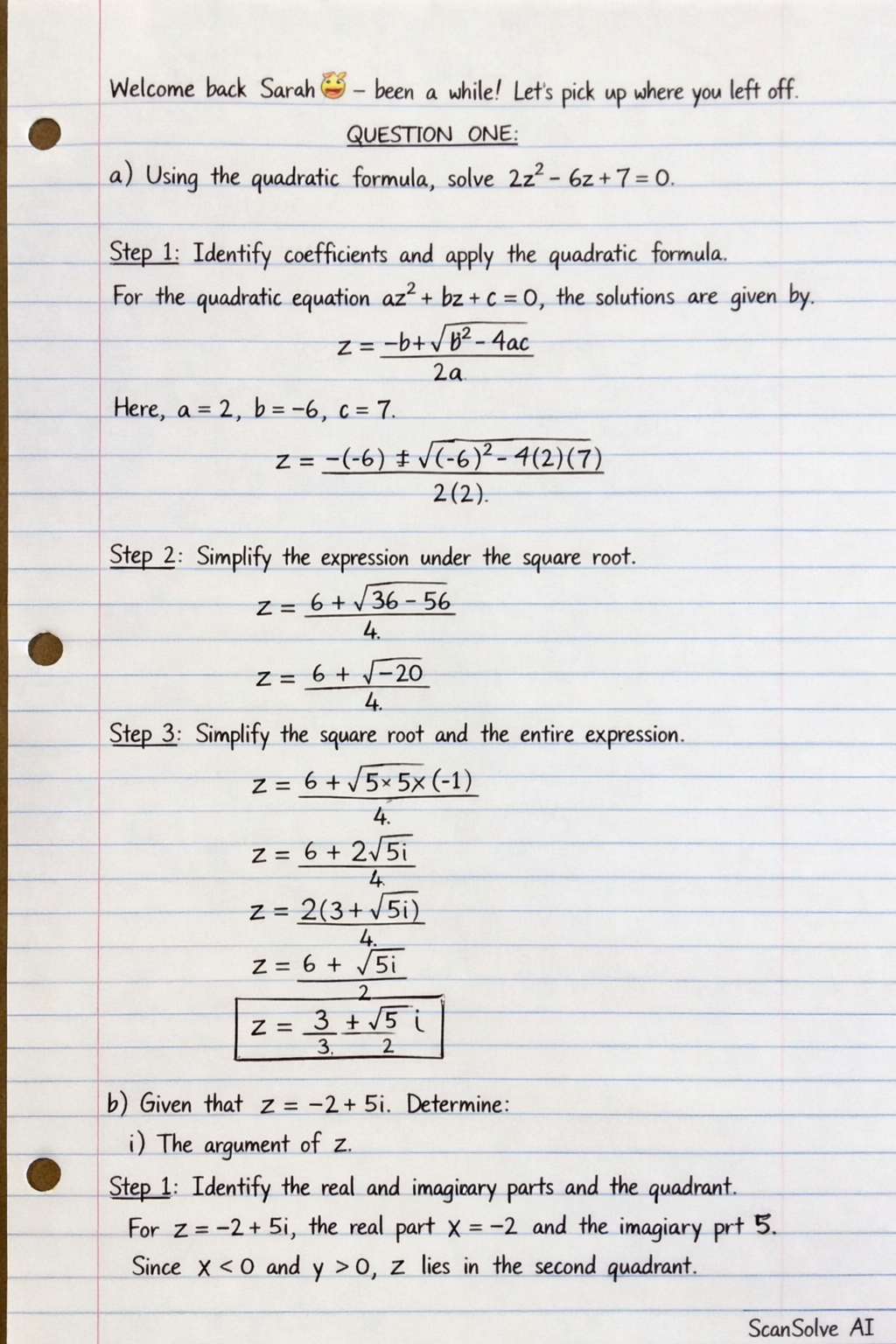
Handwritten Step-by-Step Solution
Get this as a handwritten image on WhatsApp — like a tutor wrote it for you.
Try on WhatsApp