
We read your photo as:
Simplify: a) (5+4i)(3+7i)(2-3i) b) (2-3i)(3+2i)/(4-3i)
ScanSolve AI Answer
This answer stops before the end.
It was cut off when it was first written. Ask ScanSolve this question again for the full working.
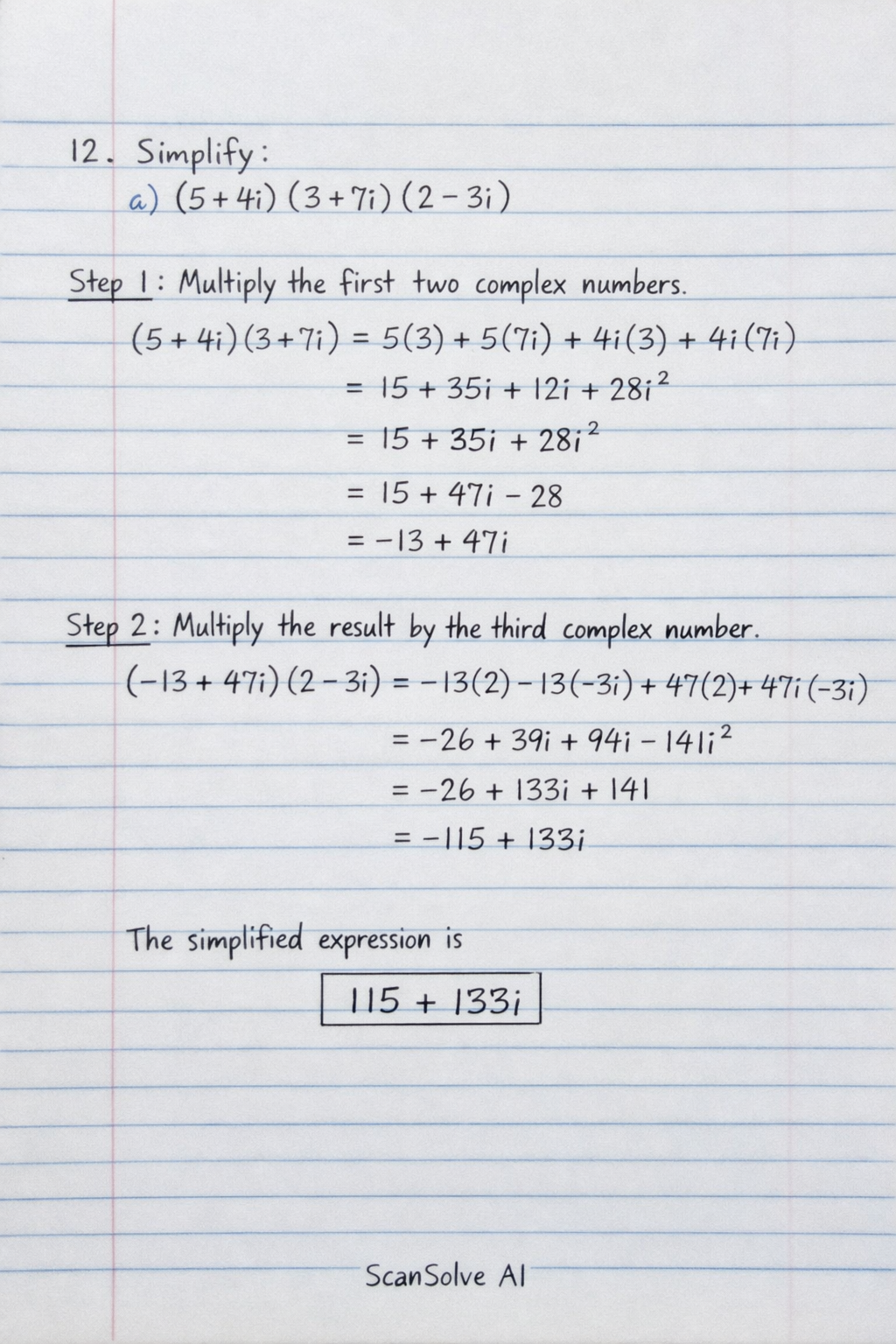
12. Simplify:
-
a)
Step 1: Multiply the first two complex numbers.
Since :
Step 2: Multiply the result by the third complex number.
Since :
The simplified expression is .
-
b)
Step 1: Multiply the complex numbers in the numerator.
Since :
Step 2: Divide the result by the denominator.
Multiply the numerator and denominator by the conjugate of the denominator, which is .
Step 3: Expand the numerator.
Step 4: Expand the denominator.
Step 5: Combine the numerator and denominator and express in form.
The simplified expression is .
-
c)
Step 1: Use Euler's formula, .
Step 2: Apply the rules of exponents for division.
Step 3: Convert back to trigonometric form using Euler's formula.
The simplified expression is .
13. Express the following in the form .
-
a)
Step 1: Simplify the first term, .
First, simplify the denominator: .
So the term becomes .
Multiply the numerator and denominator by the conjugate of the denominator, :Step 2: Simplify the second term, .
Multiply the numerator and denominator by :Step 3: Add the simplified terms.
The expression in the form is .
-
b)
Step 1: Simplify the first term, .
Multiply the numerator and denominator by the conjugate of the denominator, :Step 2: Simplify the second term, .
Multiply the numerator and denominator by the conjugate of the denominator, :Step 3: Add the simplified terms.
Group the real and imaginary parts:
Still stuck on this one?
Ask a follow-up, and the answer starts from this question.
More Mathematics Questions
Handwritten Step-by-Step Solution
Get this as a handwritten image on WhatsApp — like a tutor wrote it for you.
Try on WhatsApp