

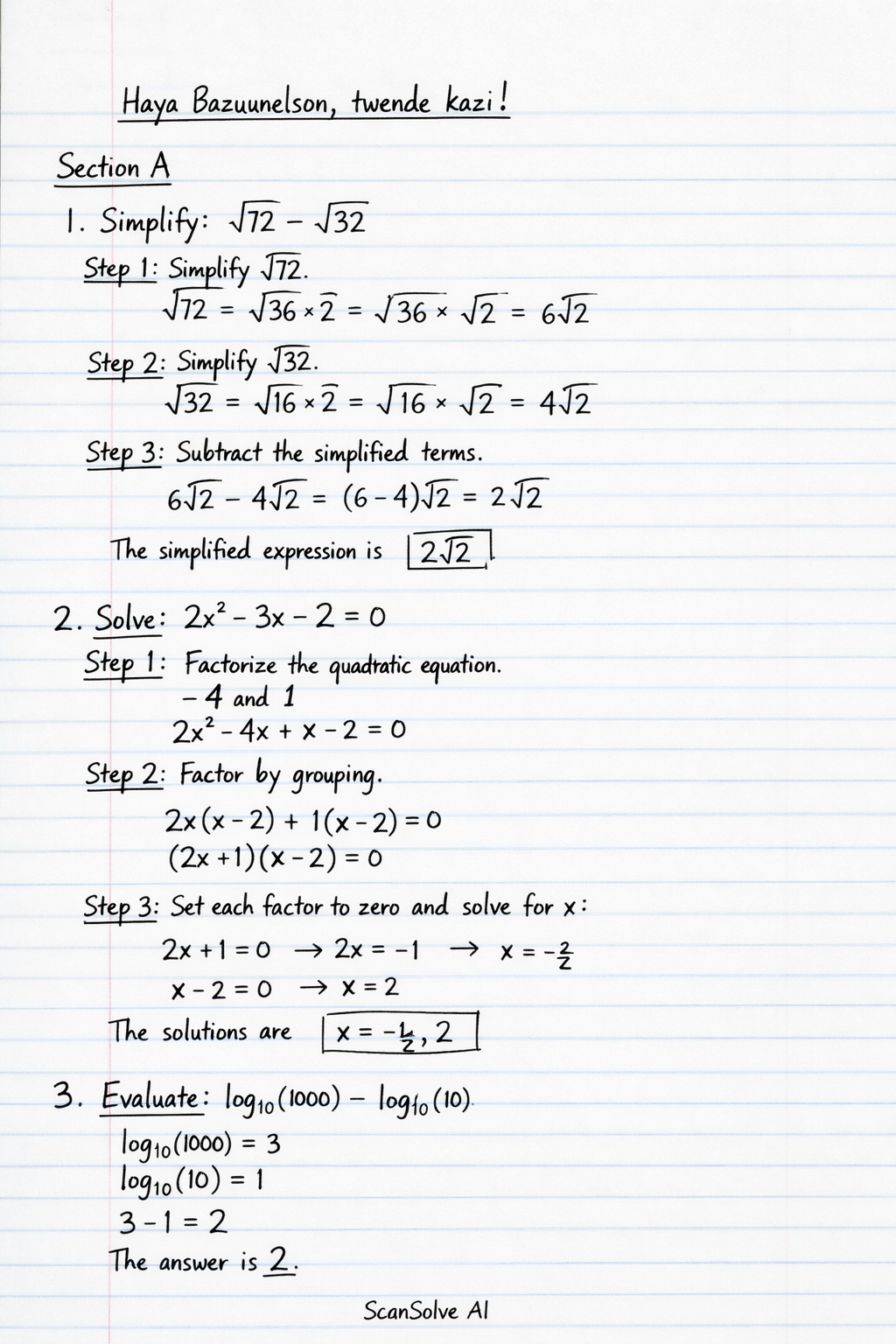
This mathematics problem involves applying core mathematical principles and formulas. Below you will find a complete step-by-step solution with detailed explanations for each step, helping you understand not just the answer but the method behind it.
ScanSolve AI Answer
Haya bazuunelson, twende kazi! Section A 1. Simplify: sqrt(72) - sqrt(32) Step 1: Simplify sqrt(72). sqrt(72) = sqrt(36 × 2) = sqrt(36) × sqrt(2) = 6sqrt(2) Step 2: Simplify sqrt(32). sqrt(32) = sqrt(16 × 2) = sqrt(16) × sqrt(2) = 4sqrt(2) Step 3: Subtract the simplified terms. 6sqrt(2) - 4sqrt(2) = (6 - 4)sqrt(2) = 2sqrt(2) The simplified expression is 2sqrt(2). 2. Solve: 2x^2 - 3x - 2 = 0 Step 1: Factorize the quadratic equation. We look for two numbers that multiply to 2 × (-2) = -4 and add up to -3. These numbers are -4 and 1. 2x^2 - 4x + x - 2 = 0 Step 2: Factor by grouping. 2x(x - 2) + 1(x - 2) = 0 (2x + 1)(x - 2) = 0 Step 3: Set each factor to zero and solve for x. 2x + 1 = 0 2x = -1 x = -(1)/(2) x - 2 = 0 x = 2 The solutions are x = -(1)/(2), 2. 3. Evaluate: _10(1000) - _10(10) Step 1: Evaluate each logarithm. _10(1000) = _10(10^3) = 3 _10(10) = 1 Step 2: Subtract the values. 3 - 1 = 2 The evaluated expression is 2. 4. Find the gradient of y = 3x^2 - 2x at x = 1 Step 1: Find the derivative (dy)/(dx). (dy)/(dx) = (d)/(dx)(3x^2 - 2x) = 6x - 2 Step 2: Substitute x = 1 into the derivative to find the gradient. Gradient = 6(1) - 2 = 6 - 2 = 4 The gradient at x=1 is 4. 5. Find the distance between points (1,2) and (4,6) Step 1: Use the distance formula D = sqrt((x_2 - x_1)^2 + (y_2 - y_1)^2). Let (x_1, y_1) = (1,2) and (x_2, y_2) = (4,6). D = sqrt((4 - 1)^2 + (6 - 2)^2) Step 2: Calculate the differences and square them. D = sqrt((3)^2 + (4)^2) D = sqrt(9 + 16) Step 3: Add and find the square root. D = sqrt(25) = 5 The distance between the points is 5 units. 6. Find the determinant of matrix 3 & 2 \\ 1 & 4 Step 1: Use the formula for the determinant of a 2 × 2 matrix a & b \\ c & d , which is ad - bc. Here, a=3, b=2, c=1, d=4. Determinant = (3)(4) - (2)(1) Step 2: Perform the multiplication and subtraction. Determinant = 12 - 2 = 10 The determinant of the matrix is 10. 7. Solve: x = sqrt(3)/2 for 0^ x 360^ Step 1: Find the principal value. The angle whose sine is sqrt(3)/2 is 60^. So, x = 60^. Step 2: Identify other quadrants where x is positive. Sine is positive in the first and second quadrants. The first quadrant solution is x_1 = 60^. The second quadrant solution is x_2 = 180^ - 60^ = 120^. The solutions in the given range are x = 60^, 120^. 8. Expand: (x + 2)(x - 3) Step 1: Use the FOIL method (First, Outer, Inner, Last). (x + 2)(x - 3) = x · x + x · (-3) + 2 · x + 2 · (-3) Step 2: Multiply the terms. = x^2 - 3x + 2x - 6 Step 3: Combine like terms. = x^2 - x - 6 The expanded expression is x^2 - x - 6. 9. Find the mean of 2, 4, 6, 8 Step 1: Sum the numbers. Sum = 2 + 4 + 6 + 8 = 20 Step 2: Divide the sum by the count of numbers (which is 4). Mean = (20)/(4) = 5 The mean is 5. 10. Integrate: 2x \,dx Step 1: Use the power rule for integration, ax^n \,dx = ax^n+1n+1 + C. Here, a=2 and n=1. 2x^1 \,dx = 2 x^1+11+1 + C Step 2: Simplify the expression. = 2 (x^2)/(2) + C = x^2 + C The integral is x^2 + C. Section B 11. (a) Solve the equation: x^2 + 5x + 6 = 0 Step 1: Factorize the quadratic equation. We look for two numbers that multiply to 6 and add up to 5. These numbers are 2 and 3. (x + 2)(x + 3) = 0 Step 2: Set each factor to zero and solve for x. x + 2 = 0 x = -2 x + 3 = 0 x = -3 The solutions are x = -2, -3. (b) Hence find the sum and product of the roots Step 1: Identify the coefficients from the equation x^2 + 5x + 6 = 0. Here, a=1, b=5, c=6. Step 2: Calculate the sum of the roots using the formula -(b)/(a). Sum of roots = -(5)/(1) = -5 Alternatively, using the roots from (a): (-2) + (-3) = -5. Step 3: Calculate the product of the roots using the formula (c)/(a). Product of roots = (6)/(1) = 6 Alternatively, using the roots from (a): (-2) × (-3) = 6. The sum of the roots is -5 and the product of the roots is 6. 12. (a) Simplify: (3x^2y)(2xy^3) Step 1: Multiply the coefficients. 3 × 2 = 6 Step 2: Multiply the x terms by adding their exponents. x^2 × x^1 = x^2+1 = x^3 Step 3: Multiply the y terms by adding their exponents. y^1 × y^3 = y^1+3 = y^4 Step 4: Combine the results. (3x^2y)(2xy^3) = 6x^3y^4 The simplified expression is 6x^3y^4. (b) Express your answer in index form The answer from part (a) is already in index form. The expression in index form is 6x^3y^4. 13. (a) Solve the simultaneous equations: x + y = 5 (Equation 1) x^2 + y^2 = 13 (Equation 2) Step 1: From Equation 1, express y in terms of x. y = 5 - x Step 2: Substitute this expression for y into Equation 2. x^2 + (5 - x)^2 = 13 Step 3: Expand and simplify the equation. x^2 + (25 - 10x + x^2) = 13 2x^2 - 10x + 25 = 13 2x^2 - 10x + 12 = 0 Step 4: Divide by 2 to simplify the quadratic equation. x^2 - 5x + 6 = 0 Step 5: Factorize the quadratic equation. (x - 2)(x - 3) = 0 Step 6: Solve for x. x - 2 = 0 x = 2 x - 3 = 0 x = 3 Step 7: Substitute the values of x back into y = 5 - x to find the corresponding y values. If x = 2: y = 5 - 2 = 3 If x = 3: y = 5 - 3 = 2 The solutions are (x=2, y=3) and (x=3, y=2). (b) Find xy Step 1: Use the pairs of solutions found in part (a). For (x=2, y=3): xy = 2 × 3 = 6 For (x=3, y=2): xy = 3 × 2 = 6 In both cases, xy is 6. 14. (a) Find the equation of a line passing through (2,3) and (4,7) Step 1: Calculate the gradient (m). m = (y_2 - y_1)/(x_2 - x_1) = (7 - 3)/(4 - 2) = (4)/(2) = 2 Step 2: Use the point-slope form y - y_1 = m(x - x_1) with one of the points, e.g., (2,3). y - 3 = 2(x - 2) Step 3: Simplify to the slope-intercept form y = mx + c. y - 3 = 2x - 4 y = 2x - 4 + 3 y = 2x - 1 The equation of the line is y = 2x - 1. (b) Find the midpoint of the line Step 1: Use the midpoint formula $M =