Simplify the following expressions and solve the inequalities: a) y2 y3, b) 50 6, c) (F6 F3) / (F4 F2), d) n7 / n2, e) 56 / 54, f) 9c5 / 9c2, and g) 1/4x - 4 <= 6.
|Mathematics
Simplify the following expressions and solve the inequalities: a) y2 y3, b) 50 6, c) (F6 F3) / (F4 F2), d) n7 / n2, e) 56 / 54, f) 9c5 / 9c2, and g) 1/4x - 4 <= 6.
ScanSolve AI Answer
Answer
y5
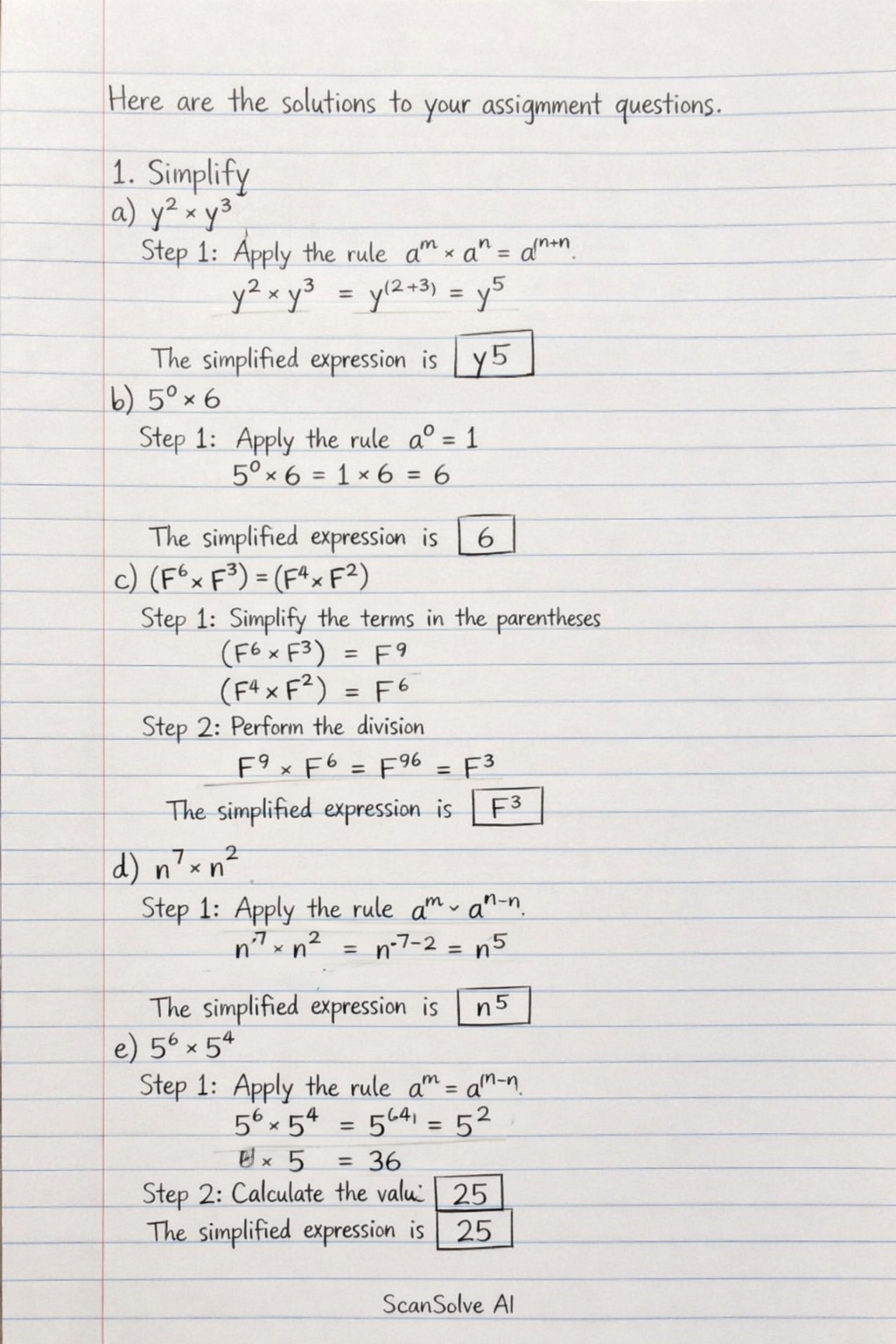
Here are the solutions to your assignment questions.
1. Simplify
a) y2×y3
Step 1: Apply the rule am×an=am+n.
y2×y3=y2+3=y5
The simplified expression is y5.
b) 50×6
Step 1: Apply the rule a0=1.
50×6=1×6=6
The simplified expression is 6.
c) (F6×F3)÷(F4×F2)
Step 1: Simplify the terms in the parentheses using am×an=am+n.
(F6×F3)=F6+3=F9(F4×F2)=F4+2=F6
Step 2: Perform the division using am÷an=am−n.
F9÷F6=F9−6=F3
The simplified expression is F3.
d) n7÷n2
Step 1: Apply the rule am÷an=am−n.
n7÷n2=n7−2=n5
The simplified expression is n5.
e) 56÷54
Step 1: Apply the rule am÷an=am−n.
56÷54=56−4=52
Step 2: Calculate the value.
52=25
The simplified expression is 25.
f) 9c5÷9c2
Step 1: Divide the numerical coefficients and apply the rule am÷an=am−n for the variables.
9c5÷9c2=99×c2c5=1×c5−2=c3
The simplified expression is c3.
2. Solve the following inequalities
a) 41x−4≤6
Step 1: Add 4 to both sides of the inequality.
41x−4+4≤6+441x≤10
Step 2: Multiply both sides by 4.
4×41x≤10×4x≤40
The solution is x≤40.
b) 3x+5>−4
Step 1: Subtract 5 from both sides of the inequality.
3x+5−5>−4−53x>−9
Step 2: Divide both sides by 3.
33x>3−9x>−3
The solution is x>−3.
c) 33−2x>−831
Step 1: Convert the mixed number to an improper fraction.
−831=−3(8×3)+1=−324+1=−325
The inequality becomes:
33−2x>−325
Step 2: Multiply both sides by 3.
3×33−2x>3×−3253−2x>−25
Step 3: Subtract 3 from both sides.
3−2x−3>−25−3−2x>−28
Step 4: Divide both sides by -2. Remember to reverse the inequality sign when dividing by a negative number.
−2−2x<−2−28x<14
The solution is x<14.
d) 5(2y+9)≥3(2y+9)
Step 1: Expand both sides of the inequality.
10y+45≥6y+27
Step 2: Subtract 6y from both sides.
10y−6y+45≥6y−6y+274y+45≥27
Step 3: Subtract 45 from both sides.
4y+45−45≥27−454y≥−18
Step 4: Divide both sides by 4.
44y≥4−18y≥−29y≥−4.5
The solution is y≥−4.5.
3. Work out the x and y intercept for the line whose equations are
a) y=4x+3
To find the x-intercept, set y=0:
0=4x+3−3=4xx=−43
To find the y-intercept, set x=0:
y=4(0)+3y=3
The x-intercept is (−43,0) and the y-intercept is (0,3).
b) 3x+2y=12
To find the x-intercept, set y=0:
3x+2(0)=123x=12x=312x=4
To find the y-intercept, set x=0:
3(0)+2y=122y=12y=212y=6
The x-intercept is (4,0) and the y-intercept is (0,6).
c) y=−2x+3
To find the x-intercept, set y=0:
0=−2x+32x=3x=23
To find the y-intercept, set x=0:
y=−2(0)+3y=3
The x-intercept is (23,0) and the y-intercept is (0,3).
4. Find the volume and surface of the following
a) sphere radius 3.5 cm
Volume of a sphere: V=34πr3
Surface area of a sphere: SA=4πr2
Given r=3.5 cm.
Step 1: Calculate the volume.
V=34×π×(3.5cm)3V=34×π×42.875cm3V≈179.59cm3
Step 2: Calculate the surface area.
SA=4×π×(3.5cm)2SA=4×π×12.25cm2SA≈153.94cm2
The volume is 179.59cm3 and the surface area is 153.94cm2.
b) cone radius 7 cm and slant height 10 cm
Volume of a cone: V=31πr2h
Surface area of a cone: SA=πr(r+l)
Given r=7 cm and l=10 cm.
First, find the height h using the Pythagorean theorem: h=l2−r2.
h=(10cm)2−(7cm)2h=100cm2−49cm2h=51cm≈7.14 cm
Step 1: Calculate the volume.
V=31×π×(7cm)2×51 cmV=31×π×49cm2×7.1414 cmV≈366.49cm3
Step 2: Calculate the surface area.
SA=π×7cm×(7cm+10cm)SA=π×7cm×17 cmSA=119πcm2SA≈373.85cm2
The volume is 366.49cm3 and the surface area is 373.85cm2.
c) cuboid of 5 m x 2 m x 3.2 m
Volume of a cuboid: V=lwh
Surface area of a cuboid: SA=2(lw+lh+wh)
Given l=5 m, w=2 m, h=3.2 m.
Step 1: Calculate the volume.
V=5m×2m×3.2 mV=32m3
Step 2: Calculate the surface area.
SA=2((5m×2m)+(5m×3.2m)+(2m×3.2m))SA=2(10m2+16m2+6.4m2)SA=2(32.4m2)SA=64.8m2
The volume is 32m3 and the surface area is 64.8m2.
d) cube of sides 4 m
Volume of a cube: V=s3
Surface area of a cube: SA=6s2
Given s=4 m.
Step 1: Calculate the volume.
V=(4m)3V=64m3
Step 2: Calculate the surface area.
SA=6×(4m)2SA=6×16m2SA=96m2
The volume is 64m3 and the surface area is 96m2.
5. A car is brought to rest from 90 km/h in 20 seconds. What is its acceleration?
Given:
Initial velocity, vi=90 km/h
Final velocity, vf=0 km/h (brought to rest)
Time, t=20 s
Step 1: Convert initial velocity from km/
Was this helpful?
Need help with your own homework?
Get instant step-by-step solutions to any question. Free to start.
Apply the rule a^m × a^n = a^m+n. y^2 × y^3 = y^2+3 = y^5 The simplified expression is y^5.
Simplify the following expressions and solve the inequalities: a) y2 y3, b) 50 6, c) (F6 F3) / (F4 F2), d) n7 / n2, e) 56 / 54, f) 9c5 / 9c2, and g) 1/4x - 4 <= 6.
This mathematics problem involves applying core mathematical principles and formulas. Below you will find a complete step-by-step solution with detailed explanations for each step, helping you understand not just the answer but the method behind it.
ScanSolve AI Answer
Here are the solutions to your assignment questions. 1. Simplify a) y^2 × y^3 Step 1: Apply the rule a^m × a^n = a^m+n. y^2 × y^3 = y^2+3 = y^5 The simplified expression is y^5. b) 5^0 × 6 Step 1: Apply the rule a^0 = 1. 5^0 × 6 = 1 × 6 = 6 The simplified expression is 6. c) (F^6 × F^3) ÷ (F^4 × F^2) Step 1: Simplify the terms in the parentheses using a^m × a^n = a^m+n. (F^6 × F^3) = F^6+3 = F^9 (F^4 × F^2) = F^4+2 = F^6 Step 2: Perform the division using a^m ÷ a^n = a^m-n. F^9 ÷ F^6 = F^9-6 = F^3 The simplified expression is F^3. d) n^7 ÷ n^2 Step 1: Apply the rule a^m ÷ a^n = a^m-n. n^7 ÷ n^2 = n^7-2 = n^5 The simplified expression is n^5. e) 5^6 ÷ 5^4 Step 1: Apply the rule a^m ÷ a^n = a^m-n. 5^6 ÷ 5^4 = 5^6-4 = 5^2 Step 2: Calculate the value. 5^2 = 25 The simplified expression is 25. f) 9c^5 ÷ 9c^2 Step 1: Divide the numerical coefficients and apply the rule a^m ÷ a^n = a^m-n for the variables. 9c^5 ÷ 9c^2 = (9)/(9) × (c^5)/(c^2) = 1 × c^5-2 = c^3 The simplified expression is c^3. 2. Solve the following inequalities a) (1)/(4)x - 4 6 Step 1: Add 4 to both sides of the inequality. (1)/(4)x - 4 + 4 6 + 4 (1)/(4)x 10 Step 2: Multiply both sides by 4. 4 × (1)/(4)x 10 × 4 x 40 The solution is x 40. b) 3x + 5 > -4 Step 1: Subtract 5 from both sides of the inequality. 3x + 5 - 5 > -4 - 5 3x > -9 Step 2: Divide both sides by 3. (3x)/(3) > (-9)/(3) x > -3 The solution is x > -3. c) (3 - 2x)/(3) > -8(1)/(3) Step 1: Convert the mixed number to an improper fraction. -8(1)/(3) = -((8 × 3) + 1)/(3) = -(24+1)/(3) = -(25)/(3) The inequality becomes: (3 - 2x)/(3) > -(25)/(3) Step 2: Multiply both sides by 3. 3 × (3 - 2x)/(3) > 3 × -(25)/(3) 3 - 2x > -25 Step 3: Subtract 3 from both sides. 3 - 2x - 3 > -25 - 3 -2x > -28 Step 4: Divide both sides by -2. Remember to reverse the inequality sign when dividing by a negative number. (-2x)/(-2) < (-28)/(-2) x < 14 The solution is x < 14. d) 5(2y+9) 3(2y+9) Step 1: Expand both sides of the inequality. 10y + 45 6y + 27 Step 2: Subtract 6y from both sides. 10y - 6y + 45 6y - 6y + 27 4y + 45 27 Step 3: Subtract 45 from both sides. 4y + 45 - 45 27 - 45 4y -18 Step 4: Divide both sides by 4. (4y)/(4) (-18)/(4) y -(9)/(2) y -4.5 The solution is y -4.5. 3. Work out the x and y intercept for the line whose equations are a) y = 4x + 3 To find the x-intercept, set y=0: 0 = 4x + 3 -3 = 4x x = -(3)/(4) To find the y-intercept, set x=0: y = 4(0) + 3 y = 3 The x-intercept is (-(3)/(4), 0) and the y-intercept is (0, 3). b) 3x + 2y = 12 To find the x-intercept, set y=0: 3x + 2(0) = 12 3x = 12 x = (12)/(3) x = 4 To find the y-intercept, set x=0: 3(0) + 2y = 12 2y = 12 y = (12)/(2) y = 6 The x-intercept is (4, 0) and the y-intercept is (0, 6). c) y = -2x + 3 To find the x-intercept, set y=0: 0 = -2x + 3 2x = 3 x = (3)/(2) To find the y-intercept, set x=0: y = -2(0) + 3 y = 3 The x-intercept is ((3)/(2), 0) and the y-intercept is (0, 3). 4. Find the volume and surface of the following a) sphere radius 3.5 cm Volume of a sphere: V = (4)/(3) r^3 Surface area of a sphere: SA = 4 r^2 Given r = 3.5 cm. Step 1: Calculate the volume. V = (4)/(3) × × (3.5 cm)^3 V = (4)/(3) × × 42.875 cm^3 V ≈ 179.59 cm^3 Step 2: Calculate the surface area. SA = 4 × × (3.5 cm)^2 SA = 4 × × 12.25 cm^2 SA ≈ 153.94 cm^2 The volume is 179.59 cm^3 and the surface area is 153.94 cm^2. b) cone radius 7 cm and slant height 10 cm Volume of a cone: V = (1)/(3) r^2 h Surface area of a cone: SA = r (r+l) Given r = 7 cm and l = 10 cm. First, find the height h using the Pythagorean theorem: h = sqrt(l^2 - r^2). h = sqrt((10 cm))^2 - (7 cm)^2 h = sqrt(100 cm)^2 - 49 cm^2 h = sqrt(51) cm ≈ 7.14 cm Step 1: Calculate the volume. V = (1)/(3) × × (7 cm)^2 × sqrt(51) cm V = (1)/(3) × × 49 cm^2 × 7.1414 cm V ≈ 366.49 cm^3 Step 2: Calculate the surface area. SA = × 7 cm × (7 cm + 10 cm) SA = × 7 cm × 17 cm SA = 119 cm^2 SA ≈ 373.85 cm^2 The volume is 366.49 cm^3 and the surface area is 373.85 cm^2. c) cuboid of 5 m x 2 m x 3.2 m Volume of a cuboid: V = lwh Surface area of a cuboid: SA = 2(lw + lh + wh) Given l = 5 m, w = 2 m, h = 3.2 m. Step 1: Calculate the volume. V = 5 m × 2 m × 3.2 m V = 32 m^3 Step 2: Calculate the surface area. SA = 2((5 m × 2 m) + (5 m × 3.2 m) + (2 m × 3.2 m)) SA = 2(10 m^2 + 16 m^2 + 6.4 m^2) SA = 2(32.4 m^2) SA = 64.8 m^2 The volume is 32 m^3 and the surface area is 64.8 m^2. d) cube of sides 4 m Volume of a cube: V = s^3 Surface area of a cube: SA = 6s^2 Given s = 4 m. Step 1: Calculate the volume. V = (4 m)^3 V = 64 m^3 Step 2: Calculate the surface area. SA = 6 × (4 m)^2 SA = 6 × 16 m^2 SA = 96 m^2 The volume is 64 m^3 and the surface area is 96 m^2. 5. A car is brought to rest from 90 km/h in 20 seconds. What is its acceleration? Given: Initial velocity, v_i = 90 km/h Final velocity, v_f = 0 km/h (brought to rest) Time, t = 20 s Step 1: Convert initial velocity from km/