
We read your photo as:
Solve simultaneously for x and y: 5x + y = 3 and 3x2 − 2xy = y2 − 105
ScanSolve AI Answer
Answers
2 partsStep-by-step solution
7 stepsHere are the solutions to the problems:
Part 1.1· 2 steps
3
To solve the inequality , we first find the roots of the corresponding quadratic equation.
Find the roots of the quadratic equation .
We can factor the quadratic expression:
The roots are and .
Determine the intervals where the inequality holds.
Since the parabola opens upwards (the coefficient of is positive), the expression is greater than or equal to zero outside the roots.
Therefore, the solution is when is less than or equal to the smaller root or greater than or equal to the larger root.The solution is .
Part 1.2
To solve the system of equations simultaneously for and :
Express in terms of from the linear equation (1).
Substitute this expression for into the quadratic equation (2).
Expand and simplify the equation.
Move all terms to one side to form a standard quadratic equation:
Divide the entire equation by 12 to simplify:
Solve the quadratic equation for .
Factor the quadratic expression:
This gives two possible values for :
Substitute these values back into the linear equation to find the corresponding values.
For :
For :
The solutions are the pairs :
Try one yourself
A new problem that tests the same skill.
Still stuck on this one?
Ask a follow-up, and the answer starts from this question.
More Mathematics Questions
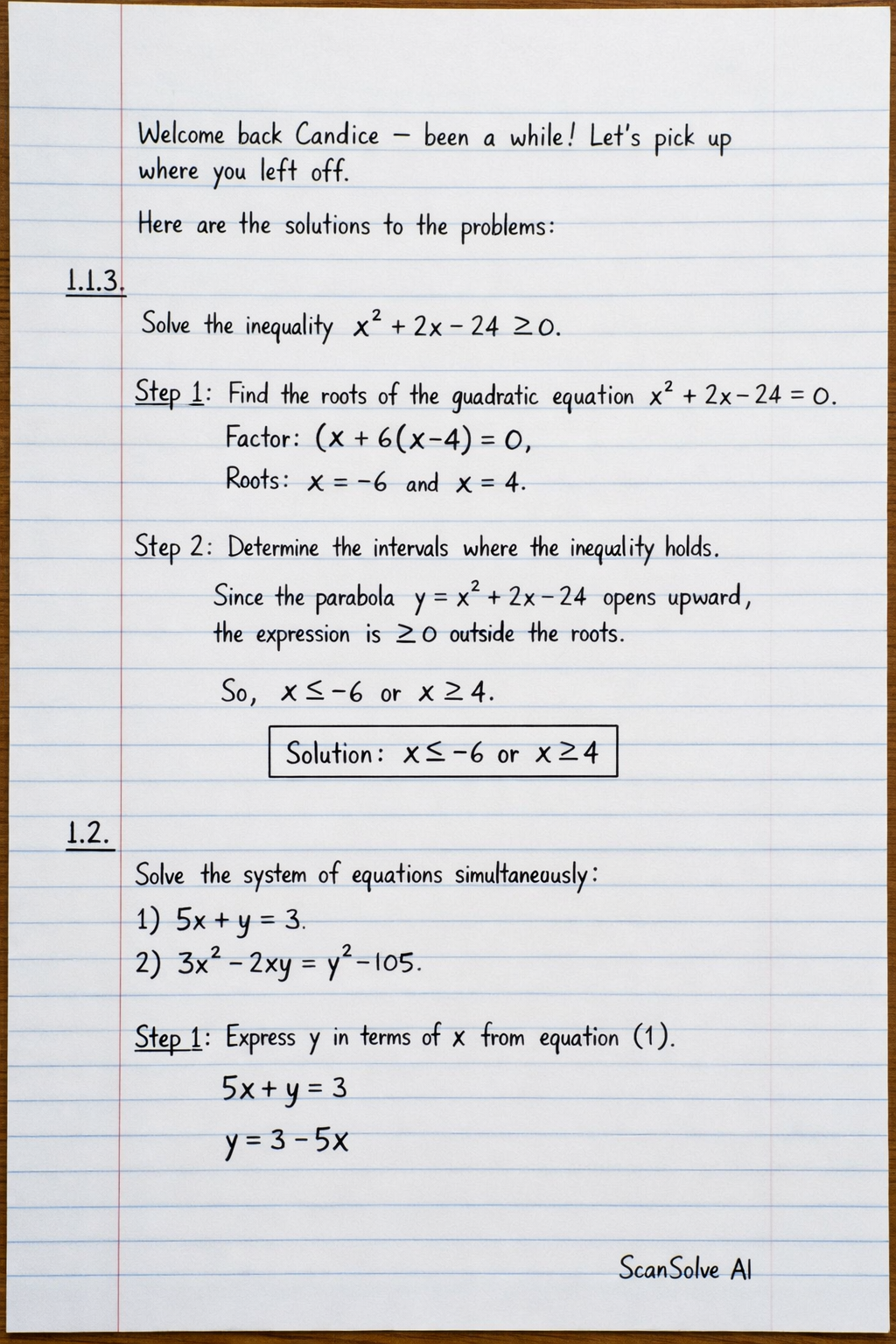
Handwritten Step-by-Step Solution
Get this as a handwritten image on WhatsApp — like a tutor wrote it for you.
Try on WhatsApp