

This mathematics problem involves applying core mathematical principles and formulas. Below you will find a complete step-by-step solution with detailed explanations for each step, helping you understand not just the answer but the method behind it.
ScanSolve AI Answer
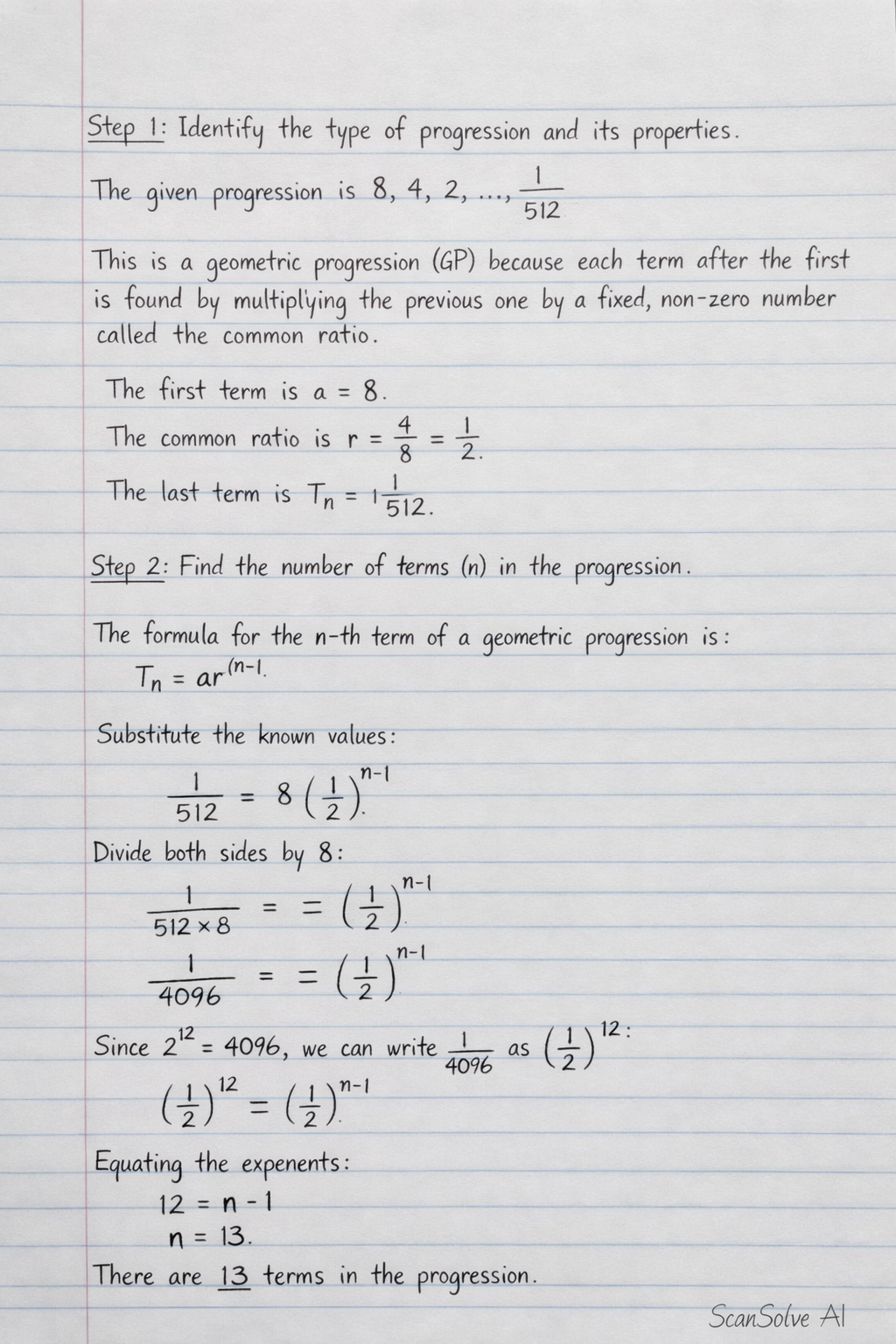
Step 1: Identify the type of progression and its properties. The given progression is 8, 4, 2, , (1)/(512). This is a geometric progression (GP) because each term after the first is found by multiplying the previous one by a fixed, non-zero number called the common ratio. The first term is a = 8. The common ratio is r = (4)/(8) = (1)/(2). The last term is T_n = (1)/(512). Step 2: Find the number of terms (n) in the progression. The formula for the n-th term of a geometric progression is T_n = ar^n-1. Substitute the known values: (1)/(512) = 8 ((1)/(2))^n-1 Divide both sides by 8: (1)/(512 × 8) = ((1)/(2))^n-1 (1)/(4096) = ((1)/(2))^n-1 Since 2^12 = 4096, we can write (1)/(4096) as ((1)/(2))^12: ((1)/(2))^12 = ((1)/(2))^n-1 Equating the exponents: 12 = n-1 n = 13 There are 13 terms in the progression. Step 3: Calculate the sum of the progression. The formula for the sum of the first n terms of a geometric progression when r < 1 is S_n = (a(1-r^n))/(1-r). Substitute a=8, r=(1)/(2), and n=13: S_13 = (8(1 - (1)/(2))^13)1 - (1)/(2) Calculate ((1)/(2))^13: ((1)/(2))^13 = 1^132^13 = (1)/(8192) Substitute this back into the sum formula: S_13 = (8(1 - 1)/(8192))(1)/(2) S_13 = (8(8192 - 1)/(8192))(1)/(2) S_13 = (8(8191)/(8192))(1)/(2) Multiply the numerator by 2 (which is the reciprocal of (1)/(2)): S_13 = 16((8191)/(8192)) S_13 = (16 × 8191)/(8192) S_13 = (8191)/(512) Step 4: Convert the sum to a decimal and round to the nearest whole number. S_13 = (8191)/(512) ≈ 15.998046875 Rounding to the nearest whole number, 15.998... becomes 16. The sum of the progression to the nearest whole number is: 16 That's 2 down. 3 left today — send the next one.