
We read your photo as:
Find the sums of the following A.P.s as far as the terms indicate.
ScanSolve AI Answer
Step-by-step solution
16 stepsHere are the solutions to the problems.
.1:
(1) Find the sums of the following A.P.s as far as the terms indicate.
- a)
Identify the first term (), common difference (), and number of terms ().
$$ a = 5 $$ $$ d = 10 - 5 = 5 $$ $$ n = 12 $$Use the formula for the sum of an A.P., .
$$ S_{12} = \frac{12}{2}(2(5) + (12-1)5) $$ $$ S_{12} = 6(10 + (11)5) $$ $$ S_{12} = 6(10 + 55) $$ $$ S_{12} = 6(65) $$ $$ S_{12} = 390 $$ The sum of the first 12 terms is $\boxed{\text{390}}$.- b)
Identify the first term (), common difference (), and number of terms ().
$$ a = 1\frac{1}{4} = \frac{5}{4} $$ $$ d = 1 - \frac{5}{4} = -\frac{1}{4} $$ $$ n = n $$Use the formula for the sum of an A.P., .
$$ S_n = \frac{n}{2}\left(2\left(\frac{5}{4}\right) + (n-1)\left(-\frac{1}{4}\right)\right) $$ $$ S_n = \frac{n}{2}\left(\frac{10}{4} - \frac{n-1}{4}\right) $$ $$ S_n = \frac{n}{2}\left(\frac{10 - (n-1)}{4}\right) $$ $$ S_n = \frac{n}{2}\left(\frac{10 - n + 1}{4}\right) $$ $$ S_n = \frac{n}{2}\left(\frac{11 - n}{4}\right) $$ $$ S_n = \frac{n(11 - n)}{8} $$ The sum of the first $n$ terms is $\boxed{\frac{n(11 - n)}{8}}$.- c)
Identify the first term (), common difference (), and number of terms ().
$$ a = 1 $$ $$ d = 2 - 1 = 1 $$ $$ n = 50 $$Use the formula for the sum of an A.P., .
$$ S_{50} = \frac{50}{2}(2(1) + (50-1)1) $$ $$ S_{50} = 25(2 + 49) $$ $$ S_{50} = 25(51) $$ $$ S_{50} = 1275 $$ The sum of the first 50 terms is $\boxed{\text{1275}}$.(2) The second term of an A.P is 15, and the 5th term is 21. Find the common difference, the first term and the sum of the first ten terms.
Write the given information using the formula for the -th term of an A.P., .
Subtract equation (1) from equation (2) to find the common difference ().
The common difference is .
Substitute into equation (1) to find the first term ().
The first term is .
Find the sum of the first ten terms () using .
The sum of the first ten terms is .
(3) Find the number of terms in the following A.P.s
- a)
Identify the first term (), common difference (), and the last term ().
$$ a = 2 $$ $$ d = 4 - 2 = 2 $$ $$ T_n = 46 $$Use the formula for the -th term of an A.P., , to find .
$$ 46 = 2 + (n-1)2 $$ $$ 46 - 2 = (n-1)2 $$ $$ 44 = 2(n-1) $$ $$ \frac{44}{2} = n-1 $$ $$ 22 = n-1 $$ $$ n = 22 + 1 $$ $$ n = 23 $$ The number of terms is $\boxed{\text{23}}$.- b)
Identify the first term (), common difference (), and the last term ().
$$ a = 2.7 $$ $$ d = 3.2 - 2.7 = 0.5 $$ $$ T_n = 17.7 $$Use the formula for the -th term of an A.P., , to find .
$$ 17.7 = 2.7 + (n-1)0.5 $$ $$ 17.7 - 2.7 = (n-1)0.5 $$ $$ 15 = (n-1)0.5 $$ $$ \frac{15}{0.5} = n-1 $$ $$ 30 = n-1 $$ $$ n = 30 + 1 $$ $$ n = 31 $$ The number of terms is $\boxed{\text{31}}$.(4) Prove that the sum of the integers from 1 to n is .
The sum of the integers from 1 to is an arithmetic progression with
First term ($a$) = 1 Common difference ($d$) = 1 Number of terms ($n$) = $n$ Last term ($L$) = $n$Use the formula for the sum of an A.P., .
This proves that the sum of the integers from 1 to is .
Still stuck on this one?
Ask a follow-up, and the answer starts from this question.
More Mathematics Questions
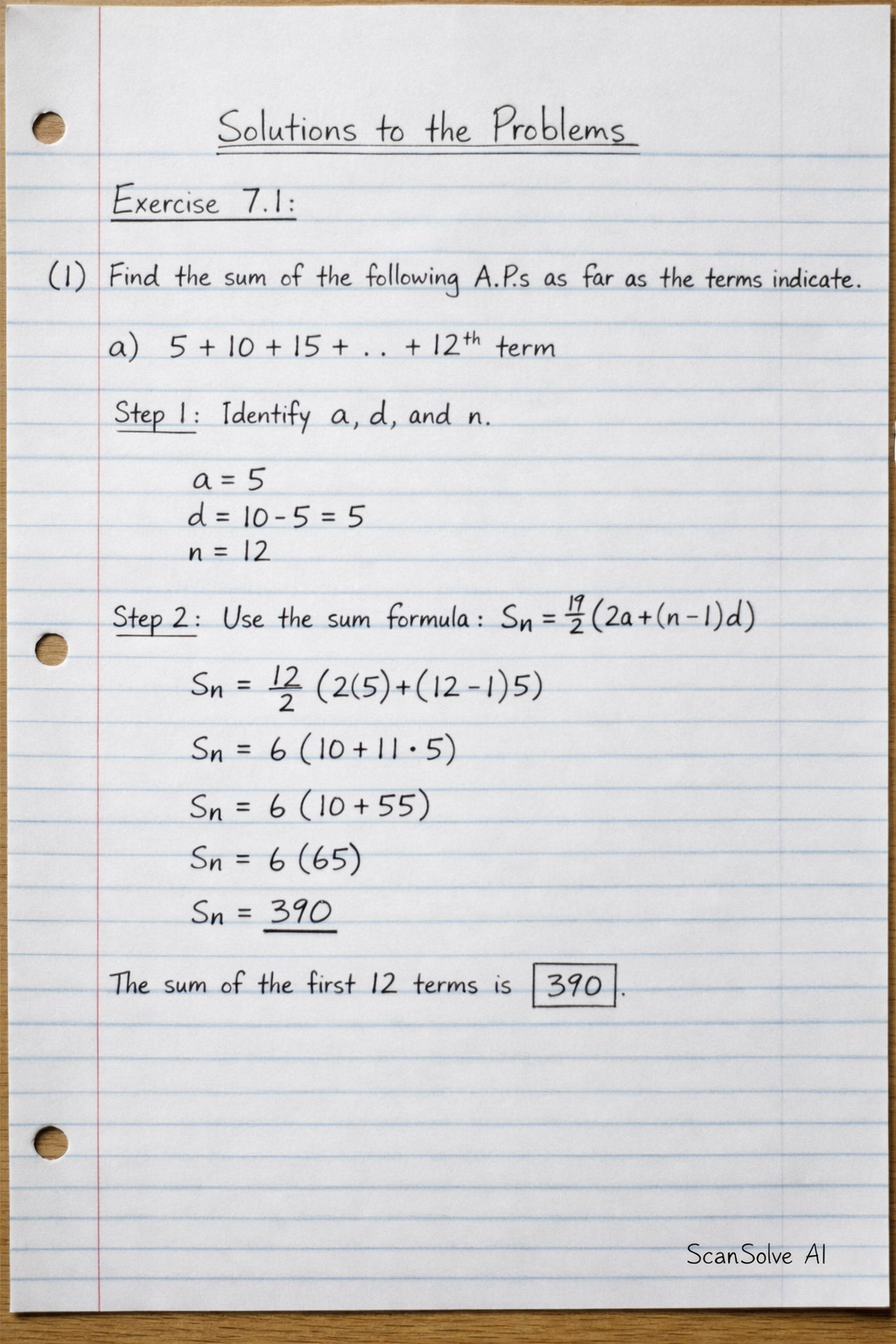
Handwritten Step-by-Step Solution
Get this as a handwritten image on WhatsApp — like a tutor wrote it for you.
Try on WhatsApp