
We read your photo as:
Show that e−xe−x+1 = (1)/(e^x+1).
Mathematics
ScanSolve AI Answer
Answer
Shown:
Step-by-step solution
4 stepsThe problem asks to show that .
Start with the left-hand side (LHS) of the equation.
To eliminate the negative exponent from the expression, multiply both the numerator and the denominator by .
Simplify the numerator and distribute in the denominator.
Recall that .
Rearrange the terms in the denominator to match the right-hand side (RHS) of the original equation.
This is equal to the RHS.
Therefore, the identity is shown.
Was this helpful?
Still stuck on this one?
Ask a follow-up, and the answer starts from this question.
Got a different question?Ask your own question
More Mathematics Questions
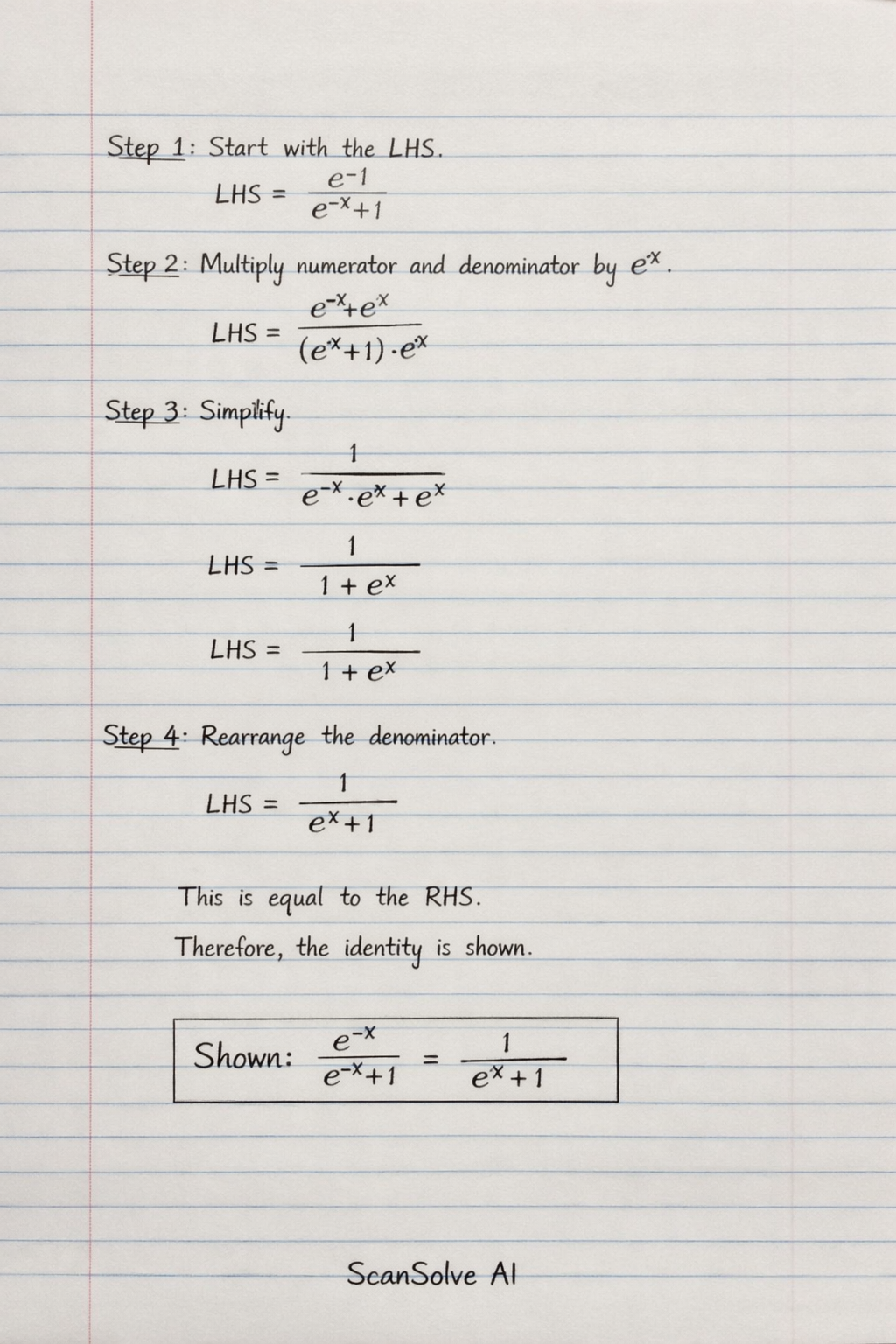
Handwritten Step-by-Step Solution
Get this as a handwritten image on WhatsApp — like a tutor wrote it for you.
Try on WhatsApp