

This mathematics problem involves applying core mathematical principles and formulas. Below you will find a complete step-by-step solution with detailed explanations for each step, helping you understand not just the answer but the method behind it.
ScanSolve AI Answer
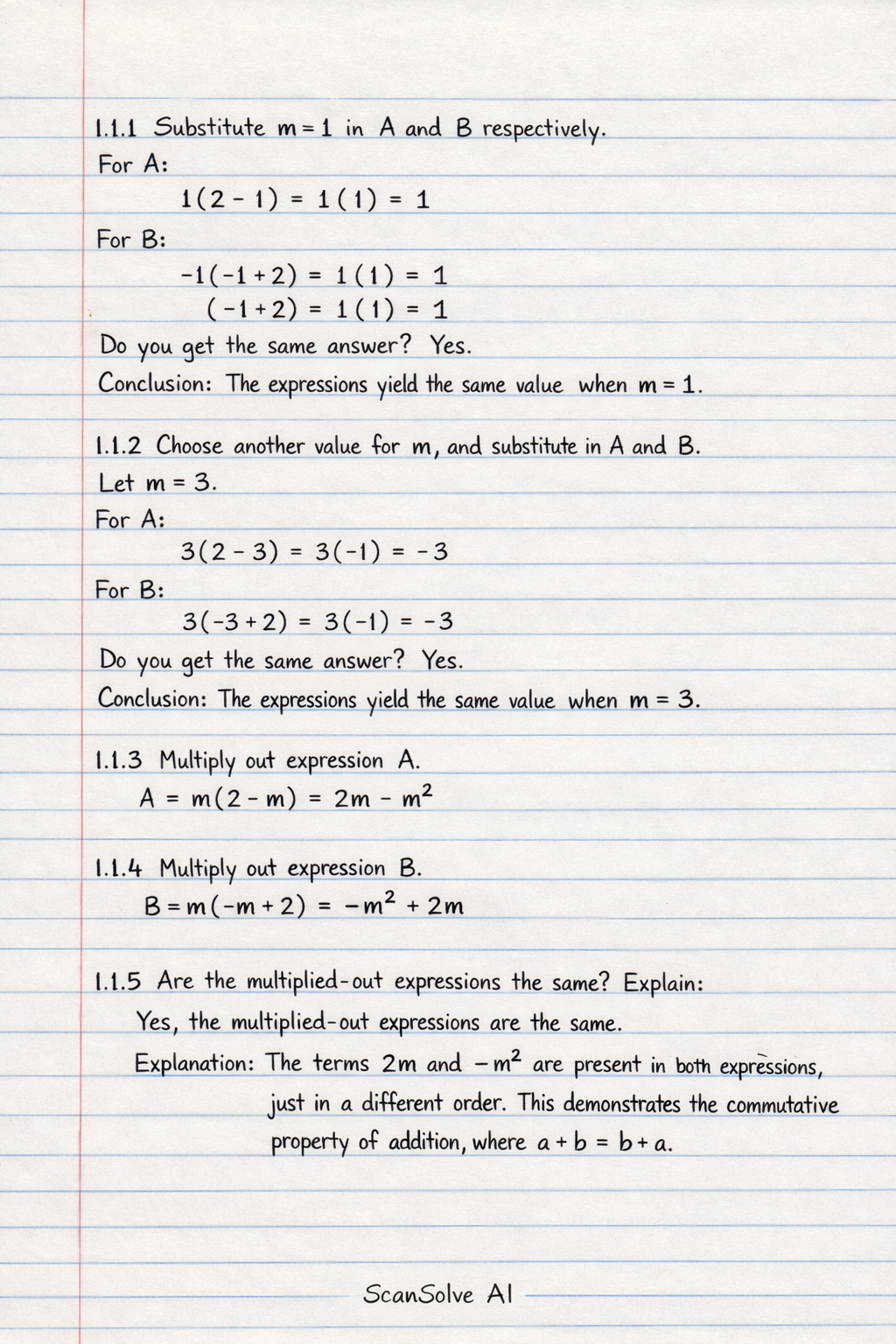
Here are the solutions to the questions: 1.1.1 Substitute m=1 in A and B respectively. For A: m(2-m) = 1(2-1) = 1(1) = 1 For B: m(-m+2) = 1(-1+2) = 1(1) = 1 Do you get the same answer? Yes. Conclusion: The expressions yield the same value when m=1. 1.1.2 Choose another value for m, and substitute in A and B. Let m=3. For A: m(2-m) = 3(2-3) = 3(-1) = -3 For B: m(-m+2) = 3(-3+2) = 3(-1) = -3 Do you get the same answer? Yes. Conclusion: The expressions yield the same value when m=3. 1.1.3 Multiply out expression A. A = m(2-m) = 2m - m^2 1.1.4 Multiply out expression B. B = m(-m+2) = -m^2 + 2m 1.1.5 Are the multiplied-out expressions the same? Explain. Yes, the multiplied-out expressions are the same. Explanation: The terms 2m and -m^2 are present in both expressions, just in a different order. This demonstrates the commutative property of addition, where a+b = b+a. 1.2.1 Substitute p=1 in C and D respectively. For C: 3(p-2) = 3(1-2) = 3(-1) = -3 For D: 3(2-p) = 3(2-1) = 3(1) = 3 Do you get the same answer? No. Conclusion: The expressions yield different values when p=1. Send me the next one 📸