

This mathematics problem involves applying core mathematical principles and formulas. Below you will find a complete step-by-step solution with detailed explanations for each step, helping you understand not just the answer but the method behind it.
ScanSolve AI Answer
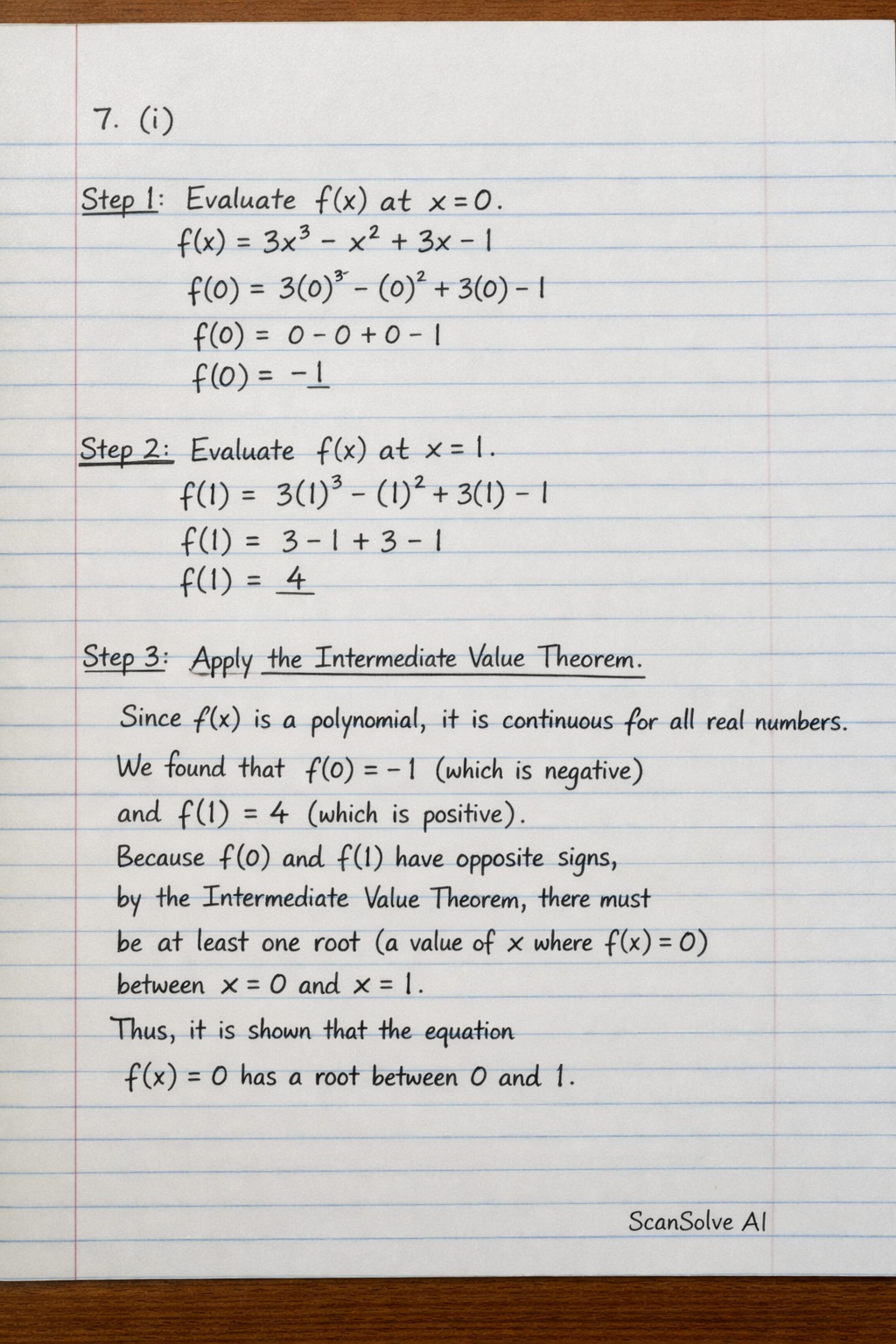
Hey Dany — ready when you are. 7. (i) Step 1: Evaluate the function f(x) at x=0. Given f(x) = 3x^3 - x^2 + 3x - 1. f(0) = 3(0)^3 - (0)^2 + 3(0) - 1 f(0) = 0 - 0 + 0 - 1 f(0) = -1 Step 2: Evaluate the function f(x) at x=1. f(1) = 3(1)^3 - (1)^2 + 3(1) - 1 f(1) = 3 - 1 + 3 - 1 f(1) = 4 Step 3: Apply the Intermediate Value Theorem. Since f(x) is a polynomial, it is continuous for all real numbers. We found that f(0) = -1 (which is negative) and f(1) = 4 (which is positive). Because f(0) and f(1) have opposite signs, by the Intermediate Value Theorem, there must be at least one root (a value of x where f(x)=0) between x=0 and x=1. Thus, it is shown that the equation f(x)=0 has a root between 0 and 1. 7. (ii) Step 1: Find (dx)/(d) and (dy)/(d). Given x = 2 and y = 2. (dx)/(d) = (d)/(d)( 2) = 2 2 (dy)/(d) = (d)/(d)( 2) = -2 2 Step 2: Find (dy)/(dx) using the chain rule. (dy)/(dx) = (dy/d)/(dx/d) = (-2 2)/(2 2) (dy)/(dx) = -( 2)/( 2) = - 2 Step 3: Find (d^2y)/(dx^2) using the chain rule. (d^2y)/(dx^2) = (d)/(d)((dy)/(dx)) · (1)/(dx/d) First, find (d)/(d)((dy)/(dx)): (d)/(d)(- 2) = -^2(2) · (d)/(d)(2) = -^2(2) · 2 = -2 ^2(2) Now substitute this back into the formula for (d^2y)/(dx^2): (d^2y)/(dx^2) = (-2 ^2(2)) · (1)/(2 2) (d^2y)/(dx^2) = (-2 ^2(2))/(2 2) Since 2 = (1)/( 2): (d^2y)/(dx^2) = (-1)/(^2(2) 2) (d^2y)/(dx^2) = (-1)/(^3(2)) (d^2y)/(dx^2) = -^3(2) Got more? Send 'em!