
We read your photo as:
Show that the length of the curve y = sqrt((1 − x2/3))3 for 0 x 1 is 3/2.
ScanSolve AI Answer
Answers
4 partsUse the left and right arrow keys to trace the curve, up and down to jump between key points, and plus and minus to zoom.
| Point | x | y |
|---|---|---|
| x-intercept | −1.73 | 0 |
| Maximum | 0 | 1 |
| x-intercept | 1.73 | 0 |
Step-by-step solution
18 stepsHere are the solutions to the questions.
Part 1
Given the curve for .
Part i· 5 steps
Show that the length of the curve C is .
Rewrite the curve equation.
The given curve is .
To find the arc length, we need to calculate .Differentiate with respect to .
Calculate .
Set up the arc length integral.
The arc length is given by the formula:
Substitute :
Evaluate the integral.
The length of the curve C is indeed .
Part ii
The point lies on the curve C.
This part of the question seems to be incomplete or incorrectly transcribed. The given curve is . If a point lies on the curve, then and .
Substituting into the curve equation:
This does not directly relate to . Without further context or a complete question, it is not possible to provide a solution for this part. Assuming it asks to find if the point lies on the curve, we would need to equate the -coordinates. However, the -value is outside the domain . Therefore, this point cannot lie on the curve C as defined.
Part iii
The curve C is rotated completely about the x-axis. Find the area of the surface of revolution obtained.
Recall the formula for the surface area of revolution about the x-axis.
Substitute the known values.
We have and .
Use a substitution to evaluate the integral.
Let .
Then .
So, .Change the limits of integration:
When , .
When , .Substitute into the integral:
To reverse the limits, change the sign:
Evaluate the integral.
The area of the surface of revolution obtained is .
Part iv
Using a theorem of Pappus, find the y-coordinates of a centroid of the arc C.
Recall Pappus's Second Theorem.
Pappus's Second Theorem states that the surface area of a surface of revolution generated by rotating a plane curve C about an external axis is equal to the product of the arc length of C and the distance traveled by the centroid of C.
where is the y-coordinate of the centroid of the arc C, and is the distance traveled by the centroid.
Use the values calculated in previous parts.
From part (i), the arc length .
From part (iii), the surface area .Solve for .
Divide both sides by :
The y-coordinate of the centroid of the arc C is .
Part 2
A square of side is rotated through about a line in its plane which is distant from the centre O of the square. Use theorems of Pappus to find:
Part a
The Volume of the Solid swept out by the Square.
Identify the properties of the square.
Side length of the square is .
Area of the square .
The centroid of the square is its geometric center.Determine the distance of the centroid from the axis of rotation.
The distance from the center O of the square to the axis of rotation is given as .
According to Pappus's First Theorem, the volume of a solid of revolution generated by rotating a plane area about an external axis is given by:where is the distance of the centroid of the area from the axis of rotation.
Calculate the volume.
The volume of the solid swept out by the square is .
Part b
The area of the Surface of the Solid.
Identify the perimeter of the square.
The perimeter of the square .
The centroid of the perimeter of the square is also its geometric center.Determine the distance of the centroid from the axis of rotation.
The distance from the centroid of the perimeter to the axis of rotation is .
According to Pappus's Second Theorem, the surface area of a surface of revolution generated by rotating a plane curve (in this case, the perimeter of the square) about an external axis is equal to the product of the length of the curve and the distance traveled by the centroid of the curve.Calculate the surface area.
The area of the surface of the solid is .
Try one yourself
A new problem that tests the same skill.
Still stuck on this one?
Ask a follow-up, and the answer starts from this question.
More Mathematics Questions
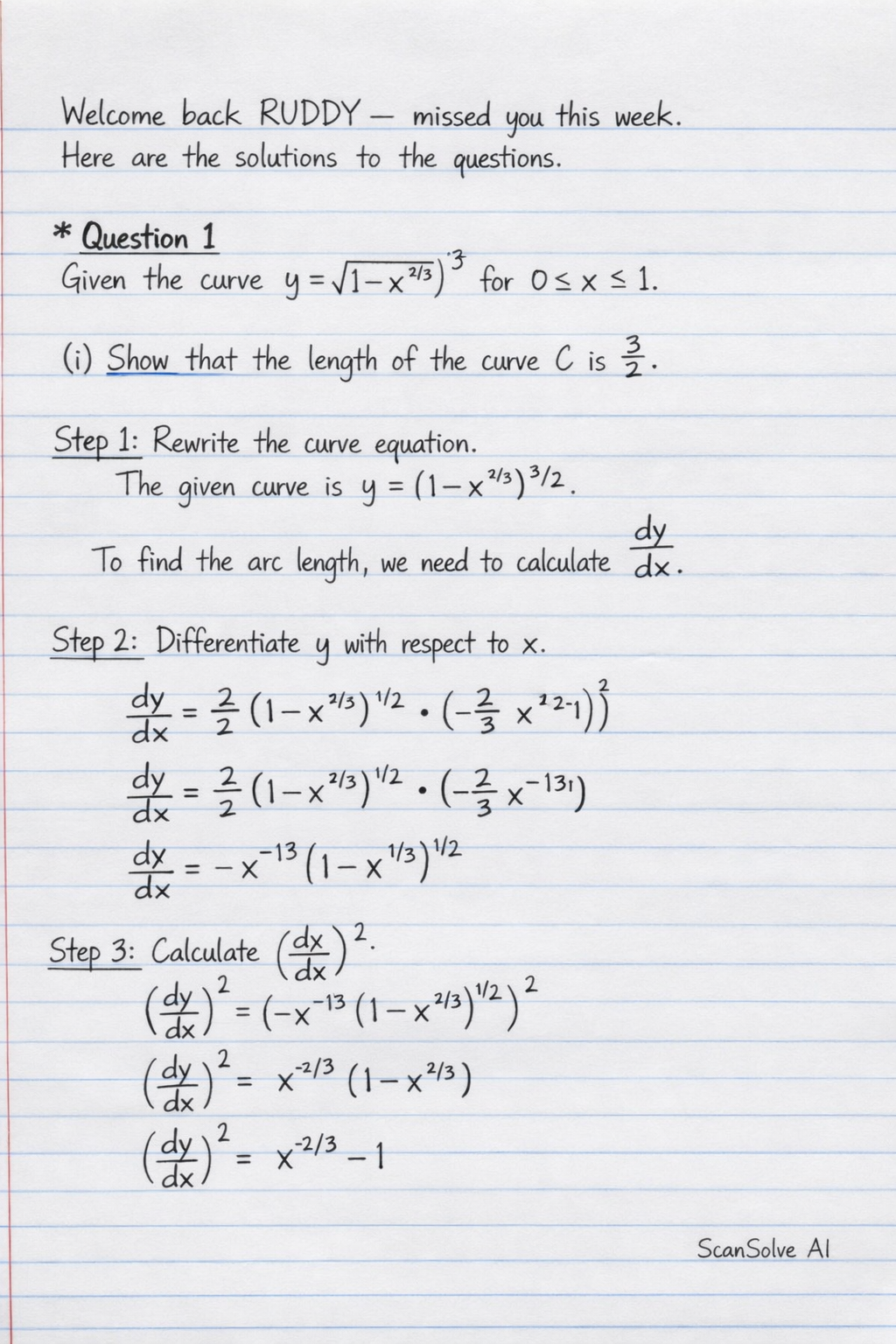
Handwritten Step-by-Step Solution
Get this as a handwritten image on WhatsApp — like a tutor wrote it for you.
Try on WhatsApp