
We read your photo as:
Prove that the sum of n arithmetic means between a and b is n times their arithmetic mean.
ScanSolve AI Answer
Answer
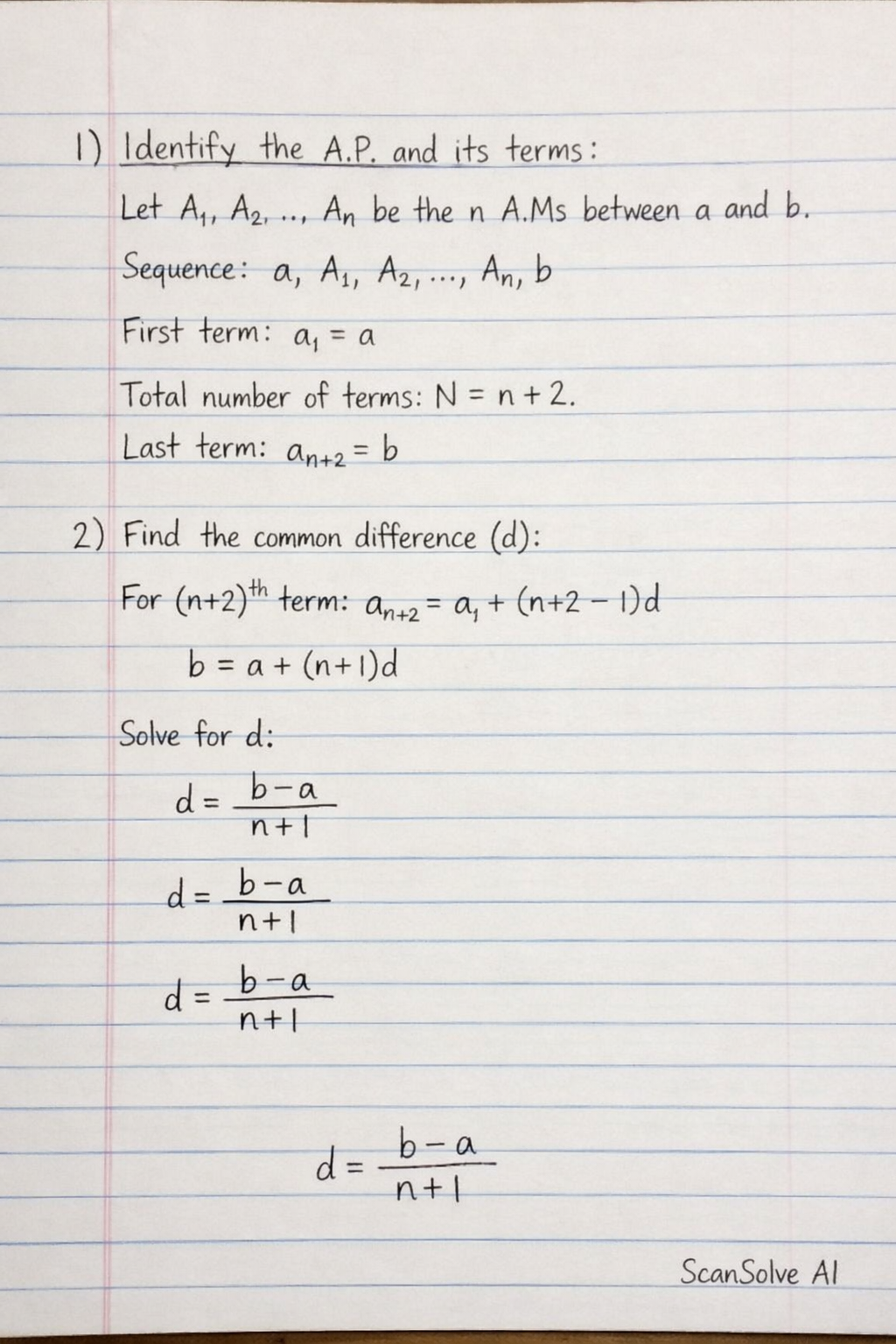
The solution provided in the image correctly demonstrates that the sum of Arithmetic Means (A.Ms) between and is equal to times their A.M.
Step-by-step solution
5 stepsExplanation of the steps:
Identify the A.P. and its terms
Let be the A.Ms between and .
This forms an Arithmetic Progression (A.P.): .
The first term of this A.P. is .
The total number of terms in this A.P. is .
The last term is .Find the common difference ()
Using the formula for the -th term of an A.P., :
For the -th term:Solving for :
This matches the derivation in the image.
Calculate the sum of the A.Ms ()
The sum of an A.P. with terms is .
Here, we are summing the terms .
The first term of this sub-sequence is , and the last term is .
So, the sum is .Now, express and in terms of and :
is the second term of the main A.P., so .
is the -th term of the main A.P., so .Substitute these into the sum formula:
This matches the image.
Substitute the value of into the sum
Substitute into the expression for :
The terms cancel out:
This matches the image.
Relate to the Arithmetic Mean
The Arithmetic Mean (A.M.) between and is .
From the previous step, we have:This completes the proof.
The solution provided in the image is correct.
Still stuck on this one?
Ask a follow-up, and the answer starts from this question.
More Mathematics Questions
Handwritten Step-by-Step Solution
Get this as a handwritten image on WhatsApp — like a tutor wrote it for you.
Try on WhatsApp