
We read your photo as:
The 5th, 6th, and 7th terms in the expansion of (1+x)ⁿ are in arithmetic progression. Find the value of n.
ScanSolve AI Answer
Answer
Step-by-step solution
7 stepsIdentify the coefficients of the 5th, 6th, and 7th terms.
The general term in the binomial expansion of is . The coefficient of the -th term is .
- The coefficient of the 5th term (for ) is .
- The coefficient of the 6th term (for ) is .
- The coefficient of the 7th term (for ) is .
Apply the condition for an arithmetic progression (A.P.).
If three terms are in an A.P., then .
For the coefficients :Express the binomial coefficients using the identity .
We can write and in terms of :
- From , we get .
- From .
Substitute these expressions into the A.P.
equation.
Since cannot be zero (as for the 6th term to exist), we can divide both sides by :
Solve the equation for .
Multiply the entire equation by the common denominator to eliminate fractions:
Rearrange the terms to form a quadratic equation:
Factor the quadratic equation.
We need two numbers that multiply to 98 and add up to -21. These numbers are -7 and -14.
Determine the possible values of .
Setting each factor to zero gives the possible values for :
Both values are valid since must be at least 6 for the 7th term to exist in the expansion.
The possible values of are .
Try one yourself
A new problem that tests the same skill.
Still stuck on this one?
Ask a follow-up, and the answer starts from this question.
More Mathematics Questions
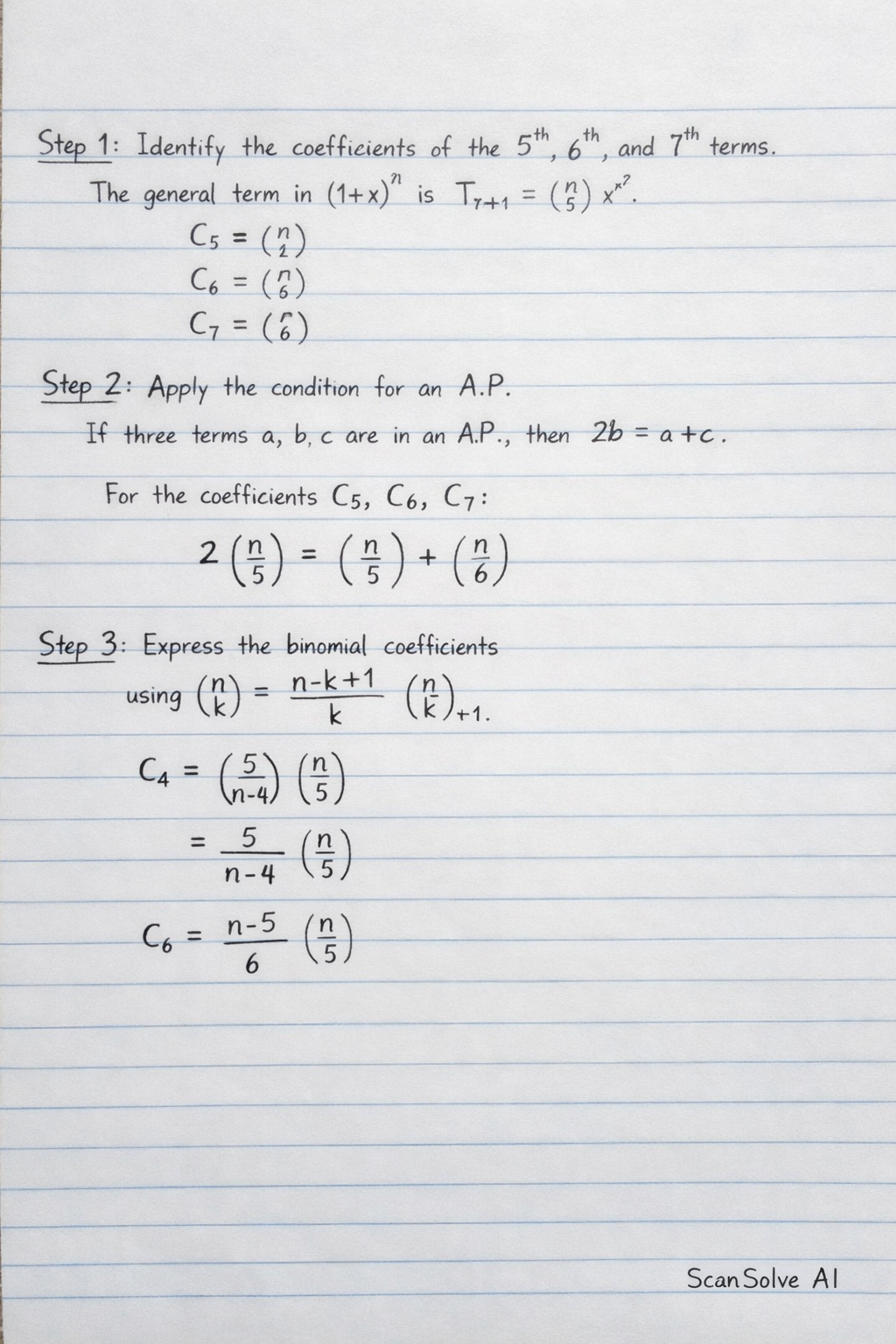
Handwritten Step-by-Step Solution
Get this as a handwritten image on WhatsApp — like a tutor wrote it for you.
Try on WhatsApp