
We read your photo as:
What is the capacity of the largest vessel which can empty the oil from three vessels containing 32 l, 24 l and 48 l an exact number of times?
ScanSolve AI Answer
Answer
Step-by-step solution
6 stepsHere's the continuation of your problems:
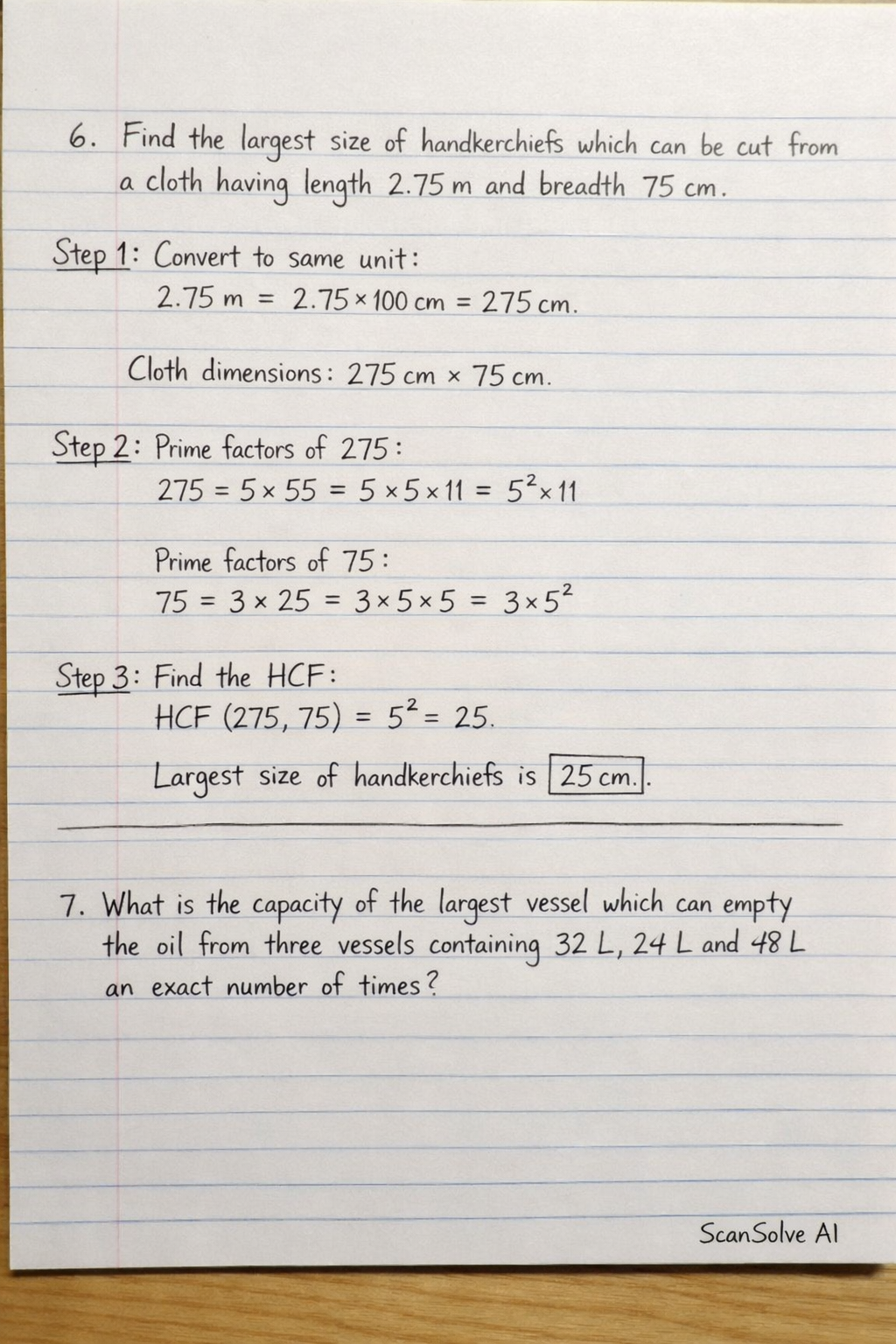
6. Find the largest size of handkerchiefs which can be cut from a cloth having length 2.75 m and breadth 75 cm.
Convert all measurements to the same unit.
Convert meters to centimeters.
The dimensions of the cloth are 275 cm by 75 cm. The largest size of square handkerchiefs will have a side length equal to the Greatest Common Divisor (GCD) or Highest Common Factor (HCF) of the length and breadth.
Find the prime factorization of each dimension.
Calculate the HCF by taking the lowest power of common prime factors.
The largest size of handkerchiefs is .
7. What is the capacity of the largest vessel which can empty the oil from three vessels containing 32 L, 24 L and 48 L an exact number of times?
The capacity of the largest vessel must be a common divisor of 32 L, 24 L, and 48 L.
We need to find the Greatest Common Divisor (GCD) or Highest Common Factor (HCF) of these capacities.
Find the prime factorization of each capacity.
Calculate the HCF by taking the lowest power of common prime factors.
The common prime factor is 2. The lowest power of 2 among is .
The prime factor 3 is not common to all three numbers (it's missing in 32).The capacity of the largest vessel is .
Try one yourself
A new problem that tests the same skill.
Still stuck on this one?
Ask a follow-up, and the answer starts from this question.
More Mathematics Questions
Handwritten Step-by-Step Solution
Get this as a handwritten image on WhatsApp — like a tutor wrote it for you.
Try on WhatsApp