We read your photo as:

The first three terms of a GP are (k-3), (2k-4), (4k-3). Find (a) the value of k, (b) the common ratio, (c) the sum of the first 10 terms.

Mathematics

ScanSolve AI Answer

Answers

3 parts
a
7
b

52\frac{5}{2}

c

3254867128\frac{3254867}{128}

Step-by-step solution

7 steps

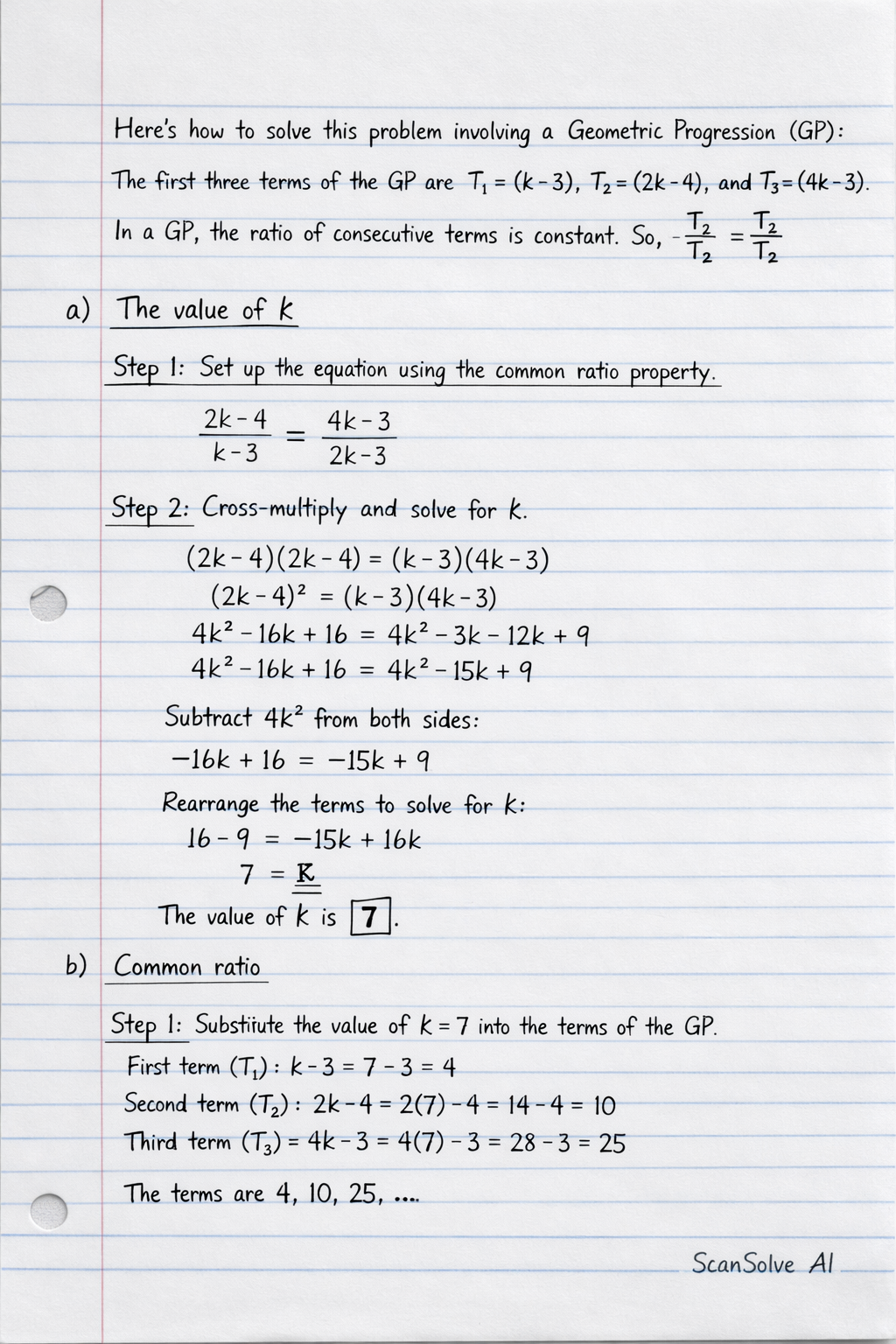
Here's how to solve this problem involving a Geometric Progression (GP):

The first three terms of the GP are T1=(k−3)T_1 = (k-3), T2=(2k−4)T_2 = (2k-4), and T3=(4k−3)T_3 = (4k-3).
In a GP, the ratio of consecutive terms is constant. So, T2T1=T3T2\frac{T_2}{T_1} = \frac{T_3}{T_2}.

Part a· 2 steps

The value of kk

  1. Set up the equation using the common ratio property.

    2k−4k−3=4k−32k−4\frac{2k-4}{k-3} = \frac{4k-3}{2k-4}
  2. Cross-multiply and solve for kk.

    (2k−4)(2k−4)=(k−3)(4k−3)(2k-4)(2k-4) = (k-3)(4k-3) (2k−4)2=(k−3)(4k−3)(2k-4)^2 = (k-3)(4k-3)

    Expand both sides:

    4k2−16k+16=4k2−3k−12k+94k^2 - 16k + 16 = 4k^2 - 3k - 12k + 9 4k2−16k+16=4k2−15k+94k^2 - 16k + 16 = 4k^2 - 15k + 9

    Subtract 4k24k^2 from both sides:

    −16k+16=−15k+9-16k + 16 = -15k + 9

    Rearrange the terms to solve for kk:

    16−9=−15k+16k16 - 9 = -15k + 16k 7=k7 = k

    The value of kk is 7\boxed{7}.

Part b

52\frac{5}{2}

Common ratio

  1. Substitute the value of k=7k=7 into the terms of the GP.

    First term (T1T_1): k−3=7−3=4k-3 = 7-3 = 4
    Second term (T2T_2): 2k−4=2(7)−4=14−4=102k-4 = 2(7)-4 = 14-4 = 10
    Third term (T3T_3): 4k−3=4(7)−3=28−3=254k-3 = 4(7)-3 = 28-3 = 25
    The terms are 4,10,25,…4, 10, 25, \dots

  2. Calculate the common ratio (rr).

    r=T2T1=104=52r = \frac{T_2}{T_1} = \frac{10}{4} = \frac{5}{2}

    Verify with the next pair of terms:

    r=T3T2=2510=52r = \frac{T_3}{T_2} = \frac{25}{10} = \frac{5}{2}

    The common ratio is 52\boxed{\frac{5}{2}}.

Part c

3254867128\frac{3254867}{128}

Sum of the first 10 terms

  1. Identify the first term (aa), common ratio (rr), and number of terms (nn).

    a=4a = 4
    r=52r = \frac{5}{2}
    n=10n = 10

  2. Use the formula for the sum of the first nn terms of a GP, Sn=a(rn−1)r−1S_n = \frac{a(r^n - 1)}{r-1}, since ∣r∣>1|r| > 1.

    S10=4((52)10−1)52−1S_{10} = \frac{4 \left( \left(\frac{5}{2}\right)^{10} - 1 \right)}{\frac{5}{2} - 1}
  3. Calculate the terms and simplify.

    First, calculate the denominator:

    52−1=52−22=32\frac{5}{2} - 1 = \frac{5}{2} - \frac{2}{2} = \frac{3}{2}

    Next, calculate (52)10\left(\frac{5}{2}\right)^{10}:

    (52)10=510210=97656251024\left(\frac{5}{2}\right)^{10} = \frac{5^{10}}{2^{10}} = \frac{9765625}{1024}

    Now substitute these values back into the sum formula:

    S10=4(97656251024−1)32S_{10} = \frac{4 \left( \frac{9765625}{1024} - 1 \right)}{\frac{3}{2}} S10=4(9765625−10241024)32S_{10} = \frac{4 \left( \frac{9765625 - 1024}{1024} \right)}{\frac{3}{2}} S10=4(97646011024)32S_{10} = \frac{4 \left( \frac{9764601}{1024} \right)}{\frac{3}{2}} S10=4×97646011024×23S_{10} = \frac{4 \times 9764601}{1024} \times \frac{2}{3} S10=9764601256×23S_{10} = \frac{9764601}{256} \times \frac{2}{3} S10=9764601128×3S_{10} = \frac{9764601}{128 \times 3} S10=9764601384S_{10} = \frac{9764601}{384}

    Divide the numerator by 3: 9764601÷3=32548679764601 \div 3 = 3254867.

    S10=3254867128S_{10} = \frac{3254867}{128}

    The sum of the first 10 terms is 3254867128\boxed{\frac{3254867}{128}}.

Was this helpful?

Try one yourself

A new problem that tests the same skill.

Still stuck on this one?

Ask a follow-up, and the answer starts from this question.

Got a different question?Ask your own question
Handwritten step-by-step solution preview

Handwritten Step-by-Step Solution

Get this as a handwritten image on WhatsApp — like a tutor wrote it for you.

Try on WhatsApp