We read your photo as:

The sum of the second and third terms of a G.P. is six times the fourth term. If the second term is 8, calculate (a) the two possible values of the common ratio, and (b) the first 5 terms of the sequence.

Mathematics

ScanSolve AI Answer

Answers

2 parts
a

12 and −13\frac{1}{2} \text{ and } -\frac{1}{3}

b
16, 8, 4, 2, 1

−24,8,−83,89,−827-24, 8, -\frac{8}{3}, \frac{8}{9}, -\frac{8}{27}

Step-by-step solution

6 steps

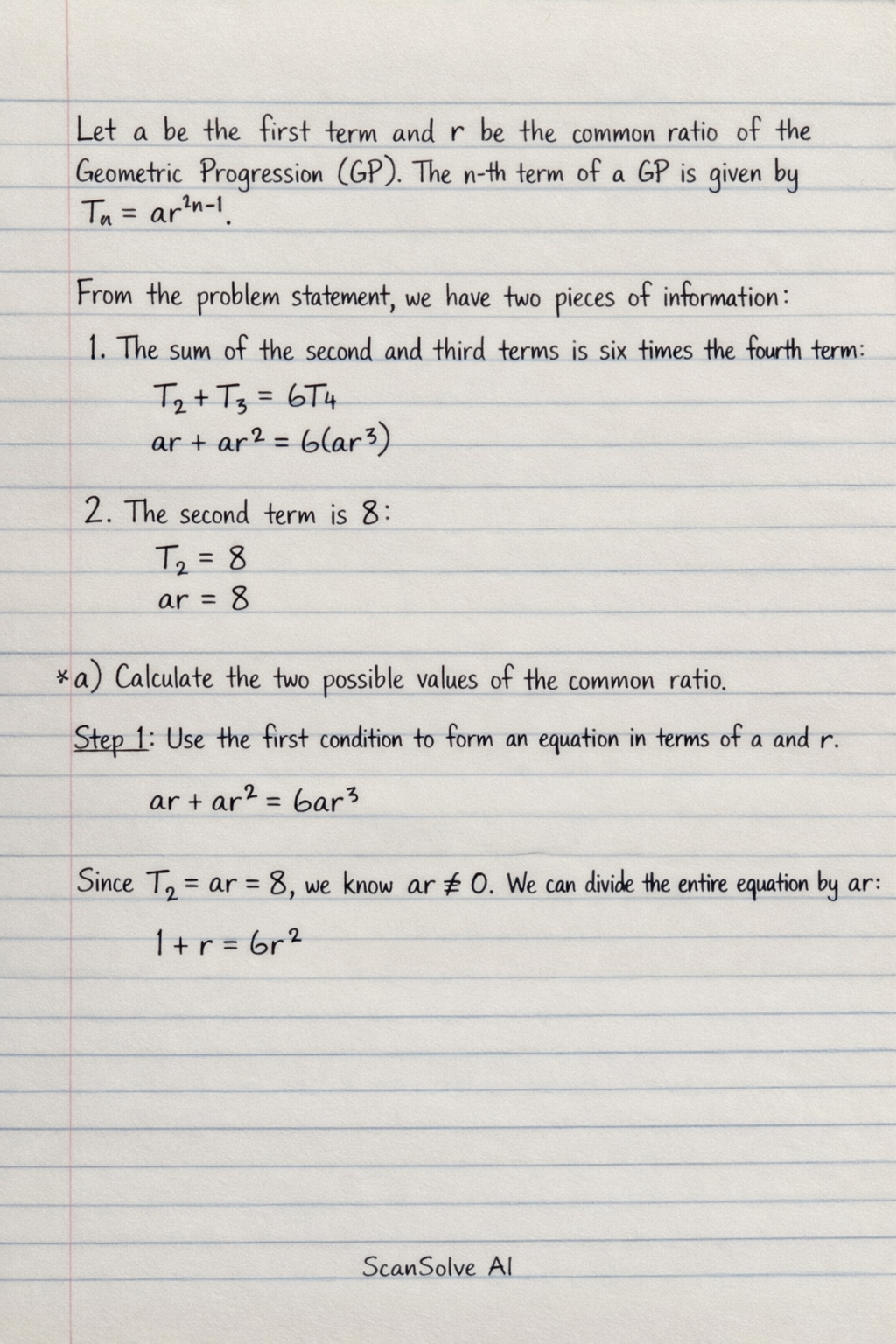
Let aa be the first term and rr be the common ratio of the Geometric Progression (GP). The nn-th term of a GP is given by Tn=arn−1T_n = ar^{n-1}.

From the problem statement, we have two pieces of information:

  1. The sum of the second and third terms is six times the fourth term: T2+T3=6T4T_2 + T_3 = 6T_4 ar+ar2=6(ar3)ar + ar^2 = 6(ar^3)

  2. The second term is 8: T2=8T_2 = 8 ar=8ar = 8

Part a· 2 steps

Calculate the two possible values of the common ratio

  1. Use the first condition to form an equation in terms of aa and rr.

    ar+ar2=6ar3ar + ar^2 = 6ar^3

    Since T2=ar=8T_2 = ar = 8, we know ar≠0ar \neq 0. We can divide the entire equation by arar:

    1+r=6r21 + r = 6r^2
  2. Rearrange the equation into a standard quadratic form and solve for rr.

    6r2−r−1=06r^2 - r - 1 = 0

    Using the quadratic formula r=−b±b2−4ac2ar = \frac{-b \pm \sqrt{b^2 - 4ac}}{2a}, where a=6a=6, b=−1b=-1, c=−1c=-1:

    r=−(−1)±(−1)2−4(6)(−1)2(6)r = \frac{-(-1) \pm \sqrt{(-1)^2 - 4(6)(-1)}}{2(6)} r=1±1+2412r = \frac{1 \pm \sqrt{1 + 24}}{12} r=1±2512r = \frac{1 \pm \sqrt{25}}{12} r=1±512r = \frac{1 \pm 5}{12}

    The two possible values for rr are:

    r1=1+512=612=12r_1 = \frac{1 + 5}{12} = \frac{6}{12} = \frac{1}{2} r2=1−512=−412=−13r_2 = \frac{1 - 5}{12} = \frac{-4}{12} = -\frac{1}{3}

    The two possible values of the common ratio are 12 and −13\boxed{\frac{1}{2} \text{ and } -\frac{1}{3}}.

Part b16, 8, 4, 2, 1

The first 5 terms of the sequence

We use the condition ar=8ar = 8 to find the first term aa for each value of rr.

Case 1: When r=12r = \frac{1}{2}

  1. Find the first term aa.

    a(12)=8a \left(\frac{1}{2}\right) = 8 a=8×2a = 8 \times 2 a=16a = 16
  2. List the first 5 terms.

    T1=a=16T_1 = a = 16
    T2=ar=16×12=8T_2 = ar = 16 \times \frac{1}{2} = 8
    T3=ar2=16×(12)2=16×14=4T_3 = ar^2 = 16 \times \left(\frac{1}{2}\right)^2 = 16 \times \frac{1}{4} = 4
    T4=ar3=16×(12)3=16×18=2T_4 = ar^3 = 16 \times \left(\frac{1}{2}\right)^3 = 16 \times \frac{1}{8} = 2
    T5=ar4=16×(12)4=16×116=1T_5 = ar^4 = 16 \times \left(\frac{1}{2}\right)^4 = 16 \times \frac{1}{16} = 1
    The first 5 terms are 16,8,4,2,1\boxed{16, 8, 4, 2, 1}.

    Case 2: When r=−13r = -\frac{1}{3}

  3. Find the first term aa.

    a(−13)=8a \left(-\frac{1}{3}\right) = 8 a=8×(−3)a = 8 \times (-3) a=−24a = -24
  4. List the first 5 terms.

    T1=a=−24T_1 = a = -24
    T2=ar=−24×(−13)=8T_2 = ar = -24 \times \left(-\frac{1}{3}\right) = 8
    T3=ar2=−24×(−13)2=−24×19=−249=−83T_3 = ar^2 = -24 \times \left(-\frac{1}{3}\right)^2 = -24 \times \frac{1}{9} = -\frac{24}{9} = -\frac{8}{3}
    T4=ar3=−24×(−13)3=−24×(−127)=2427=89T_4 = ar^3 = -24 \times \left(-\frac{1}{3}\right)^3 = -24 \times \left(-\frac{1}{27}\right) = \frac{24}{27} = \frac{8}{9}
    T5=ar4=−24×(−13)4=−24×181=−2481=−827T_5 = ar^4 = -24 \times \left(-\frac{1}{3}\right)^4 = -24 \times \frac{1}{81} = -\frac{24}{81} = -\frac{8}{27}
    The first 5 terms are −24,8,−83,89,−827\boxed{-24, 8, -\frac{8}{3}, \frac{8}{9}, -\frac{8}{27}}.

Was this helpful?

Try one yourself

A new problem that tests the same skill.

Still stuck on this one?

Ask a follow-up, and the answer starts from this question.

Got a different question?Ask your own question
Handwritten step-by-step solution preview

Handwritten Step-by-Step Solution

Get this as a handwritten image on WhatsApp — like a tutor wrote it for you.

Try on WhatsApp