
We read your photo as:
The graphs of f(x) = p^x + q and a straight line g are drawn below. A(3; 4) is a point of intersection of f and g. B (0;-3) and C are the y- and x-intercepts of f respectively. E and D are the x- and y-intercepts of g respectively.
ScanSolve AI Answer
Step-by-step solution
4 stepsIdentify the horizontal asymptote from the graph.
The function has a horizontal asymptote at . From the graph, the dashed line indicates the horizontal asymptote is .
Therefore, .Use the -intercept of to verify and set up an equation for .
The point B is the -intercept of . Substitute and into the equation .
Since (for ), and we found :
This confirms that is consistent with the -intercept.
Use point A to find the value of .
The point A lies on the graph of . Substitute , , and into the equation .
Solve for .
Add 4 to both sides of the equation:
Take the cube root of both sides:
The values are and .
Still stuck on this one?
Ask a follow-up, and the answer starts from this question.
More Mathematics Questions
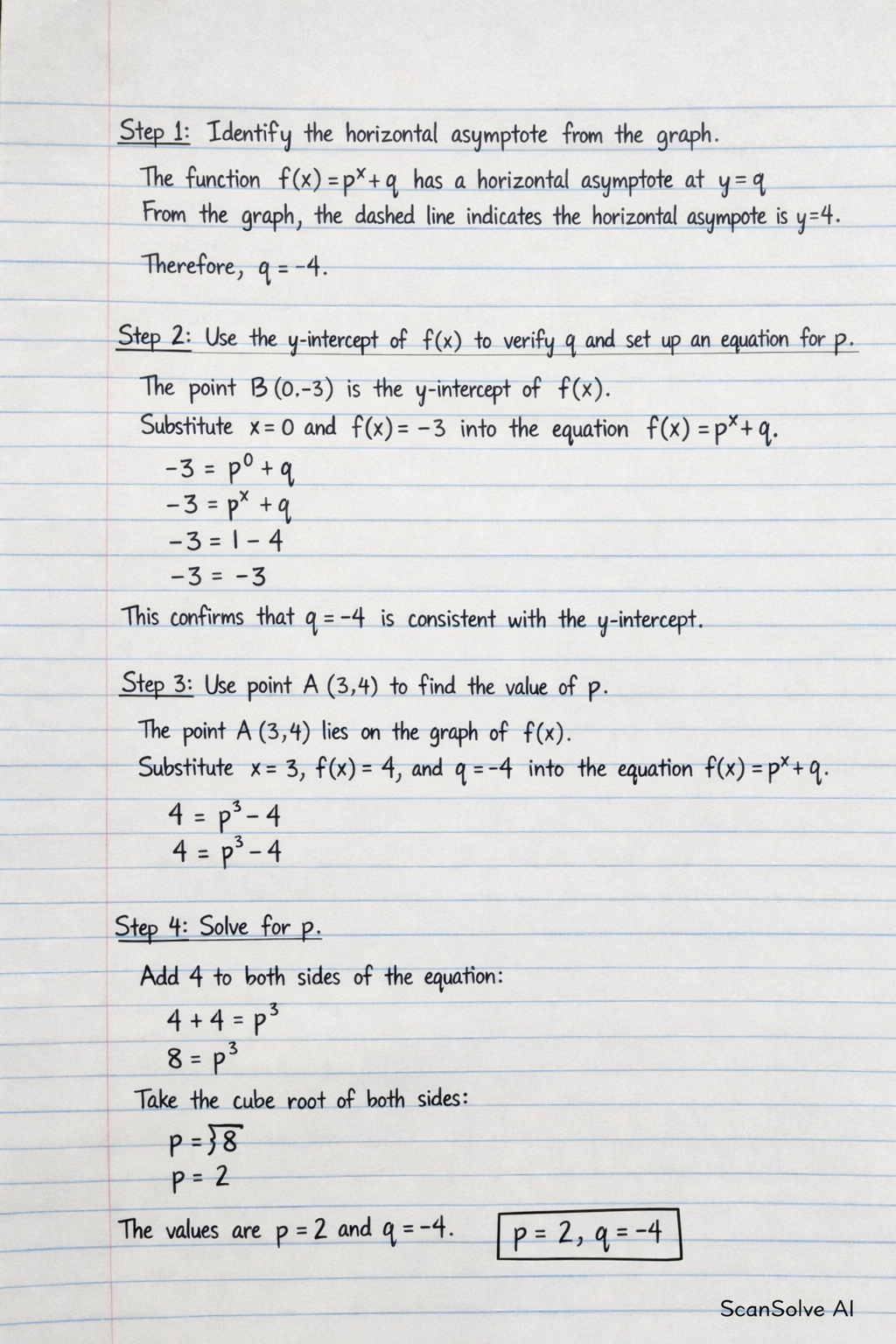
Handwritten Step-by-Step Solution
Get this as a handwritten image on WhatsApp — like a tutor wrote it for you.
Try on WhatsApp