
We read your photo as:
The image displays two geometric diagrams. The first is an isosceles triangle ABC with AD as the altitude. AB = AC = 8 and AD = 9. The second diagram shows a triangle with a vertex labeled A and a side labeled 18.
ScanSolve AI Answer
Answer
Step-by-step solution
4 stepsThe image shows an isosceles triangle with and an altitude . We need to find the length of the base .
Identify the properties of the triangle.
Since is an isosceles triangle with , the altitude to the base also bisects the base. This means . Also, is perpendicular to , forming two right-angled triangles, and .
Use the Pythagorean theorem in .
In the right-angled triangle , we have the hypotenuse and one leg . We can find the length of the other leg using the Pythagorean theorem: .
Calculate the length of .
Take the square root of both sides to find :
To simplify the radical, find the largest perfect square factor of 48, which is 16:
Calculate the length of .
Since bisects , .
The length of is .
Try one yourself
A new problem that tests the same skill.
Still stuck on this one?
Ask a follow-up, and the answer starts from this question.
More Mathematics Questions
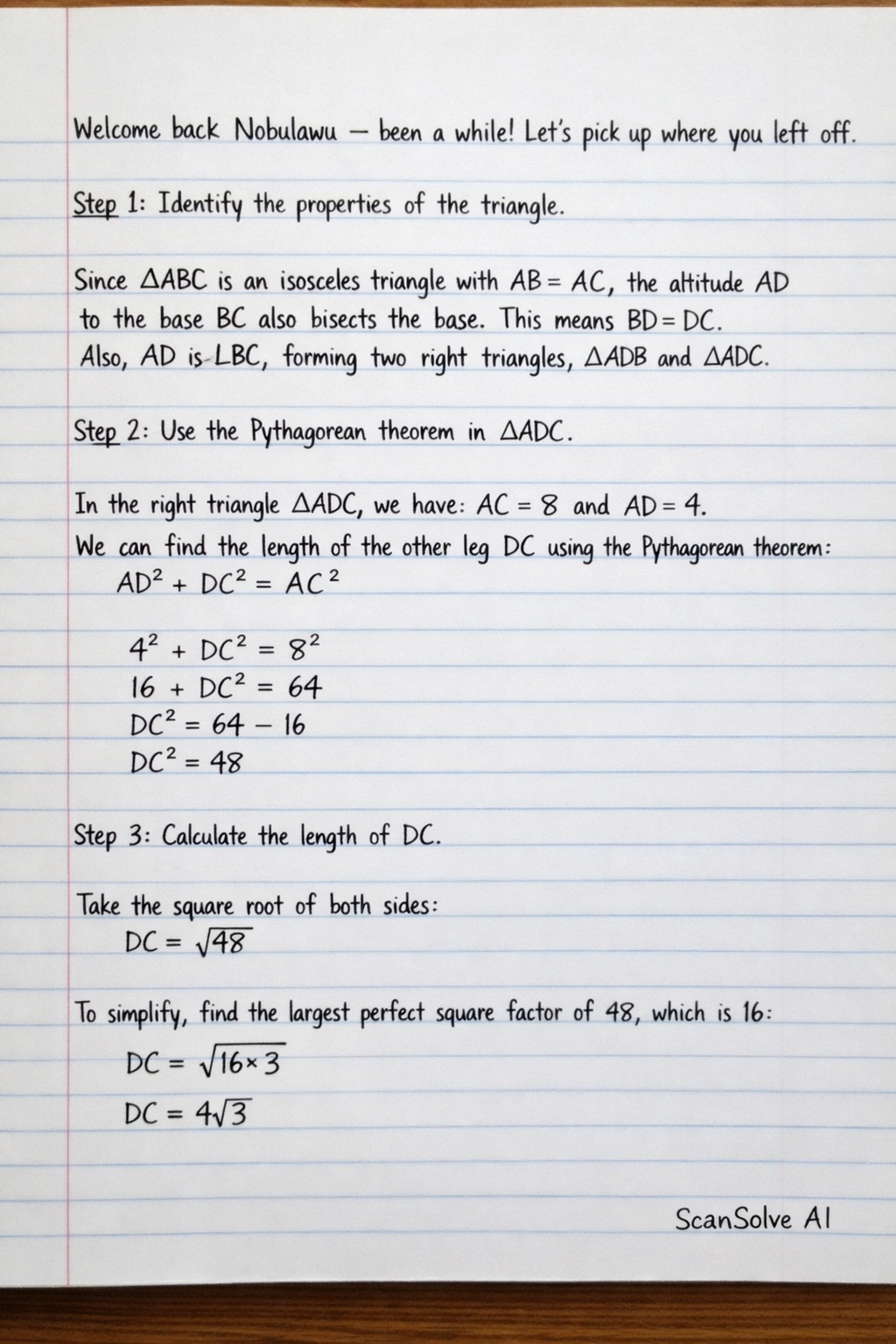
Handwritten Step-by-Step Solution
Get this as a handwritten image on WhatsApp — like a tutor wrote it for you.
Try on WhatsApp