

This mathematics problem involves applying core mathematical principles and formulas. Below you will find a complete step-by-step solution with detailed explanations for each step, helping you understand not just the answer but the method behind it.
ScanSolve AI Answer
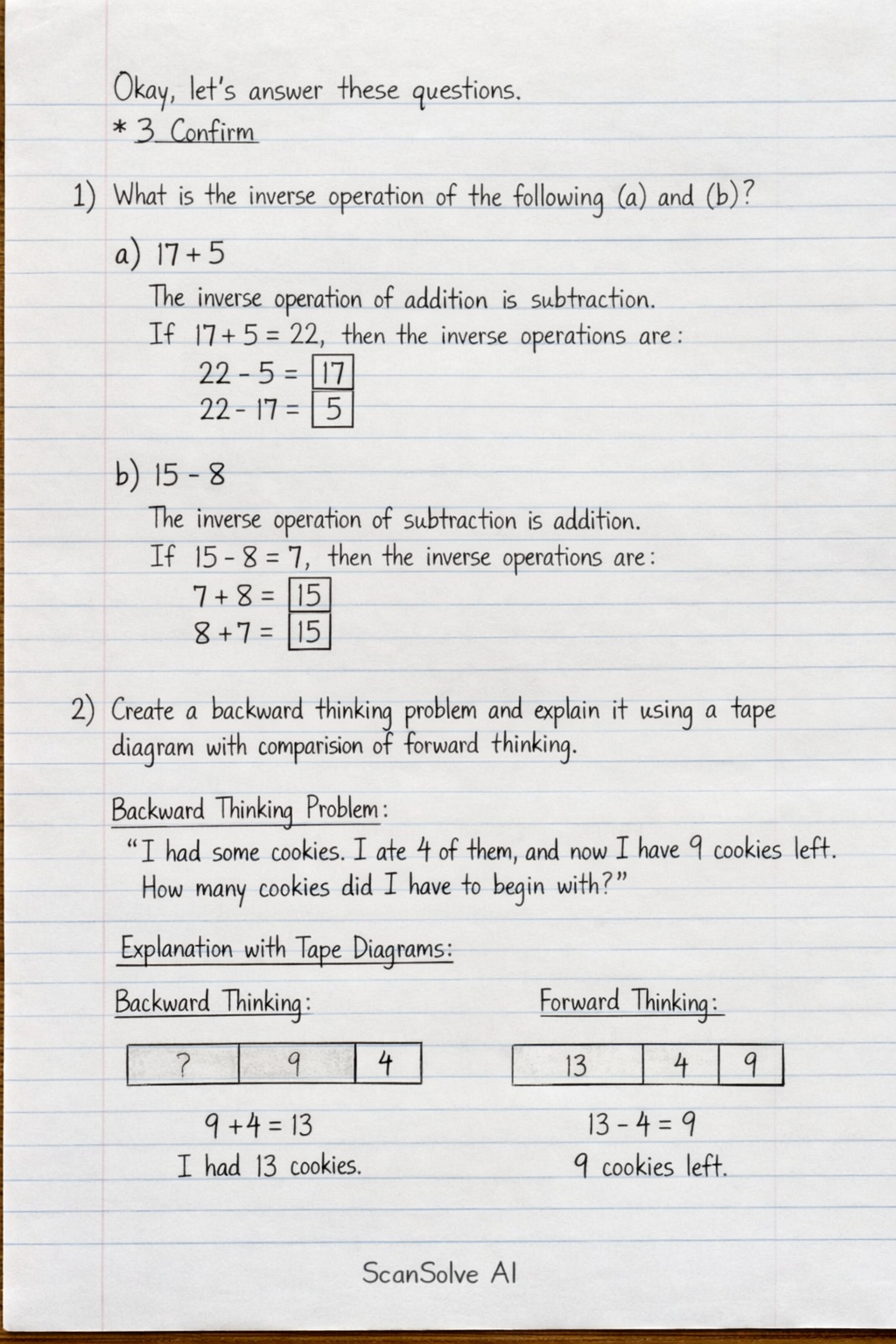
Okay, let's answer these questions. 3 Confirm 1) What is the inverse operation of the following (a) and (b)? a) 17 + 5 The inverse operation of addition is subtraction. If 17 + 5 = 22, then the inverse operations are: 22 - 5 = 17 22 - 17 = 5 b) 15 - 8 The inverse operation of subtraction is addition. If 15 - 8 = 7, then the inverse operations are: 7 + 8 = 15 8 + 7 = 15 2) Create a backward thinking problem and explain it using a tape diagram with comparison of forward thinking. Backward Thinking Problem: "I had some cookies. I ate 4 of them, and now I have 9 cookies left. How many cookies did I have to begin with?" Explanation with Tape Diagrams: Forward Thinking (Subtraction): If you start with an unknown number of cookies (X), eat 4, and have 9 left, the equation is X - 4 = 9. Tape Diagram for Forward Thinking: [ Total Cookies (X) ] [-----][-------------] [ 4 ][ 9 ] This diagram shows that the total X is made up of the 4 eaten and the 9 remaining. Backward Thinking (Addition - Inverse Operation): To solve this problem using backward thinking, you reverse the process. If you ended up with 9 cookies after eating 4, you must add the 4 cookies back to the 9 you have to find the original amount. Equation: 9 + 4 = X Tape Diagram for Backward Thinking: [-------------][-----] [ 9 ][ 4 ] [ Total Cookies (X) ] This diagram shows that the 9 cookies you have now, plus the 4 you ate, make up the total you started with. 9 + 4 = 13 So, you had 13 cookies at the beginning. 4 Practice 1) Read the Grade 3 textbook (p. 18) and do all exercise. As an AI, I cannot read physical textbooks or complete exercises from them. 2) Read teacher's manual (p.22-23) to understand how to teach it. As an AI, I cannot read physical manuals. 3) Practice demonstrating the solving of addition and subtraction by using tape diagrams. a) Addition using a tape diagram (e.g., 6 + 7): Problem: "A gardener planted 6 rose bushes and 7 tulip bulbs. How many plants did the gardener put in total?" Tape Diagram: First, draw a tape for the rose bushes. [ Rose Bushes (6) ] Then, extend the tape for the tulip bulbs. [ Rose Bushes (6) ][ Tulip Bulbs (7) ] The total length of the tape represents the sum. [ Rose Bushes (6) ][ Tulip Bulbs (7) ] [---------------------------------] [ Total Plants ( ? ) ] From the diagram, we add the lengths: 6 + 7 = 13 The gardener planted 13 plants in total. b) Subtraction using a tape diagram (e.g., 16 - 9): Problem: "There are 16 birds on a branch. 9 of them fly away. How many birds are left on the branch?" Tape Diagram: First, draw a tape for the total number of birds. [---------------------------------] [ Total Birds (16) ] Then, mark off the portion for the birds that flew away. [ Birds Flew (9) ][ Birds Left ( ? ) ] [---------------------------------] [ Total Birds (16) ] The remaining part of the tape represents the number of birds left. To find the unknown part, we subtract the known part from the total: 16 - 9 = 7 There are 7 birds left on the branch. 3 done, 2 left today. You're making progress.