

This mathematics problem involves applying core mathematical principles and formulas. Below you will find a complete step-by-step solution with detailed explanations for each step, helping you understand not just the answer but the method behind it.
ScanSolve AI Answer
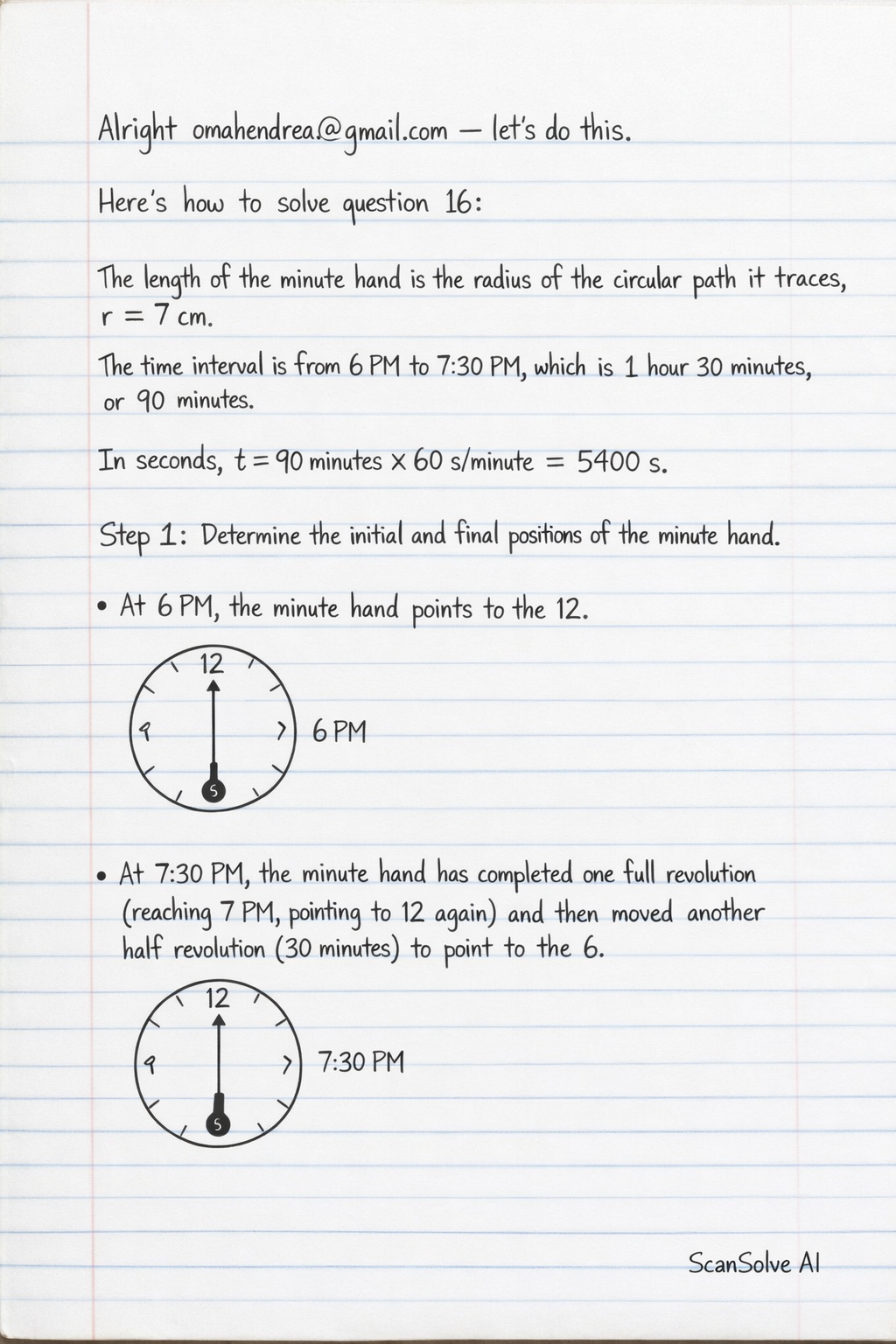
Alright omahendrea@gmail.com — let's do this. Here's how to solve question 16: The length of the minute hand is the radius of the circular path it traces, r = 7 cm. The time interval is from 6 PM to 7:30 PM, which is 1 hour 30 minutes, or 90 minutes. In seconds, t = 90 minutes × 60 s/minute = 5400 s. Step 1: Determine the initial and final positions of the minute hand. At 6 PM, the minute hand points to the 12. At 7:30 PM, the minute hand has completed one full revolution (reaching 7 PM, pointing to 12 again) and then moved another half revolution (30 minutes) to point to the 6. a) Distance travelled: The minute hand completes 1.5 revolutions in 90 minutes. The distance for one revolution is the circumference of the circle, C = 2 r. C = 2 × × 7 cm = 14 cm Distance travelled for 1.5 revolutions: D = 1.5 × 14 cm = 21 cm D ≈ 21 × 3.14159 cm ≈ 65.97 cm The distance travelled is 21 cm or approximately 65.97 cm. b) Displacement: The initial position is at the 12 mark. The final position is at the 6 mark. The displacement is the straight-line distance from the initial to the final position. This is the diameter of the circle. Displacement = 2r = 2 × 7 cm = 14 cm The displacement is 14 cm. c) Speed: Speed is the total distance travelled divided by the total time taken. Speed = Distance travelledTime Speed = 21 cm90 minutes = (7)/(30) cm/minute Speed ≈ 65.97 cm90 minutes ≈ 0.733 cm/minute In cm/s: Speed = 21 cm5400 s = (7)/(1800) cm/s Speed ≈ 65.97 cm5400 s ≈ 0.0122 cm/s The speed is (7)/(30) cm/minute or approximately 0.733 cm/minute. d) Velocity: Velocity is the total displacement divided by the total time taken. The direction is from the 12 o'clock position to the 6 o'clock position (downwards). Velocity = DisplacementTime Velocity = 14 cm90 minutes = (7)/(45) cm/minute Velocity ≈ 14 cm90 minutes ≈ 0.156 cm/minute In cm/s: Velocity = 14 cm5400 s = (7)/(2700) cm/s Velocity ≈ 14 cm5400 s ≈ 0.00259 cm/s The velocity is (7)/(45) cm/minute downwards or approximately 0.156 cm/minute downwards. What's next?