
We read your photo as:
What are the solutions for problems 7, 8, and 9? Problem 7 asks to identify a finite set among given options. Problem 8 requires finding f(2) for f(x) = 4x+2. Problem 9 asks for the range and arrow di
ScanSolve AI Answer
Use the left and right arrow keys to trace the curve, up and down to jump between key points, and plus and minus to zoom.
| Point | x | y |
|---|---|---|
| x-intercept | −0.5 | 0 |
| y-intercept | 0 | 2 |
Step-by-step solution
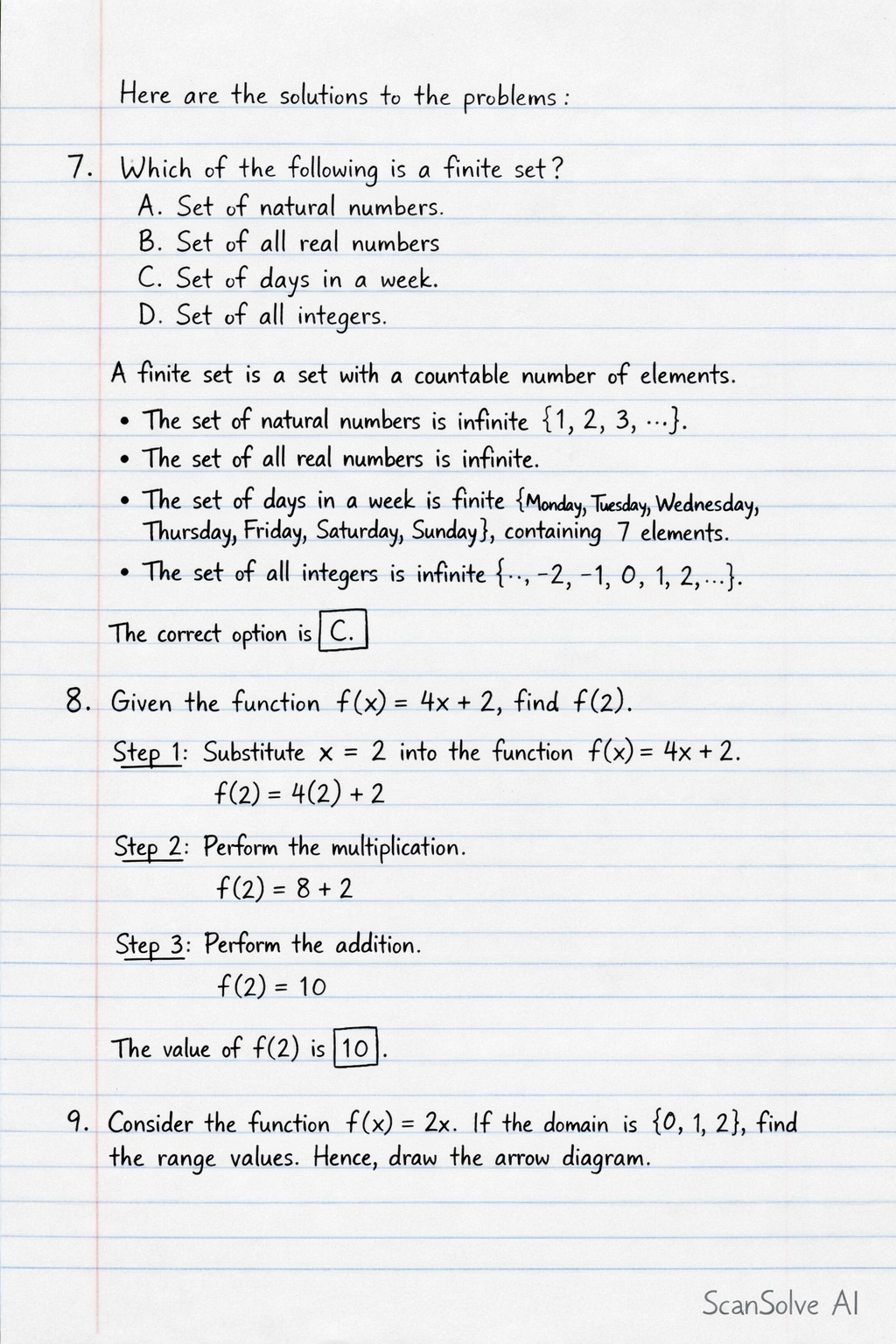
10 stepsHere are the solutions to the problems:
7. Which of the following is a finite set?
A. Set of natural numbers
B. Set of all real numbers
C. Set of days in a week
D. Set of all integers
A finite set is a set with a countable number of elements.
- The set of natural numbers is infinite ().
- The set of all real numbers is infinite.
- The set of days in a week is finite (), containing 7 elements.
- The set of all integers is infinite ().
The correct option is .
8. Given the function , find .
Substitute into the function .
Perform the multiplication.
Perform the addition.
The value of is .
9. Consider the function . If the domain is , find the range values. Hence, draw the arrow diagram.
Calculate the range values by substituting each domain value into the function .
For :
For :
For :
The range values are .
Draw the arrow diagram.
Domain:
Range:
The arrow diagram shows the mapping from each domain element to its corresponding range element:10. Out of 17 teachers in a school, 10 teach Economics, and 9 teach Maths. The number of teachers who teach both subjects is twice that of those who teach none of the subjects. Use a Venn diagram to find the numbers that teach:
(a) Both subjects.
(b) None of the subject.
(c) Only one subject.
Let be the set of teachers who teach Economics and be the set of teachers who teach Maths.
Total teachers .
Number of teachers teaching Economics, .
Number of teachers teaching Maths, .Let be the number of teachers who teach both subjects, i.e., .
Let be the number of teachers who teach none of the subjects, i.e., .From the problem statement, the number of teachers who teach both subjects is twice that of those who teach none:
The number of teachers who teach only Economics is .
The number of teachers who teach only Maths is .The total number of teachers is the sum of those who teach only Economics, only Maths, both, and none:
Simplify the equation.
Substitute into the simplified equation.
Solve for .
So, the number of teachers who teach none of the subjects is 2.
Solve for using .
So, the number of teachers who teach both subjects is 4.
Calculate the number of teachers who teach only one subject.
Number of teachers who teach only Economics .
Number of teachers who teach only Maths .
Number of teachers who teach only one subject .The answers are:
(a) Both subjects:
(b) None of the subject:
(c) Only one subject:
Still stuck on this one?
Ask a follow-up, and the answer starts from this question.
More Mathematics Questions
Handwritten Step-by-Step Solution
Get this as a handwritten image on WhatsApp — like a tutor wrote it for you.
Try on WhatsApp