
We read your photo as:
Solve the following problems involving algebraic equations and functions: a) Find g(1+x) given g(x) = x2 + 1. b) Find the range of x for which F(x) < -3 given F(x) = 2x − 1. c) Simplify F(x) * g(x). d
Mathematics
ScanSolve AI Answer
Answers
4 partsStep-by-step solution
11 stepsHere are the solutions to the problems.
: Solving for
Step 1: Divide both sides of the equation by 223.
The value of is approximately 0.39013.
: Functions
Given and .
Part a· 2 steps
Find .
Substitute into the expression for .
Expand the expression.
Part b
Find the range of values of for which .
Set up the inequality using the given function .
Add 1 to both sides of the inequality.
Divide both sides by 2.
Part c
Simplify .
Write the product of and .
Expand the product using the distributive property.
Rearrange the terms in descending order of power.
Part d
Simplify .
Write the difference .
Distribute the negative sign to the terms in .
Combine like terms and arrange in descending order of power.
Was this helpful?
Try one yourself
A new problem that tests the same skill.
Still stuck on this one?
Ask a follow-up, and the answer starts from this question.
Got a different question?Ask your own question
More Mathematics Questions
QGiven the functions f: x -> 2x + 3 and g: x -> x − 1. (a) Find f(−2) (b) Find g⁻¹(x) (c) Find fg(x)…QSolve the inequalities: 1/(x+6) < 2/3-3n. Find domain and range of functions g(x)=x−2…QSolve for x in the following algebra problems: a) x+7=15, b) −3x=−6, c) 9x−7=11, d) x/4=−5, e)…QA function f is defined on the set of integers as: f(x) = 2x+1 for −1 <= x < 0, −3x+1 for 0 <= x…QConsider the function f(x) = ((x+1)2)/2x − 3. Find f(1), f(−1), f(2). Find the solution of the…
Browse by topic:Algebra
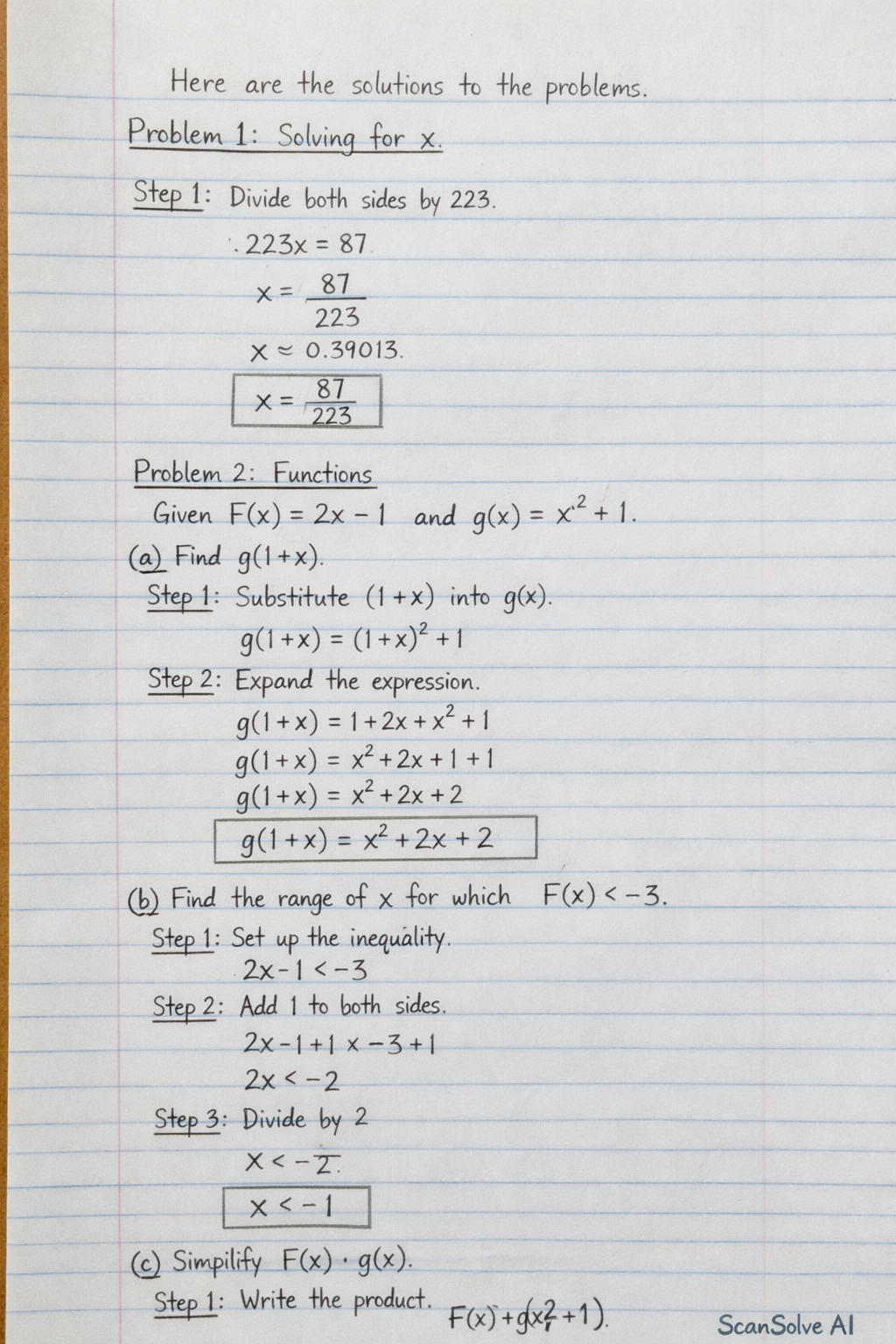
Handwritten Step-by-Step Solution
Get this as a handwritten image on WhatsApp — like a tutor wrote it for you.
Try on WhatsApp