
This mathematics problem involves applying core mathematical principles and formulas. Below you will find a complete step-by-step solution with detailed explanations for each step, helping you understand not just the answer but the method behind it.
ScanSolve AI Answer
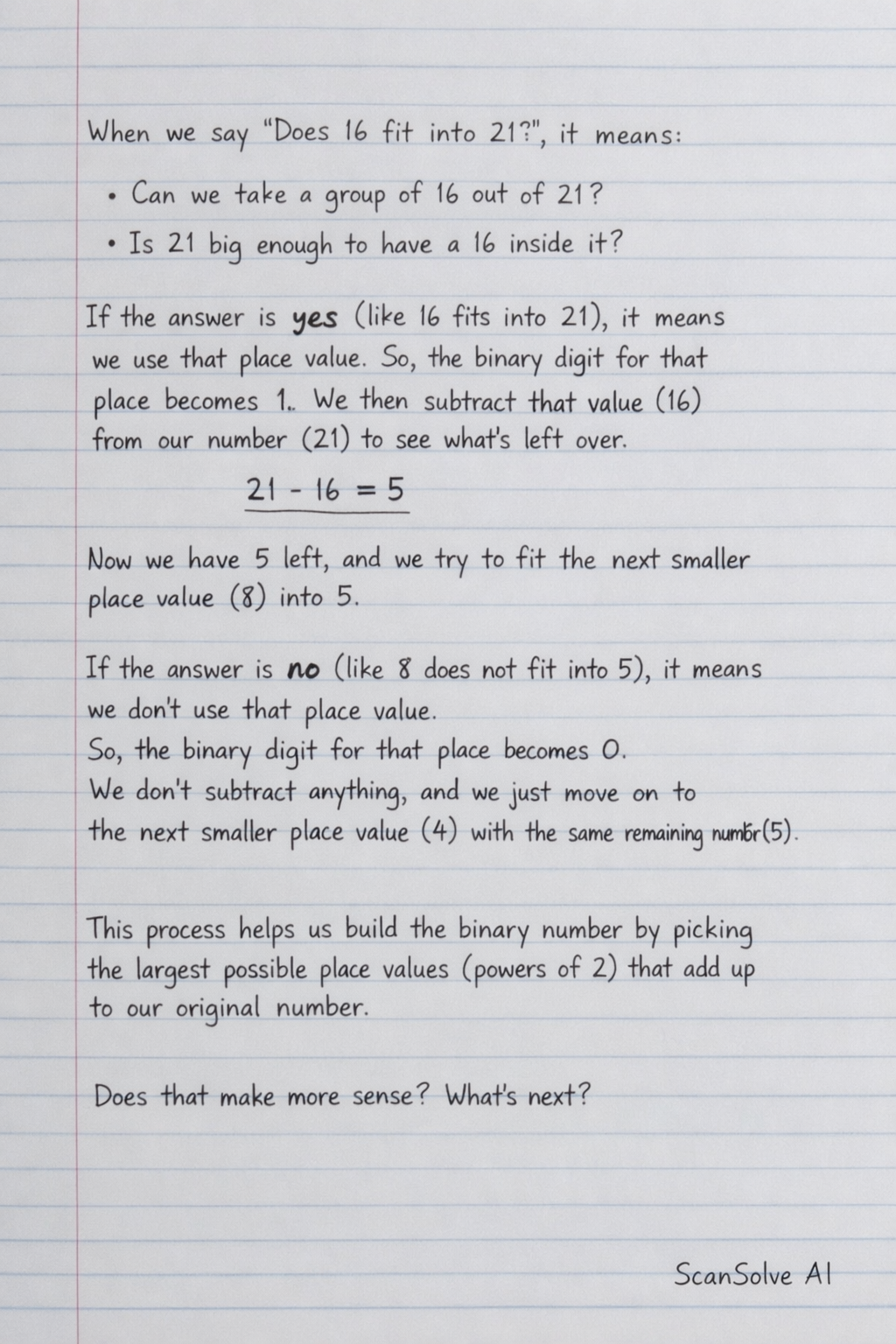
You're asking about how we decide which binary digits (the 1s and 0s) to use when converting a normal number like 21 back into binary. When we say "Does 16 fit into 21?", it means: • Can we take a group of 16 out of 21? • Is 21 big enough to have a 16 inside it? If the answer is yes (like 16 fits into 21), it means we use that place value. So, the binary digit for that place becomes 1. We then subtract that value (16) from our number (21) to see what's left over. 21 - 16 = 5 Now we have 5 left, and we try to fit the next smaller place value (8) into 5. If the answer is no (like 8 does not fit into 5), it means we don't use that place value. So, the binary digit for that place becomes 0. We don't subtract anything, and we just move on to the next smaller place value (4) with the same remaining number (5). This process helps us build the binary number by picking the largest possible place values (powers of 2) that add up to our original number. Does that make more sense? What's next?