

This mathematics problem involves applying core mathematical principles and formulas. Below you will find a complete step-by-step solution with detailed explanations for each step, helping you understand not just the answer but the method behind it.
ScanSolve AI Answer
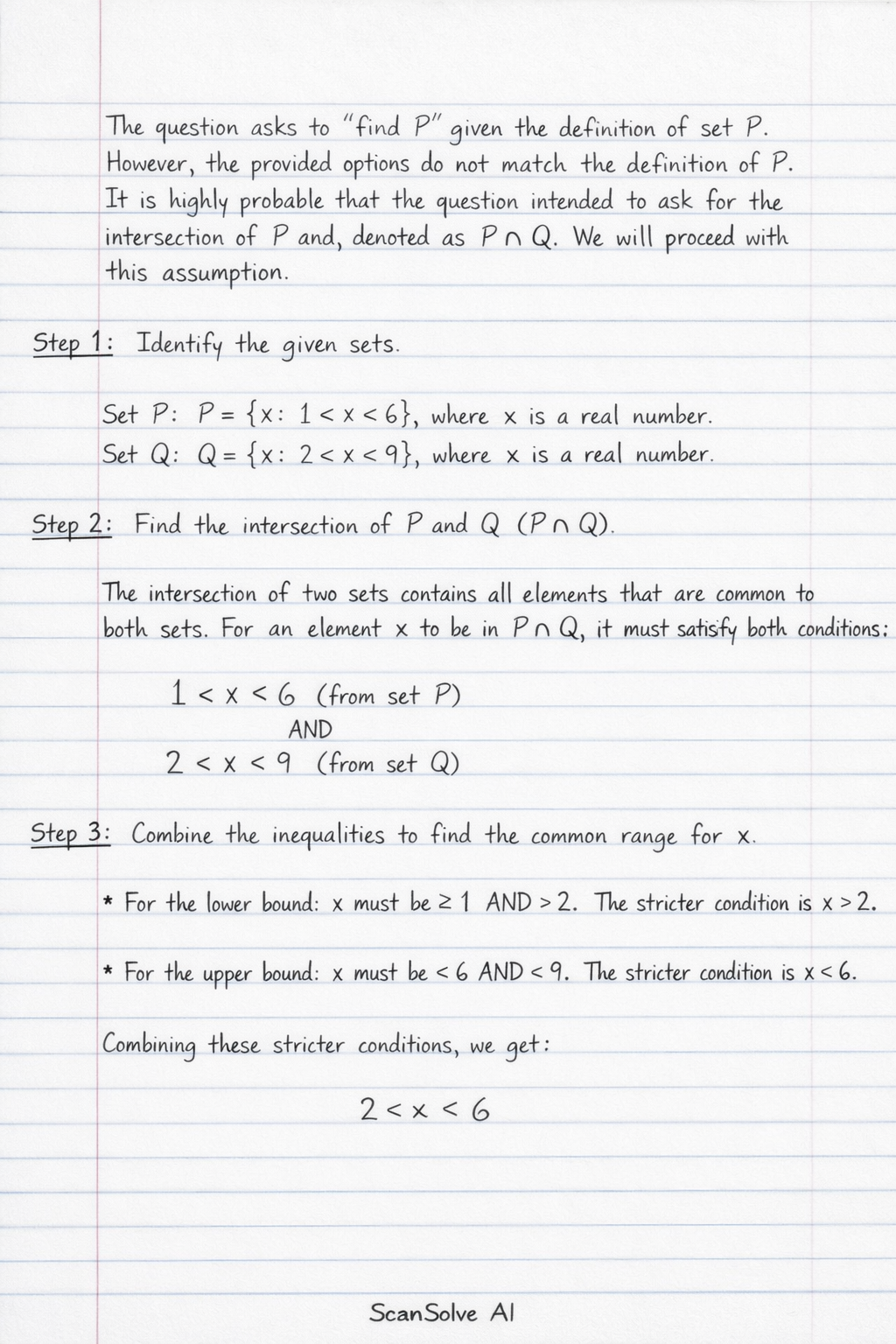
The question asks to "find P" given the definition of set P. However, the provided options do not match the definition of P. It is highly probable that the question intended to ask for the intersection of P and Q, denoted as P Q. We will proceed with this assumption. Step 1: Identify the given sets. Set P is defined as P = \x: 1 x 6\, where x is a real number. Set Q is defined as Q = \x: 2 < x < 9\, where x is a real number. Step 2: Find the intersection of P and Q (P Q). The intersection of two sets contains all elements that are common to both sets. For an element x to be in P Q, it must satisfy both conditions: 1 x 6 (from set P) AND 2 < x < 9 (from set Q) Step 3: Combine the inequalities to find the common range for x. For the lower bound: x must be greater than or equal to 1 AND greater than 2. The stricter condition is x > 2. For the upper bound: x must be less than or equal to 6 AND less than 9. The stricter condition is x 6. Combining these stricter conditions, we get: 2 < x 6 Therefore, P Q = \x: 2 < x 6\. Step 4: Compare the result with the given options. A) \x: 2 < x 6\ B) \x: 2 < x < 6\ C) \x: 2 x < 6\ D) \x: 2 x 6\ The calculated intersection matches option A. The final answer is A