

This mathematics problem involves applying core mathematical principles and formulas. Below you will find a complete step-by-step solution with detailed explanations for each step, helping you understand not just the answer but the method behind it.
ScanSolve AI Answer
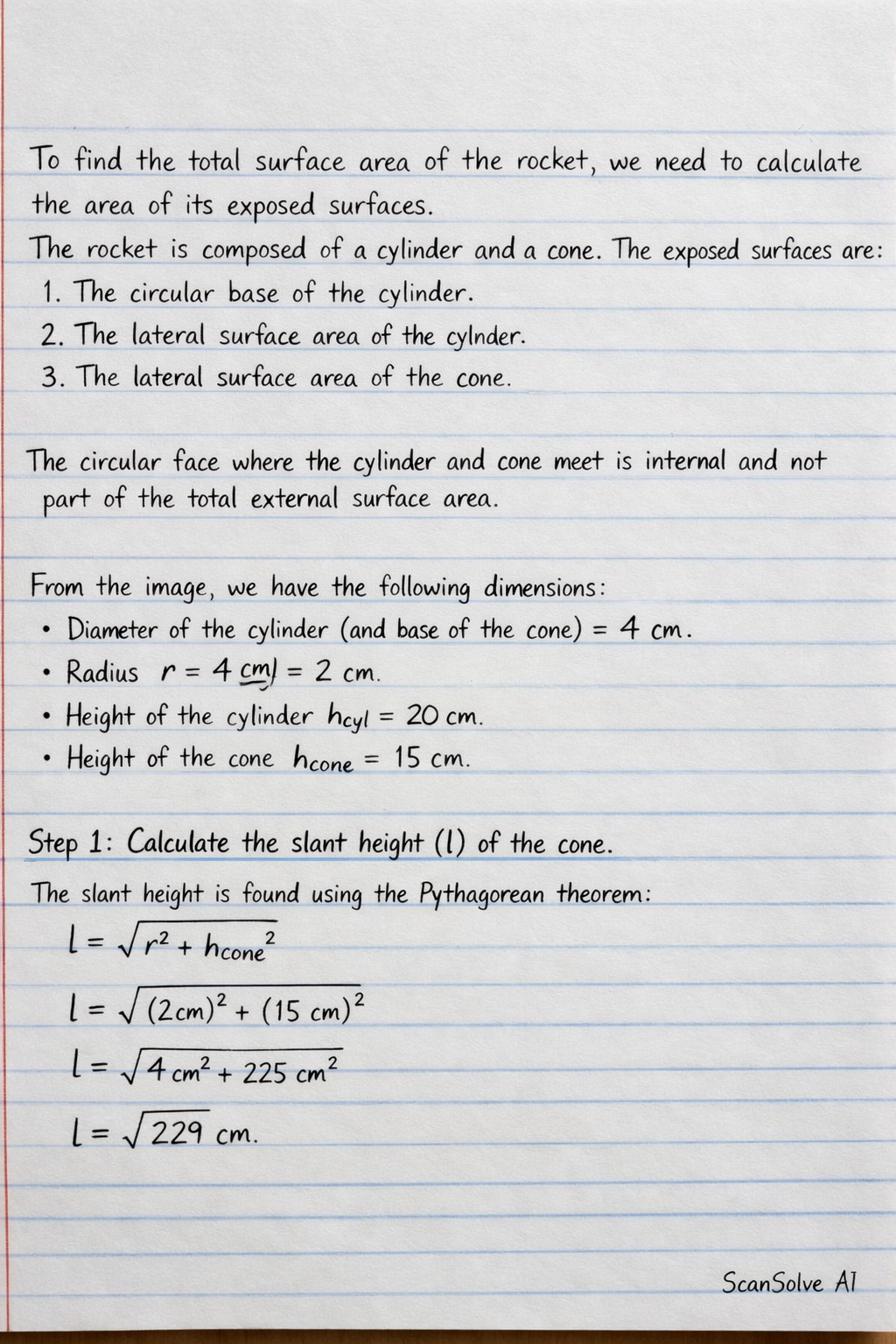
To find the total surface area of the rocket, we need to calculate the area of its exposed surfaces. The rocket is composed of a cylinder and a cone. The exposed surfaces are: 1. The circular base of the cylinder. 2. The lateral surface area of the cylinder. 3. The lateral surface area of the cone. The circular face where the cylinder and cone meet is internal and not part of the total external surface area. From the image, we have the following dimensions: Diameter of the cylinder (and base of the cone) = 4 cm. Radius r = 4 cm2 = 2 cm. Height of the cylinder h_cyl = 20 cm. Height of the cone h_cone = 15 cm. Step 1: Calculate the slant height (l) of the cone. The slant height is found using the Pythagorean theorem: l = sqrt(r^2 + h_cone)^2 l = sqrt((2 cm))^2 + (15 cm)^2 l = sqrt(4 cm)^2 + 225 cm^2 l = sqrt(229) cm Step 2: Calculate the area of the circular base of the cylinder. A_base = r^2 A_base = (2 cm)^2 A_base = 4 cm^2 Step 3: Calculate the lateral surface area of the cylinder. A_cyl\_lat = 2 r h_cyl A_cyl\_lat = 2 (2 cm) (20 cm) A_cyl\_lat = 80 cm^2 Step 4: Calculate the lateral surface area of the cone. A_cone\_lat = r l A_cone\_lat = (2 cm) (sqrt(229) cm) A_cone\_lat = 2 sqrt(229) cm^2 Step 5: Calculate the total surface area (A_total) by summing the areas of the exposed surfaces. A_total = A_base + A_cyl\_lat + A_cone\_lat A_total = 4 cm^2 + 80 cm^2 + 2 sqrt(229) cm^2 A_total = (84 + 2 sqrt(229)) cm^2 Factor out 2: A_total = 2 (42 + sqrt(229)) cm^2 Step 6: Calculate the numerical value (using ≈ 3.14159 and sqrt(229) ≈ 15.1327). A_total ≈ 2 × 3.14159 × (42 + 15.1327) A_total ≈ 6.28318 × 57.1327 A_total ≈ 359.08 cm^2 The total surface area of the rocket is 2 (42 + sqrt(229)) cm^2 ≈ 359.08 cm^2. That's 2 down. 3 left today — send the next one.