
We read your photo as:
To show that (1)/(x) xⁿ = (x xⁿ)/(_x (x-1)).
ScanSolve AI Answer
This answer stops before the end.
It was cut off when it was first written. Ask ScanSolve this question again for the full working.
Here's the solution for 1(b)i and 1(b)ii:
1(b)i)
The question asks to show that .
It appears there might be a typo in the denominator of the Right Hand Side (RHS). A standard logarithmic identity (the change of base formula) states . Applying this to the Left Hand Side (LHS) with , , and choosing , we get .
We will proceed by showing this standard identity, assuming the question intended the denominator to be instead of , as the latter would only hold for specific values of rather than as a general identity.
Step 1: Start with the Left Hand Side (LHS) of the intended identity.
Step 2: Apply the change of base formula using base .
Step 3: Simplify the numerator and denominator using the logarithm properties and .
Step 4: Substitute these simplified terms back into the LHS expression.
Step 5: Now, consider the Right Hand Side (RHS) of the intended identity.
Step 6: Simplify the numerator and denominator as in Step 3.
Step 7: Substitute these simplified terms back into the RHS expression.
Since and , we have shown that .
Therefore, .
1(b)ii)
The question asks to show that .
Step 1: Start with the Right Hand Side (RHS) of the equation.
Step 2: Recognize that the expression inside the logarithm is a perfect square: .
Step 3: Rewrite the term inside the parenthesis with a common denominator.
Still stuck on this one?
Ask a follow-up, and the answer starts from this question.
More Mathematics Questions
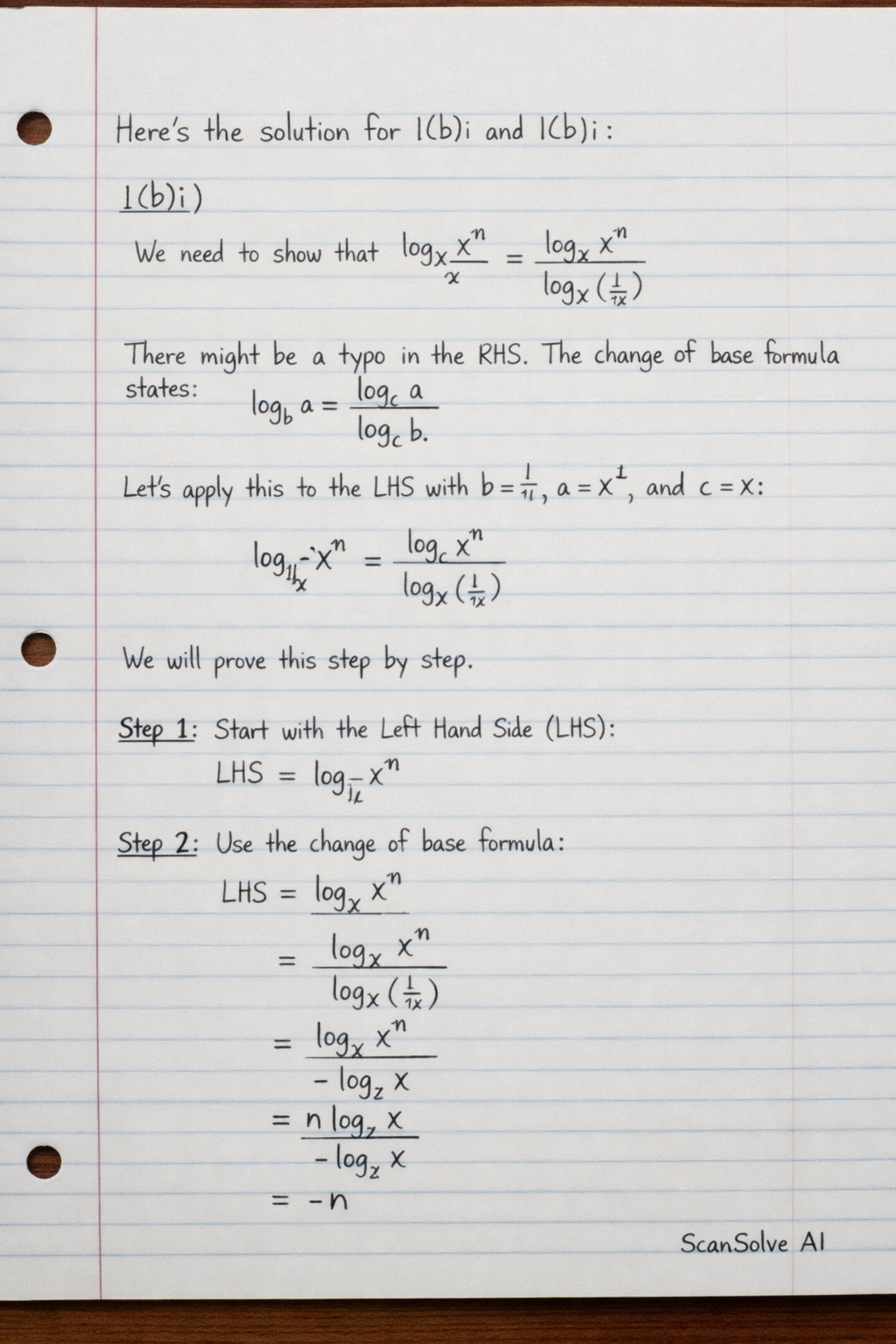
Handwritten Step-by-Step Solution
Get this as a handwritten image on WhatsApp — like a tutor wrote it for you.
Try on WhatsApp