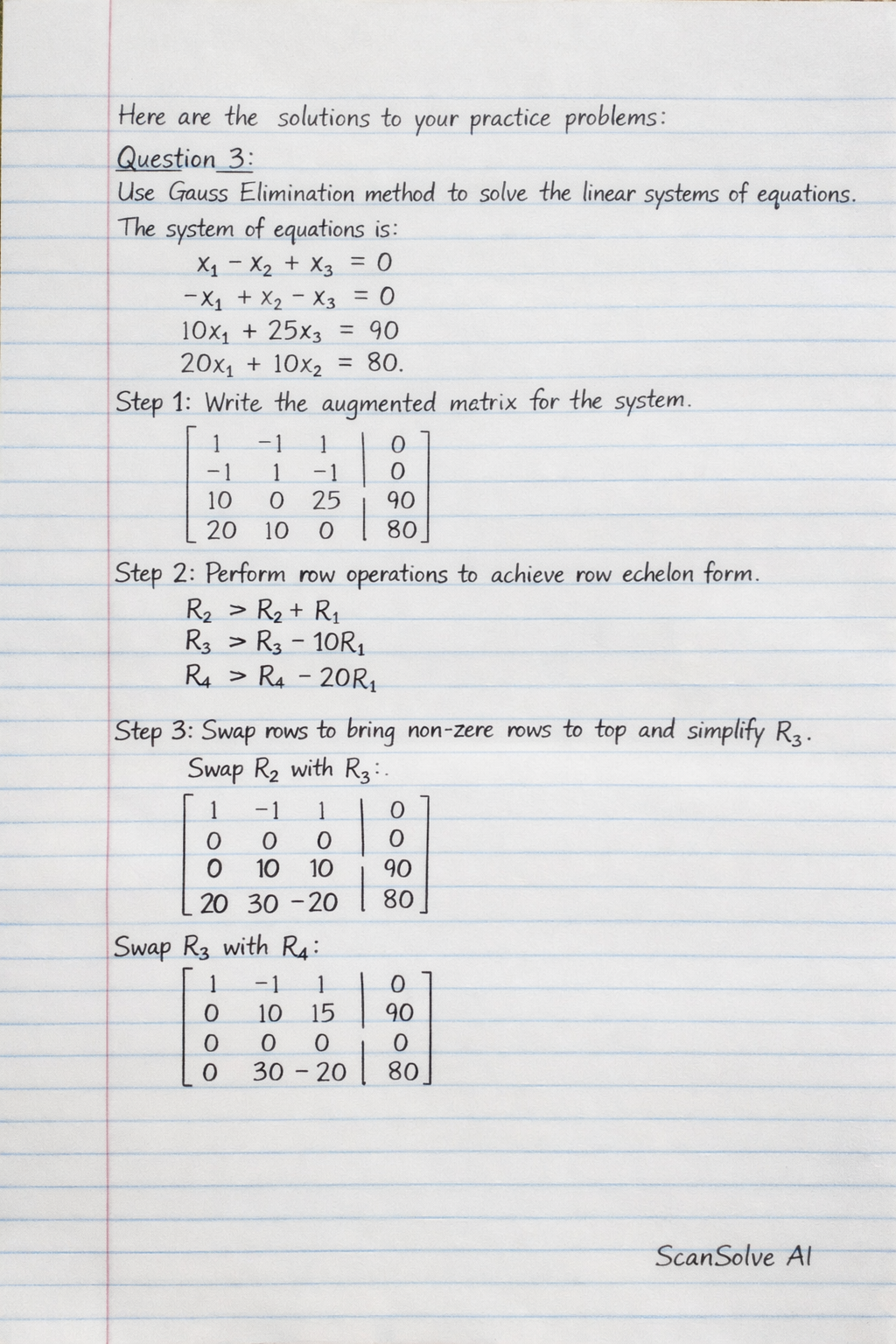
Here are the solutions to your practice problems:
Question 3:
Use Gauss Elimination method to solve the linear systems of equations.
The system of equations is:
x1−x2+x3=0
−x1+x2−x3=0
10x1+25x3=90
20x1+10x2=80
Step 1: Write the augmented matrix for the system.
1 & -1 & 1 & | & 0 \\
-1 & 1 & -1 & | & 0 \\
10 & 0 & 25 & | & 90 \\
20 & 10 & 0 & | & 80
\end{bmatrix}$$
Step 2: Perform row operations to achieve row echelon form.
$R_2 \leftarrow R_2 + R_1$
$R_3 \leftarrow R_3 - 10R_1$
$R_4 \leftarrow R_4 - 20R_1$
$$\begin{bmatrix}
1 & -1 & 1 & | & 0 \\
0 & 0 & 0 & | & 0 \\
0 & 10 & 15 & | & 90 \\
0 & 30 & -20 & | & 80
\end{bmatrix}$$
Step 3: Swap rows to bring non-zero rows to the top and simplify $R_3$.
Swap $R_2$ with $R_3$.
$$\begin{bmatrix}
1 & -1 & 1 & | & 0 \\
0 & 10 & 15 & | & 90 \\
0 & 0 & 0 & | & 0 \\
0 & 30 & -20 & | & 80
\end{bmatrix}$$
Swap $R_3$ with $R_4$.
$$\begin{bmatrix}
1 & -1 & 1 & | & 0 \\
0 & 10 & 15 & | & 90 \\
0 & 30 & -20 & | & 80 \\
0 & 0 & 0 & | & 0
\end{bmatrix}$$
$R_2 \leftarrow \frac{1}{10}R_2$
$$\begin{bmatrix}
1 & -1 & 1 & | & 0 \\
0 & 1 & 1.5 & | & 9 \\
0 & 30 & -20 & | & 80 \\
0 & 0 & 0 & | & 0
\end{bmatrix}$$
Step 4: Continue row operations.
$R_3 \leftarrow R_3 - 30R_2$
$$\begin{bmatrix}
1 & -1 & 1 & | & 0 \\
0 & 1 & 1.5 & | & 9 \\
0 & 0 & -20 - 30(1.5) & | & 80 - 30(9) \\
0 & 0 & 0 & | & 0
\end{bmatrix}$$
$$\begin{bmatrix}
1 & -1 & 1 & | & 0 \\
0 & 1 & 1.5 & | & 9 \\
0 & 0 & -65 & | & -190 \\
0 & 0 & 0 & | & 0
\end{bmatrix}$$
Step 5: Normalize the third row.
$R_3 \leftarrow -\frac{1}{65}R_3$
$$\begin{bmatrix}
1 & -1 & 1 & | & 0 \\
0 & 1 & 1.5 & | & 9 \\
0 & 0 & 1 & | & \frac{190}{65} \\
0 & 0 & 0 & | & 0
\end{bmatrix}$$
Simplify the fraction: $\frac{190}{65} = \frac{38}{13}$.
$$\begin{bmatrix}
1 & -1 & 1 & | & 0 \\
0 & 1 & 1.5 & | & 9 \\
0 & 0 & 1 & | & \frac{38}{13} \\
0 & 0 & 0 & | & 0
\end{bmatrix}$$
Step 6: Use back substitution to solve for $x_1, x_2, x_3$.
From the third row: $x_3 = \frac{38}{13}$.
From the second row: $x_2 + 1.5x_3 = 9$
$x_2 + \frac{3}{2}\left(\frac{38}{13}\right) = 9$
$x_2 + \frac{57}{13} = 9$
$x_2 = 9 - \frac{57}{13} = \frac{117 - 57}{13} = \frac{60}{13}$.
From the first row: $x_1 - x_2 + x_3 = 0$
$x_1 - \frac{60}{13} + \frac{38}{13} = 0$
$x_1 - \frac{22}{13} = 0$
$x_1 = \frac{22}{13}$.
The solution is $x_1 = \frac{22{13}}$, $x_2 = \frac{60{13}}$, $x_3 = \frac{38{13}}$.
**Question 4:**
Find the current $I(t)$ in an RLC circuit with $R=11\Omega$, $L=0.1H$, $C=10^{-2}F$ which is connected to the source of emf $E(t) = 110\sin(120\pi t)$ at a frequency of $60Hz$, assuming the current and capacitor charge are $0$ when $t=0$ seconds.
Given: $R=11\Omega$, $L=0.1H$, $C=10^{-2}F$, $E(t) = 110\sin(120\pi t)$.
Angular frequency $\omega = 120\pi$ rad/s.
Initial conditions: $I(0)=0$ and $Q(0)=0$.
Step 1: Set up the differential equation for the charge $Q(t)$ in a series RLC circuit.
$$L \frac{d^2Q}{dt^2} + R \frac{dQ}{dt} + \frac{1}{C}Q = E(t)$$
Substitute the given values:
$$0.1 \frac{d^2Q}{dt^2} + 11 \frac{dQ}{dt} + \frac{1}{10^{-2}}Q = 110\sin(120\pi t)$$
$$0.1 \frac{d^2Q}{dt^2} + 11 \frac{dQ}{dt} + 100Q = 110\sin(120\pi t)$$
Step 2: Find the homogeneous solution $Q_h(t)$ and the particular solution $Q_p(t)$.
The characteristic equation for the homogeneous part is $0.1r^2 + 11r + 100 = 0$, or $r^2 + 110r + 1000 = 0$.
Using the quadratic formula, $r = \frac{-110 \pm \sqrt{110^2 - 4(1000)}}{2} = \frac{-110 \pm \sqrt{12100 - 4000}}{2} = \frac{-110 \pm \sqrt{8100}}{2} = \frac{-110 \pm 90}{2}$.
The roots are $r_1 = -10$ and $r_2 = -100$.
So, $Q_h(t) = A e^{-10t} + B e^{-100t}$.
For the particular solution $Q_p(t)$, we use the phasor method for steady-state current.
The impedance $Z = R + j\left(\omega L - \frac{1}{\omega C}\right)$.
$\omega L = 120\pi \times 0.1 = 12\pi \approx 37.6991\Omega$.
$\frac{1}{\omega C} = \frac{1}{120\pi \times 10^{-2}} = \frac{1}{1.2\pi} \approx 0.2653\Omega$.
$Z = 11 + j(12\pi - \frac{1}{1.2\pi}) \approx 11 + j(37.6991 - 0.2653) = 11 + j37.4338\Omega$.
The magnitude of impedance $|Z| = \sqrt{11^2 + (37.4338)^2} = \sqrt{121 + 1399.98} = \sqrt{1520.98} \approx 38.9997\Omega$.
The phase angle of impedance $\phi_Z = \arctan\left(\frac{37.4338}{11}\right) \approx 73.61^\circ \approx 1.2848$ radians.
The peak current $I_{peak} = \frac{E_{peak}}{|Z|} = \frac{110}{38.9997} \approx 2.8205$ A.
The steady-state current is $I_p(t) = I_{peak} \sin(\omega t - \phi_Z) = 2.8205 \sin(120\pi t - 73.61^\circ)$.
The steady-state charge $Q_p(t)$ leads the current by $90^\circ$ in a capacitive circuit, or lags the voltage by $90^\circ$.
$Q_p(t) = \frac{I_{peak}}{\omega} \sin(\omega t - \phi_Z - \frac{\pi}{2}) = \frac{2.8205}{120\pi} \sin(120\pi t - 73.61^\circ - 90^\circ)$
$Q_p(t) = 0.00747 \sin(120\pi t - 163.61^\circ)$.
Alternatively, $Q_p(t) = C_1 \cos(120\pi t) + C_2 \sin(120\pi t)$, where $C_1 \approx -0.002108$ and $C_2 \approx -0.007173$ (from previous thought process).
Step 3: Apply initial conditions to the total solution $Q(t) = Q_h(t) + Q_p(t)$.
$Q(t) = A e^{-10t} + B e^{-100t} + 0.00747 \sin(120\pi t - 163.61^\circ)$.
$I(t) = \frac{dQ}{dt} = -10A e^{-10t} - 100B e^{-100t} + 2.8205 \sin(120\pi t - 73.61^\circ)$.
Using $Q(0)=0$:
$0 = A e^0 + B e^0 + 0.00747 \sin(-163.61^\circ)$
$0 = A + B + 0.00747(-0.2822)$
$0 = A + B - 0.002108$
$A + B = 0.002108 \quad (Eq. 1)$
Using $I(0)=0$:
$0 = -10A e^0 - 100B e^0 + 2.8205 \sin(-73.61^\circ)$
$0 = -10A - 100B + 2.8205(-0.9599)$
$0 = -10A - 100B - 2.707$
$-10A - 100B = 2.707 \quad (Eq. 2)$
Step 4: Solve the system of equations for $A$ and $B$.
From (Eq. 1), $A = 0.002108 - B$. Substitute into (Eq. 2):
$-10(0.002108 - B) - 100B = 2.707$
$-0.02108 + 10B - 100B = 2.707$
$-90B = 2.707 + 0.02108$
$-90B = 2.72808$
$B = -\frac{2.72808}{90} \approx -0.030312$
$A = 0.002108 - (-0.030312) = 0.002108 + 0.030312 = 0.03242$.
The current $I(t)$ is:
$$I(t) = -10(0.03242) e^{-10t} - 100(-0.030312) e^{-100t} + 2.8205 \sin(120\pi t - 73.61^\circ)$$
$$I(t) = -0.3242 e^{-10t + 3.0312 e^{-100t} + 2.8205 \sin(120\pi t - 73.61^\circ) A}$$
Drop the next question! 📸