
We read your photo as:
Triangles DEF and PQF are similar and the area of triangle PQF is 25 cm². Calculate the area of triangle DEF.
ScanSolve AI Answer
Step-by-step solution
4 stepsSolve Question 4.
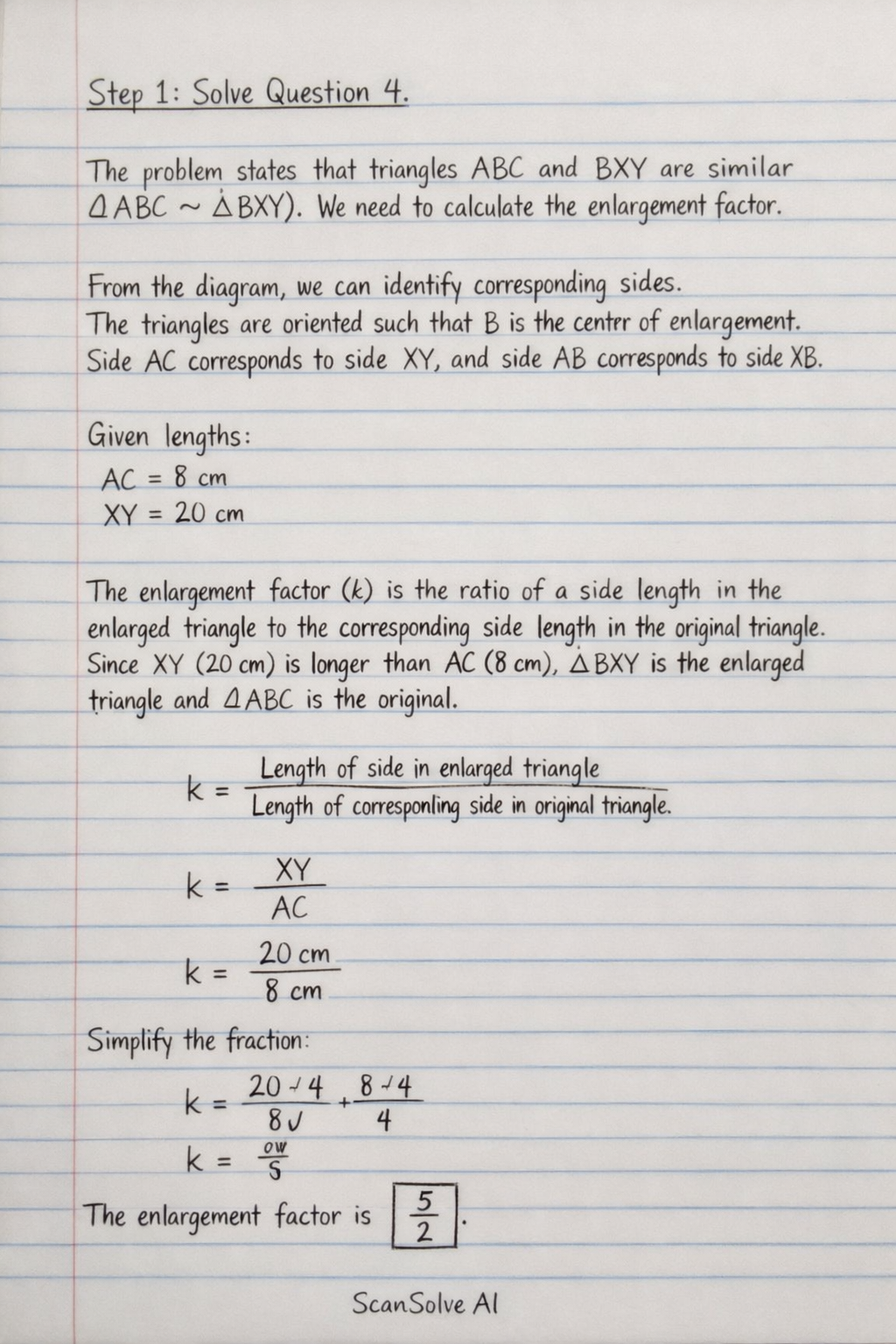
The problem states that triangles ABC and BXY are similar (). We need to calculate the enlargement factor.
From the diagram, we can identify corresponding sides. The triangles are oriented such that B is the center of enlargement. Side AC corresponds to side XY, and side AB corresponds to side XB.
Given lengths:
AC = 8 cm
XY = 20 cmThe enlargement factor () is the ratio of a side length in the enlarged triangle to the corresponding side length in the original triangle. Since XY (20 cm) is longer than AC (8 cm), is the enlarged triangle and is the original.
Simplify the fraction:
The enlargement factor is .
Solve Question 5.
The problem states that triangles ABC and XYZ are similar (). We need to find the length of side BC.
Given lengths:
In : AB = 2 cm, BC =
In : XY = 5.6 cm, YZ = 14 cm, XZ = 11.2 cmSince the triangles are similar, the ratio of their corresponding sides is equal.
The corresponding sides are:
AB corresponds to XY
BC corresponds to YZ
AC corresponds to XZWe can set up a proportion using the known side lengths and the unknown side :
Substitute the given values:
To solve for , multiply both sides by 14:
The length of BC is .
Solve Question 6.
We need to show that in the given figure.
Consider and .- Side AB is equal to side AC (given by the single tick marks).
- Side BD is equal to side CD (given by the double tick marks).
- Side AD is common to both triangles.
Since all three corresponding sides are equal (, , ), the triangles and are congruent by the Side-Side-Side (SSS) congruence criterion.
Because the triangles are congruent, their corresponding angles are equal. Therefore, corresponds to , and thus:
This shows that the angle ABD is equal to the angle ACD.
Solve Question 7.
The problem states that triangles DEF and PQF are similar (). We are given the area of and need to calculate the area of .
Given lengths:
EF = 15 cm
FQ = 10 cm
Area ofWhen two triangles are similar, the ratio of their areas is equal to the square of the ratio of their corresponding sides.
From the similarity statement , side EF corresponds to side QF.
The ratio of corresponding sides () is:The ratio of the areas is :
Now, solve for Area():
The area of triangle DEF is .
Still stuck on this one?
Ask a follow-up, and the answer starts from this question.
More Mathematics Questions
Handwritten Step-by-Step Solution
Get this as a handwritten image on WhatsApp — like a tutor wrote it for you.
Try on WhatsApp