Two airliners, A and B, fly from point P to points Q and R respectively. Given their coordinates and speed, determine which airliner arrives earlier and by how much.
|Mathematics
Two airliners, A and B, fly from point P to points Q and R respectively. Given their coordinates and speed, determine which airliner arrives earlier and by how much.
ScanSolve AI Answer
Answer
Airliner B arrives earlier by 167 minutes
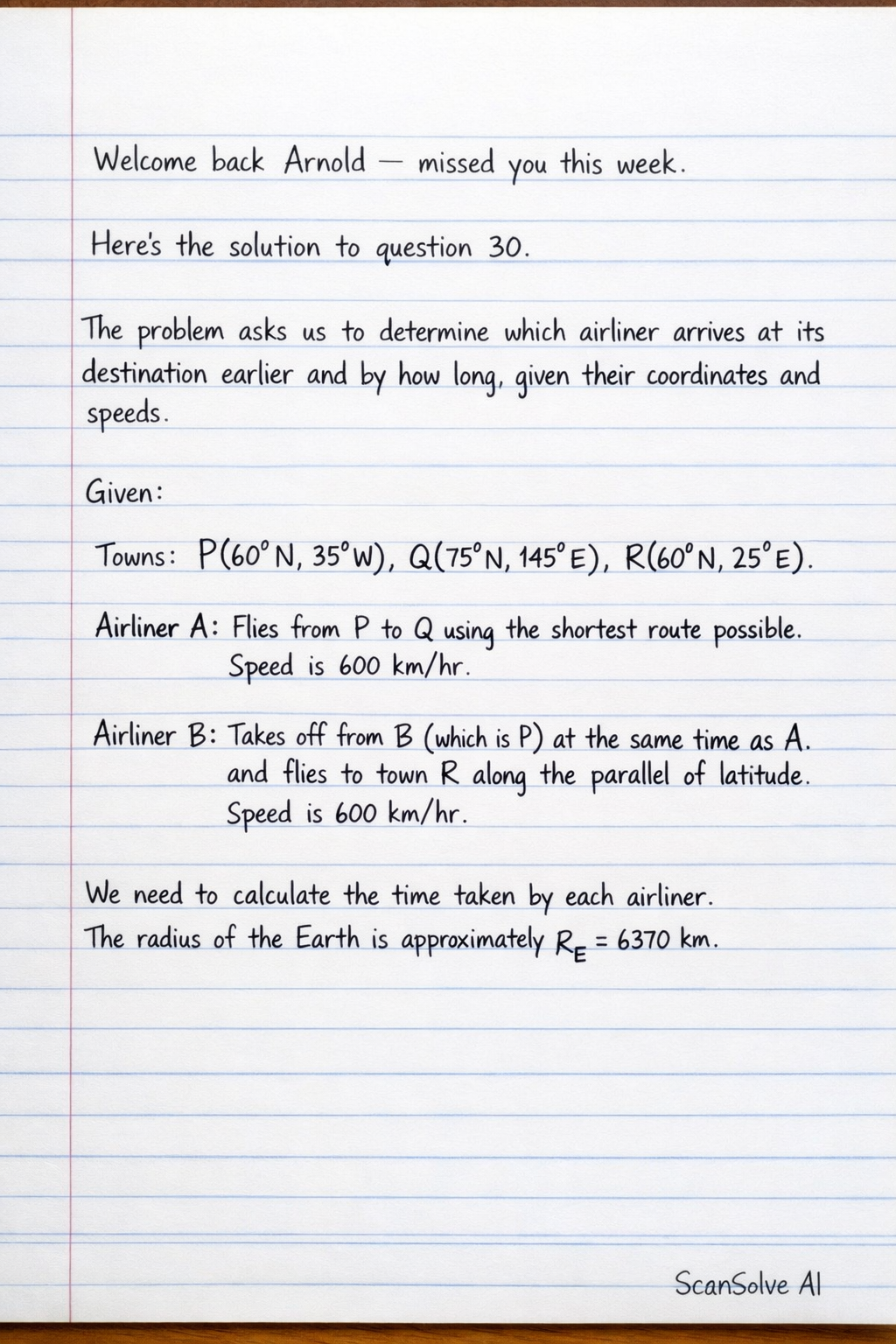
Welcome back Arnold — missed you this week.
Here's the solution to question 30.
The problem asks us to determine which airliner arrives at its destination earlier and by how long, given their coordinates and speeds.
Given:
Towns: P(60∘N,35∘W), Q(75∘N,145∘E), R(60∘N,25∘E).
Airliner A: Flies from P to Q using the shortest route possible. Speed is 600km/hr.
Airliner B: Takes off from B (which is P) at the same time as A and flies to town R along the parallel of latitude. Speed is 600km/hr.
We need to calculate the time taken by each airliner. The radius of the Earth is approximately RE=6370km.
Step 1: Calculate the distance for Airliner A (shortest route).
The shortest route between two points on Earth is along a great circle. The angle θ between two points (L1,λ1) and (L2,λ2) on a great circle is given by:
cosθ=sinL1sinL2+cosL1cosL2cos(λ2−λ1)
For Airliner A, P(60∘N,35∘W) and Q(75∘N,145∘E).
L1=60∘, L2=75∘.
λ1=−35∘ (West), λ2=145∘ (East).
The difference in longitude is Δλ=λ2−λ1=145∘−(−35∘)=145∘+35∘=180∘.
cosθ=sin60∘sin75∘+cos60∘cos75∘cos180∘cosθ=(23)(46+2)+(21)(46−2)(−1)cosθ=818+6−86−2cosθ=832+6−6+2=842=22
So, θ=arccos(22)=45∘.
Convert θ to radians: θ=45∘×180∘π=4π radians.
The distance DA=REθ.
DA=6370km×4πDA≈6370×0.785398≈5002.8km
Time taken by Airliner A: TA=SpeedDA.
TA=600km/hr5002.8km≈8.338hours
Step 2: Calculate the distance for Airliner B (along the parallel of latitude).
Airliner B flies from P(60∘N,35∘W) to R(60∘N,25∘E) along the parallel of latitude 60∘N.
The distance along a parallel of latitude is given by D=REcosLΔλ, where Δλ is the difference in longitude in radians.
Here, L=60∘.
λP=35∘W, λR=25∘E.
The difference in longitude Δλ=35∘+25∘=60∘.
Convert Δλ to radians: Δλ=60∘×180∘π=3π radians.
DB=6370km×cos60∘×3πDB=6370km×21×3πDB=66370π≈3337.8km
Time taken by Airliner B: TB=SpeedDB.
TB=600km/hr3337.8km≈5.563hours
Step 3: Compare arrival times.
TA≈8.338hoursTB≈5.563hours
Airliner B arrives earlier.
Step 4: Calculate the difference in arrival time in minutes.
Difference in time =TA−TB=8.338−5.563=2.775hours.
Convert to minutes: 2.775hours×60minutes/hour=166.5minutes.
Rounding to the nearest minute, the difference is 167minutes.
Airliner B arrives earlier by approximately 167 minutes.
The final answer is AirlinerBarrivesearlierby167minutes.
Send me the next one 📸
Was this helpful?
Need help with your own homework?
Get instant step-by-step solutions to any question. Free to start.
Welcome back Arnold — missed you this week. Here's the solution to question 30.
Two airliners, A and B, fly from point P to points Q and R respectively. Given their coordinates and speed, determine which airliner arrives earlier and by how much.
This mathematics problem involves applying core mathematical principles and formulas. Below you will find a complete step-by-step solution with detailed explanations for each step, helping you understand not just the answer but the method behind it.
ScanSolve AI Answer
Welcome back Arnold — missed you this week. Here's the solution to question 30. The problem asks us to determine which airliner arrives at its destination earlier and by how long, given their coordinates and speeds. Given: Towns: P(60^ N, 35^ W), Q(75^ N, 145^ E), R(60^ N, 25^ E). Airliner A: Flies from P to Q using the shortest route possible. Speed is 600 \, km/hr. Airliner B: Takes off from B (which is P) at the same time as A and flies to town R along the parallel of latitude. Speed is 600 \, km/hr. We need to calculate the time taken by each airliner. The radius of the Earth is approximately R_E = 6370 \, km. Step 1: Calculate the distance for Airliner A (shortest route). The shortest route between two points on Earth is along a great circle. The angle between two points (L_1, _1) and (L_2, _2) on a great circle is given by: = L_1 L_2 + L_1 L_2 (_2 - _1) For Airliner A, P(60^ N, 35^ W) and Q(75^ N, 145^ E). L_1 = 60^, L_2 = 75^. _1 = -35^ (West), _2 = 145^ (East). The difference in longitude is = _2 - _1 = 145^ - (-35^) = 145^ + 35^ = 180^. = 60^ 75^ + 60^ 75^ 180^ = (sqrt(3)2) (sqrt(6)+sqrt(2)4) + ((1)/(2)) (sqrt(6)-sqrt(2)4) (-1) = sqrt(18)+sqrt(6)8 - sqrt(6)-sqrt(2)8 = 3sqrt(2)+sqrt(6)-sqrt(6)+sqrt(2)8 = 4sqrt(2)8 = sqrt(2)2 So, = (sqrt(2)2) = 45^. Convert to radians: = 45^ × ()/(180^) = ()/(4) radians. The distance D_A = R_E . D_A = 6370 \, km × ()/(4) D_A ≈ 6370 × 0.785398 ≈ 5002.8 \, km Time taken by Airliner A: T_A = (D_A)/(Speed). T_A = 5002.8 \, km600 \, km/hr ≈ 8.338 \, hours Step 2: Calculate the distance for Airliner B (along the parallel of latitude). Airliner B flies from P(60^ N, 35^ W) to R(60^ N, 25^ E) along the parallel of latitude 60^ N. The distance along a parallel of latitude is given by D = R_E L , where is the difference in longitude in radians. Here, L = 60^. _P = 35^ W, _R = 25^ E. The difference in longitude = 35^ + 25^ = 60^. Convert to radians: = 60^ × ()/(180^) = ()/(3) radians. D_B = 6370 \, km × 60^ × ()/(3) D_B = 6370 \, km × (1)/(2) × ()/(3) D_B = (6370 )/(6) ≈ 3337.8 \, km Time taken by Airliner B: T_B = (D_B)/(Speed). T_B = 3337.8 \, km600 \, km/hr ≈ 5.563 \, hours Step 3: Compare arrival times. T_A ≈ 8.338 \, hours T_B ≈ 5.563 \, hours Airliner B arrives earlier. Step 4: Calculate the difference in arrival time in minutes. Difference in time = T_A - T_B = 8.338 - 5.563 = 2.775 \, hours. Convert to minutes: 2.775 \, hours × 60 \, minutes/hour = 166.5 \, minutes. Rounding to the nearest minute, the difference is 167 \, minutes. Airliner B arrives earlier by approximately 167 minutes. The final answer is Airliner B arrives earlier by 167 minutes. Send me the next one 📸