

This mathematics problem involves applying core mathematical principles and formulas. Below you will find a complete step-by-step solution with detailed explanations for each step, helping you understand not just the answer but the method behind it.
ScanSolve AI Answer
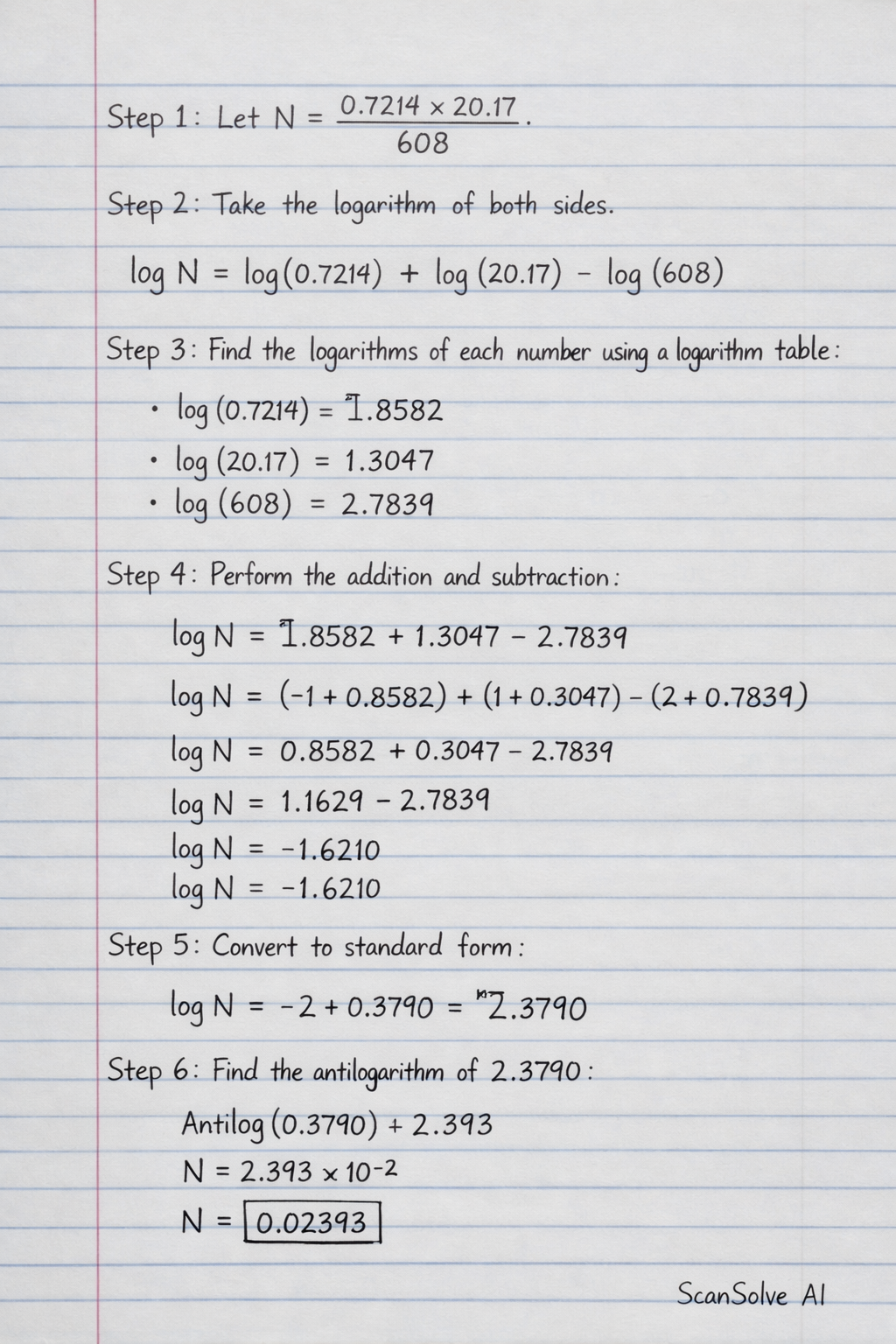
Here are the solutions to the questions from the image: 11. Use logarithms table to evaluate (0.7214 × 20.17)/(608). Step 1: Let N = (0.7214 × 20.17)/(608). Step 2: Take the logarithm of both sides. N = (0.7214) + (20.17) - (608) Step 3: Find the logarithms of each number using a logarithm table. (0.7214) = 1.8582 (20.17) = 1.3047 (608) = 2.7839 Step 4: Perform the addition and subtraction. N = 1.8582 + 1.3047 - 2.7839 N = (-1 + 0.8582) + (1 + 0.3047) - (2 + 0.7839) N = 0.8582 + 0.3047 - 2.7839 N = 1.1629 - 2.7839 N = -1.6210 Step 5: Convert the negative logarithm to the standard form with a negative characteristic and positive mantissa. N = -2 + 0.3790 = 2.3790 Step 6: Find the antilogarithm of 2.3790. Antilog(0.3790) ≈ 2.393 N = 2.393 × 10^-2 N = 0.02393 12. During an agricultural project, every learner was to make a seedbed from a square piece of land measuring 3m by 3m leaving a uniform path of x cm all round. Original side length of the square land = 3 m = 300 cm. Path width = x cm all around. a) Express the length and the width of the seedbed in terms of x. The path reduces the length and width from both sides. So, the total reduction is 2x. Length of seedbed = Original length - 2 × path width Length = (300 - 2x) cm Width of seedbed = Original width - 2 × path width Width = (300 - 2x) cm b) Express the area of the seedbed in terms of x. The seedbed is also square, with side length (300 - 2x) cm. Area of seedbed = Length × Width Area = (300 - 2x) × (300 - 2x) Area = (300 - 2x)^2 cm^2 13. Cherono's kitchen is in the shape of a square. Determine the area of the kitchen garden if each side measures (2y + 11) using quadratic identities. Step 1: The side length of the square kitchen garden is (2y + 11). Step 2: The area of a square is (side)^2. Area = (2y + 11)^2 Step 3: Use the quadratic identity (a+b)^2 = a^2 + 2ab + b^2. Here, a = 2y and b = 11. Area = (2y)^2 + 2(2y)(11) + (11)^2 Area = 4y^2 + 44y + 121 The area of the kitchen garden is 4y^2 + 44y + 121 square units. 14. The sides of a rectangular field is 104 m and 297 m wide. Using the quadratic identity (a+b)(a-b) = a^2 - b^2 to determine the area of the rectangular field. Step 1: The sides of the rectangular field are 297 m and 104 m. The area is 297 × 104. Step 2: To use the identity (a+b)(a-b) = a^2 - b^2, we need to find a and b such that a+b = 297 and a-b = 104. Adding the two equations: (a+b) + (a-b) = 297 + 104 2a = 401 a = (401)/(2) = 200.5 Subtracting the second equation from the first: (a+b) - (a-b) = 297 - 104 2b = 193 b = (193)/(2) = 96.5 Step 3: Substitute a and b into the identity. Area = (200.5 + 96.5)(200.5 - 96.5) Area = (200.5)^2 - (96.5)^2 Step 4: Calculate the squares. (200.5)^2 = 40200.25 (96.5)^2 = 9312.25 Step 5: Subtract the values to find the area. Area = 40200.25 - 9312.25 Area = 30888 m^2 15. Solve: 5^x+2 = 125^x-1 Step 1: Express both sides of the equation with the same base. We know that 125 = 5^3. 5^x+2