
We read your photo as:
Find the value of the following limits: 5. lim (x->2) [1/(x(x-2)2) - 1/(x2-3x+2)]; 6. lim (x->1) [1/(1-x) - 3/(1-x3)]
Mathematics
ScanSolve AI Answer
Step-by-step solution
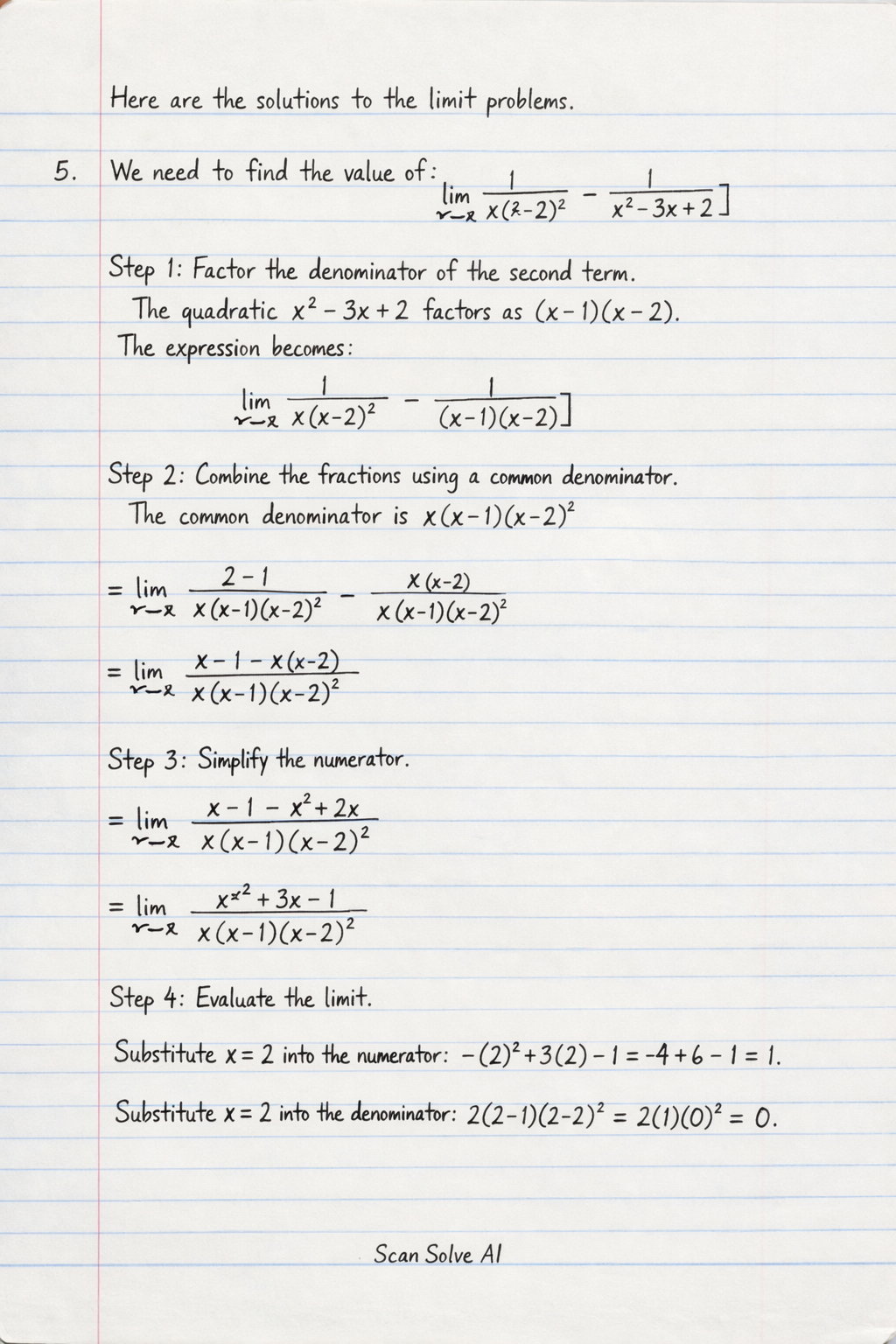
14 stepsHere are the solutions to the limit problems.
- We need to find the value of:
Factor the denominator of the second term.
The quadratic $x^2-3x+2$ factors as $(x-1)(x-2)$. The expression becomes: $$ \lim_{x \to 2} \left[ \frac{1}{x(x-2)^2} - \frac{1}{(x-1)(x-2)} \right] $$Combine the fractions using a common denominator.
The common denominator is $x(x-1)(x-2)^2$. $$ = \lim_{x \to 2} \left[ \frac{(x-1)}{x(x-1)(x-2)^2} - \frac{x(x-2)}{x(x-1)(x-2)^2} \right] $$ $$ = \lim_{x \to 2} \frac{(x-1) - x(x-2)}{x(x-1)(x-2)^2} $$Simplify the numerator.
$$ = \lim_{x \to 2} \frac{x-1 - x^2 + 2x}{x(x-1)(x-2)^2} $$ $$ = \lim_{x \to 2} \frac{-x^2 + 3x - 1}{x(x-1)(x-2)^2} $$Evaluate the limit.
Substitute $x=2$ into the numerator: $-(2)^2 + 3(2) - 1 = -4 + 6 - 1 = 1$. Substitute $x=2$ into the denominator: $2(2-1)(2-2)^2 = 2(1)(0)^2 = 0$. Since the numerator approaches 1 and the denominator approaches 0 from the positive side (because $(x-2)^2$ is always positive, and $x(x-1)$ is positive near $x=2$), the limit is $\frac{1}{0^+}$. The value of the limit is $\boxed{\infty}$.6. We need to find the value of:
Factor the denominator of the second term.
The difference of cubes formula is $a^3-b^3 = (a-b)(a^2+ab+b^2)$. So, $1-x^3 = (1-x)(1+x+x^2)$. The expression becomes: $$ \lim_{x \to 1} \left( \frac{1}{1-x} - \frac{3}{(1-x)(1+x+x^2)} \right) $$Combine the fractions using a common denominator.
The common denominator is $(1-x)(1+x+x^2)$. $$ = \lim_{x \to 1} \frac{(1+x+x^2) - 3}{(1-x)(1+x+x^2)} $$Simplify the numerator.
$$ = \lim_{x \to 1} \frac{x^2 + x - 2}{(1-x)(1+x+x^2)} $$Factor the numerator and simplify.
The numerator $x^2+x-2$ factors as $(x+2)(x-1)$. Also, note that $(1-x) = -(x-1)$. $$ = \lim_{x \to 1} \frac{(x+2)(x-1)}{-(x-1)(1+x+x^2)} $$ Cancel out the common factor $(x-1)$ (since $x \ne 1$ as $x \to 1$): $$ = \lim_{x \to 1} \frac{x+2}{-(1+x+x^2)} $$Evaluate the limit by substituting .
$$ = \frac{1+2}{-(1+1+1^2)} = \frac{3}{-(1+1+1)} = \frac{3}{-3} = -1 $$ The value of the limit is $\boxed{-1}$.7. We need to find the value of:
Check for indeterminate form.
Substitute $x=\sqrt{2}$ into the numerator: $(\sqrt{2})^4 - 4 = 4 - 4 = 0$. Substitute $x=\sqrt{2}$ into the denominator: $(\sqrt{2})^2 + 3\sqrt{2}(\sqrt{2}) - 8 = 2 + 3(2) - 8 = 2 + 6 - 8 = 0$. This is an indeterminate form $\frac{0}{0}$, so we need to factor.Factor the numerator.
The numerator is a difference of squares: $x^4 - 4 = (x^2)^2 - 2^2 = (x^2 - 2)(x^2 + 2)$. Further factor $x^2 - 2 = (x - \sqrt{2})(x + \sqrt{2})$. So, $x^4 - 4 = (x - \sqrt{2})(x + \sqrt{2})(x^2 + 2)$.Factor the denominator.
Since substituting $x=\sqrt{2}$ into the denominator yields 0, $(x-\sqrt{2})$ must be a factor. We can find the other factor by polynomial division or by inspection: $x^2 + 3\sqrt{2}x - 8 = (x - \sqrt{2})(x + 4\sqrt{2})$.Substitute the factored forms into the limit expression.
$$ = \lim_{x \to \sqrt{2}} \frac{(x - \sqrt{2})(x + \sqrt{2})(x^2 + 2)}{(x - \sqrt{2})(x + 4\sqrt{2})} $$Cancel the common factor and evaluate the limit.
Cancel out $(x - \sqrt{2})$ (since $x \ne \sqrt{2}$ as $x \to \sqrt{2}$):
$$
= \lim_{x \to \sqrt{2}} \frac{(x + \sqrt{2})(x^2 + 2)}{x + 4\sqrt{2}}
$$
Now substitute $x=\sqrt{2}$:
$$
= \frac{(\sqrt{2} + \sqrt{2})((\sqrt{2})^2 + 2)}{\sqrt{2} + 4\sqrt{2}}
$$
$$
= \frac{(2\sqrt{2})(2 + 2)}{5\sqrt{2}}
$$
$$
= \frac{(2\sqrt{2})(4)}{5\sqrt{2}}
$$
$$
= \frac{8\sqrt{2}}{5\sqrt{2}} = \frac{8}{5}
$$
The value of the limit is $\boxed{\frac{8}{5}}$.
Was this helpful?
Still stuck on this one?
Ask a follow-up, and the answer starts from this question.
Got a different question?Ask your own question
More Mathematics Questions
QFind the values of the following limits: 1) Lim (3-x)/(2+x) as x->2, 2) Lim (x2-9)/(x−3) as x->3, 3)…QEvaluate the following limits: 1. lim x->1 (x−1)/(x−1) 2. lim x->1 (x2-1)/(x2-1) 3. lim x->3…QEvaluate the following limits: 9. lim x->0 x2 cos(1/x) 10. lim x->−2 |x+2|/(x+2)QEvaluate the following limits: (a) lim(5x+1) as x->2, (b) lim(2x²+6x−2) as x->1, (c)…QEvaluate the limit of each of the following: (i) limx->2 (3-x)/(x+2) (ii) limx->1 (5-x)/(x+3) (iii)…
Browse by topic:Calculus
Handwritten Step-by-Step Solution
Get this as a handwritten image on WhatsApp — like a tutor wrote it for you.
Try on WhatsApp