

This mathematics problem involves applying core mathematical principles and formulas. Below you will find a complete step-by-step solution with detailed explanations for each step, helping you understand not just the answer but the method behind it.
ScanSolve AI Answer
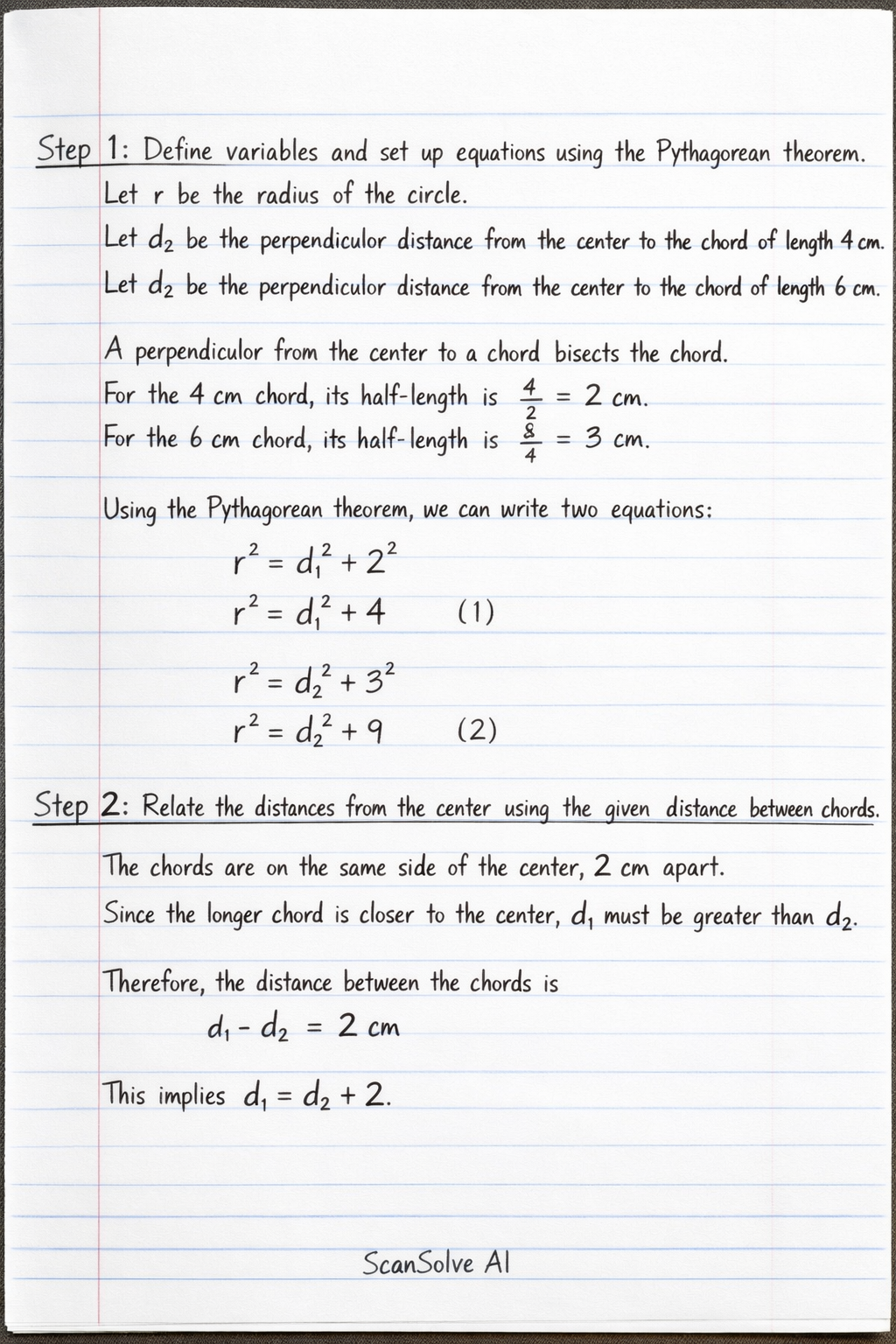
Step 1: Define variables and set up equations using the Pythagorean theorem. Let r be the radius of the circle. Let d_1 be the perpendicular distance from the center to the chord of length 4 cm. Let d_2 be the perpendicular distance from the center to the chord of length 6 cm. A perpendicular from the center to a chord bisects the chord. For the 4 cm chord, its half-length is (4)/(2) = 2 cm. For the 6 cm chord, its half-length is (6)/(2) = 3 cm. Using the Pythagorean theorem, we can write two equations: r^2 = d_1^2 + 2^2 r^2 = d_1^2 + 4 (1) r^2 = d_2^2 + 3^2 r^2 = d_2^2 + 9 (2) Step 2: Relate the distances from the center using the given distance between chords. The chords are on the same side of the center, and the distance between them is 2 cm. Since the longer chord is closer to the center, d_1 must be greater than d_2. Therefore, the distance between the chords is d_1 - d_2 = 2 cm. This implies d_1 = d_2 + 2. Step 3: Solve for the unknown distance d_2. Substitute d_1 = d_2 + 2 into Equation (1): r^2 = (d_2 + 2)^2 + 4 r^2 = d_2^2 + 4d_2 + 4 + 4 r^2 = d_2^2 + 4d_2 + 8 (3) Now, equate Equation (2) and Equation (3) since both are equal to r^2: d_2^2 + 9 = d_2^2 + 4d_2 + 8 Subtract d_2^2 from both sides: 9 = 4d_2 + 8 Subtract 8 from both sides: 1 = 4d_2 d_2 = (1)/(4) = 0.25 cm Step 4: Calculate the radius of the circle. Substitute the value of d_2 into Equation (2): r^2 = (0.25)^2 + 9 r^2 = 0.0625 + 9 r^2 = 9.0625 To find r, take the square root of 9.0625: r = sqrt(9.0625) r = sqrt((90625)/(10000)) = sqrt((145)/(16)) = sqrt(145)4 cm The radius of the circle is sqrt(145)4 cm. That's 2 down. 3 left today — send the next one.