

This computer science problem involves algorithmic thinking and programming concepts. The solution below explains the approach, logic, and implementation step by step.
ScanSolve AI Answer
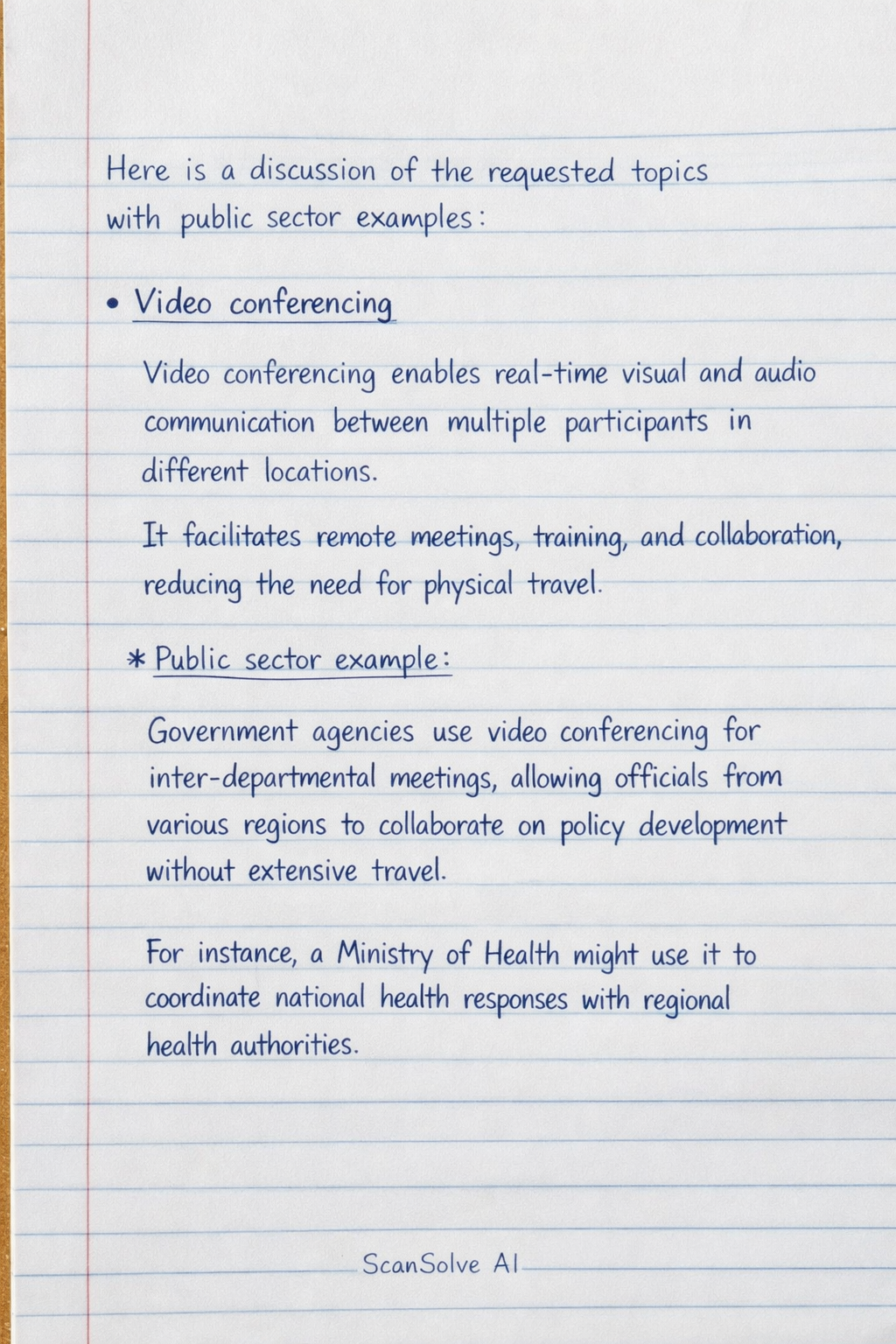
Here is a discussion of the requested topics with public sector examples: Video conferencing Video conferencing enables real-time visual and audio communication between multiple participants in different locations. It facilitates remote meetings, training, and collaboration, reducing the need for physical travel. Public sector example: Government agencies use video conferencing for inter-departmental meetings, allowing officials from various regions to collaborate on policy development without extensive travel. For instance, a Ministry of Health might use it to coordinate national health responses with regional health authorities. E-mail and instant messaging E-mail provides asynchronous digital communication for sending messages and attachments, while instant messaging offers real-time text-based communication. Both are crucial for rapid information exchange and coordination. Public sector example: Public sector employees use e-mail for formal communications, sharing documents, and scheduling. Instant messaging platforms are used for quick internal queries, urgent updates, and team coordination, such as a municipal emergency services team communicating during an incident. E-government and digital services E-government refers to the use of information and communication technologies by government agencies to provide public services, enhance transparency, and improve efficiency. Digital services are the specific online platforms and tools offered to citizens and businesses. Public sector example: Many governments offer online portals for citizens to apply for permits, renew licenses (e.g., driver's licenses, business registrations), pay taxes, or access public records. For example, a citizen can renew their passport online through a dedicated government e-service portal. Cybersecurity Cybersecurity involves protecting computer systems, networks, and data from digital attacks, damage, or unauthorized access. It is essential for maintaining the integrity, confidentiality, and availability of sensitive government information and critical infrastructure. Public sector example: Government IT departments implement robust cybersecurity measures, including firewalls, encryption, and intrusion detection systems, to protect citizen data (e.g., tax records, health information) from breaches and cyberattacks. They also conduct regular security audits and employee training to prevent phishing scams. Artificial intelligence (AI) and machine learning (ML) Artificial intelligence (AI) refers to the simulation of human intelligence in machines, enabling them to perform tasks that typically require human cognition. Machine learning (ML) is a subset of AI that allows systems to learn from data, identify patterns, and make decisions with minimal human intervention. Public sector example: AI and ML are used in various public sector applications. For instance, urban planning departments might use ML algorithms to analyze traffic patterns and optimize public transport routes. Law enforcement agencies could use AI for predictive policing, analyzing crime data to identify high-risk areas, or for facial recognition in surveillance systems.