
We read your photo as:
How do you evaluate the limit of the numerator as x approaches infinity in the given expression?
Mathematics
ScanSolve AI Answer
Answer
You're asking about the part where we evaluate the limit of the numerator as .
Let's break down that step:
Step 1: Understanding the limit evaluation.
We had the expression for as:
When we take the limit as , we consider what happens to each term involving :
- For any constant , .
- For any constant , .
Applying this to our expression:
- (in the first square root)
- (in the second square root)
So, when we substitute these limit values into the expression for :
This is how we arrive at the value of 1 for the limit of the numerator.
Was this helpful?
Still stuck on this one?
Ask a follow-up, and the answer starts from this question.
Got a different question?Ask your own question
More Mathematics Questions
QEvaluate the limit: _x infinity (1 − (2)/(x))^xQEvaluate the limit of the numerator.QCheck the form of the limit. As x infinity, both the numerator (x² − x) and the denominator (x³…QEvaluate the exponent of the exponential function as x approaches -infinity.QEvaluate the following limits: x infinity ( x)/(sqrt(x)) and x 0 ( x)/(x)
Browse by topic:Calculus
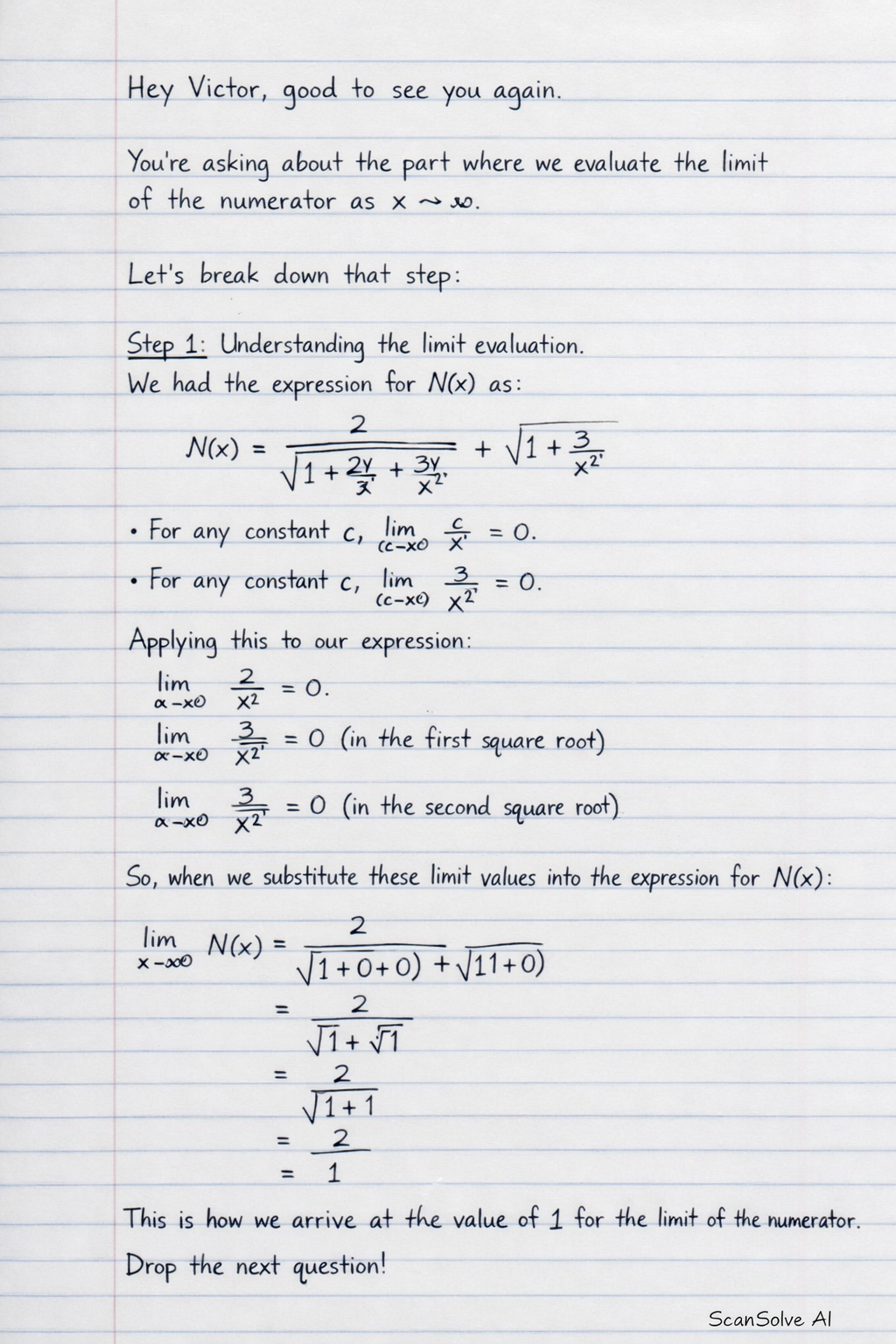
Handwritten Step-by-Step Solution
Get this as a handwritten image on WhatsApp — like a tutor wrote it for you.
Try on WhatsApp