
We read your photo as:
1 Le Chatelier's principle states that if a change in conditions (such as temperature, pressure, or concentration of reactants) is applied to a system at equilibrium, the system will shift in a
ScanSolve AI Answer
Answer
Step-by-step solution
6 stepsHere are the solutions to the questions:
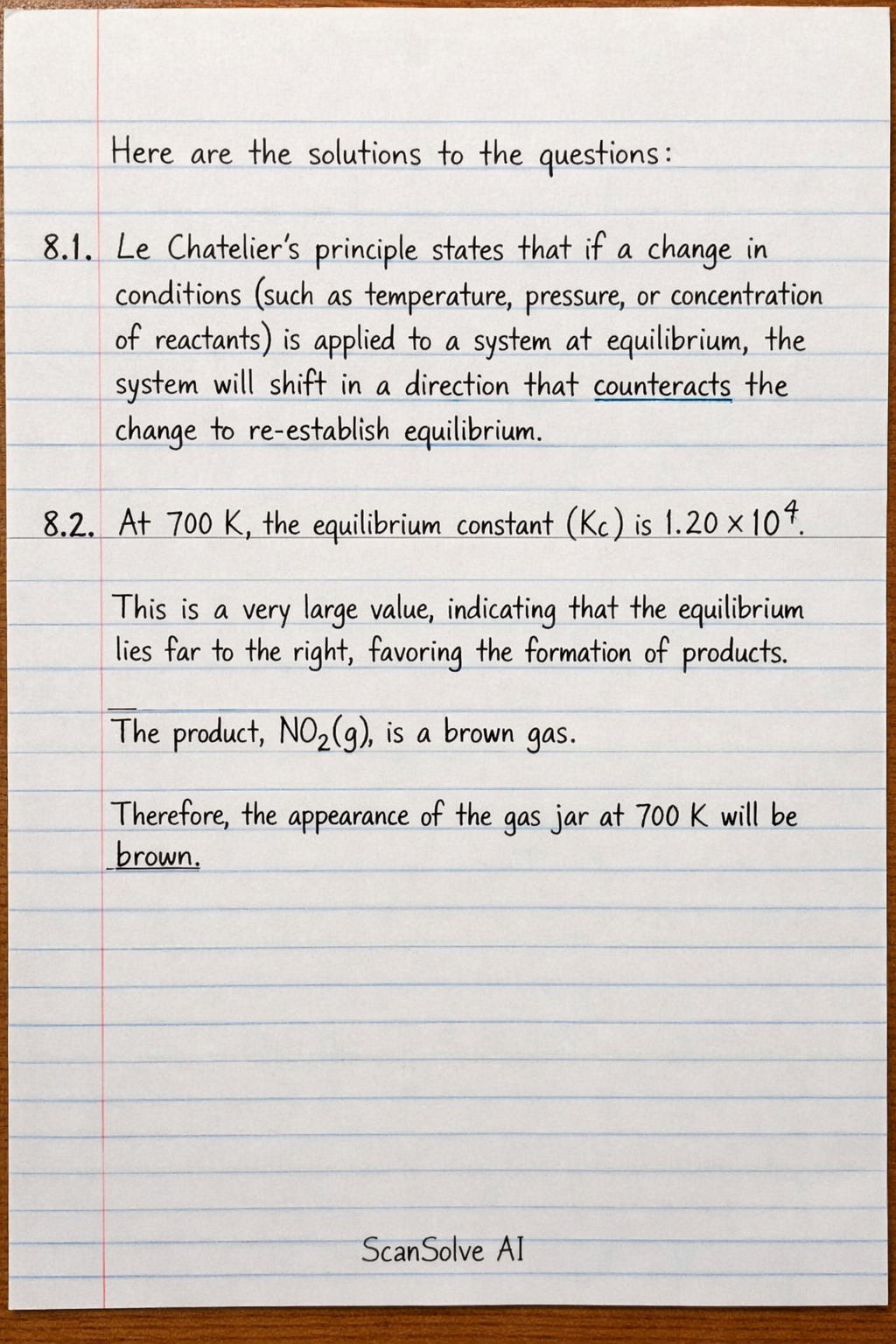
8.1 Le Chatelier's principle states that if a change in conditions (such as temperature, pressure, or concentration of reactants) is applied to a system at equilibrium, the system will shift in a direction that counteracts the change to re-establish equilibrium.
8.2 At 700 K, the equilibrium constant () is . This is a very large value, indicating that the equilibrium lies far to the right, favoring the formation of products. The product, , is a brown gas. Therefore, the appearance of the gas jar at 700 K will be brown.
Part 8.3
To determine if the reaction is exothermic or endothermic, we observe the trend of with temperature from the table
- As the temperature increases from 300 K to 700 K, the value of significantly increases (from to ).
- An increase in with increasing temperature means that the equilibrium shifts to favor the products (right side of the reaction).
- According to Le Chatelier's principle, if increasing the temperature shifts the equilibrium to the product side, the forward reaction must be endothermic (absorbs heat). This is because the system tries to absorb the added heat by favoring the endothermic direction.
Part 8.4
Two ways, other than temperature change, that can increase the rate of the forward reaction at 500 K are
- Increasing the concentration of the reactant, .
- Adding a suitable catalyst.
Part 8.5
The reaction is:
Calculate the initial moles of .
The molar mass of is .
Initial moles of .Calculate the moles of that decomposed.
of decomposed.
Moles decomposed .Set up an ICE (Initial, Change, Equilibrium) table for moles.
Species (mol) (mol) Initial 0.920 0 Change Equil. 0.38088 Calculate the equilibrium concentrations.
The volume of the container is .
.
.Calculate the equilibrium constant, .
Determine the temperature T from the table.
The calculated is approximately .
From the table, a value of corresponds to a temperature of .
Therefore, the temperature T at which the reaction took place is .
Part 8.6
The effect of adding more on the value of the equilibrium constant, , is that it *REMAINS THE SAME
Reason: The equilibrium constant () is a constant value for a specific reaction at a given temperature. It does not change with changes in the concentration of reactants or products. Adding more will cause the equilibrium to shift to the right to consume the added reactant, but the ratio of products to reactants at equilibrium (i.e., ) will remain unchanged as long as the temperature is constant.
Try one yourself
A new problem that tests the same skill.
Still stuck on this one?
Ask a follow-up, and the answer starts from this question.
More Physics Questions
Handwritten Step-by-Step Solution
Get this as a handwritten image on WhatsApp — like a tutor wrote it for you.
Try on WhatsApp