

This physics problem tests your understanding of fundamental physical laws and their applications. The step-by-step solution below breaks down the problem using relevant equations and physical reasoning.
ScanSolve AI Answer
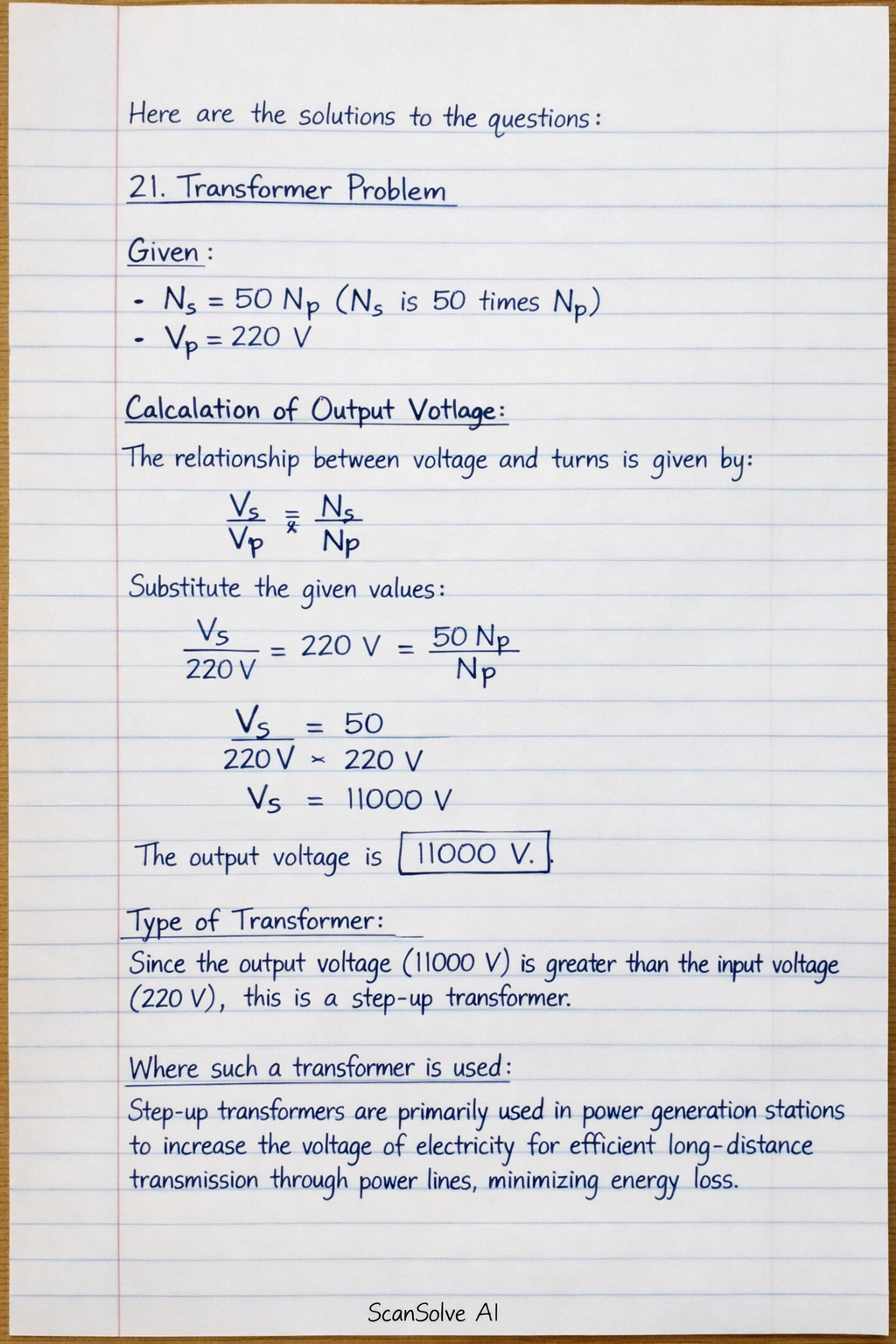
Here are the solutions to the questions: 21. Transformer Problem Given: Number of turns in secondary coil (N_s) = 50 times the number of turns in primary coil (N_p), so N_s = 50 N_p. Input voltage (V_p) = 220 V. Calculation of Output Voltage: The relationship between voltage and the number of turns in a transformer is given by: (V_s)/(V_p) = (N_s)/(N_p) Substitute the given values: (V_s)/(220 V) = (50 N_p)/(N_p) (V_s)/(220 V) = 50 V_s = 50 × 220 V V_s = 11000 V The output voltage is 11000 V. Type of Transformer: Since the output voltage (11000 V) is greater than the input voltage (220 V), this is a step-up transformer. Where such a transformer is used: Step-up transformers are primarily used in power generation stations to increase the voltage of electricity for efficient long-distance transmission through power lines, minimizing energy loss. 22. Ray Diagram (Dispersion of Light) a) Which process is shown in the given diagram? The process shown is the dispersion of light. This is when white light splits into its constituent colors upon passing through a prism. b) What is the colour of the rays A and B? In the spectrum formed by a prism, red light deviates the least, and violet light deviates the most. Ray A deviates less than Ray B. Therefore, Ray A is Red and Ray B is Violet. c) Which ray has more speed (A or B) in the glass medium? The speed of light in a medium is inversely proportional to the refractive index of the medium for that color. Red light (Ray A) has a lower refractive index in glass than violet light (Ray B). Therefore, Ray A (Red) has more speed in the glass medium. d) Ray B is bending more than Ray A. What is the reason for this? Ray B (violet light) bends more than Ray A (red light) because the refractive index of the glass medium is higher for violet light than for red light. Light with a higher refractive index travels slower and deviates more when passing from one medium to another. 23. Laboratory Preparation of Gas a) Which gas is being collected in gas jar? The reaction of ammonium chloride (NH_4Cl) with calcium hydroxide (Ca(OH)_2) is a common laboratory method for preparing ammonia gas (NH_3). The inverted gas jar indicates collection by downward displacement of air, which is suitable for a gas lighter than air like ammonia. The gas being collected is Ammonia (NH_3). b) What would happen if this gas is directly sent to gas jar without passing tower X? Tower X is a drying tower. Ammonia gas is highly soluble in water. If the gas is directly sent to the gas jar without passing through tower X, it would be moist or wet ammonia gas, as water vapor produced during the reaction or present in the apparatus would not be removed. c) Write the balanced chemical equation of the gas prepared in laboratory. The balanced chemical equation for the preparation of ammonia gas from ammonium chloride and calcium hydroxide is: 2NH_4Cl(s) + Ca(OH)_2(s) 2NH_3(g) + CaCl_2(s) + 2H_2O(l)