We read your photo as:

400g decayed to 50g in 24 days. Find the half-life t_(1)/(2).

Physics

ScanSolve AI Answer

Answers

3 parts
1

8 days8 \text{ days}

2

16 years16 \text{ years}

3

8192 g8192 \text{ g}

Step-by-step solution

18 steps

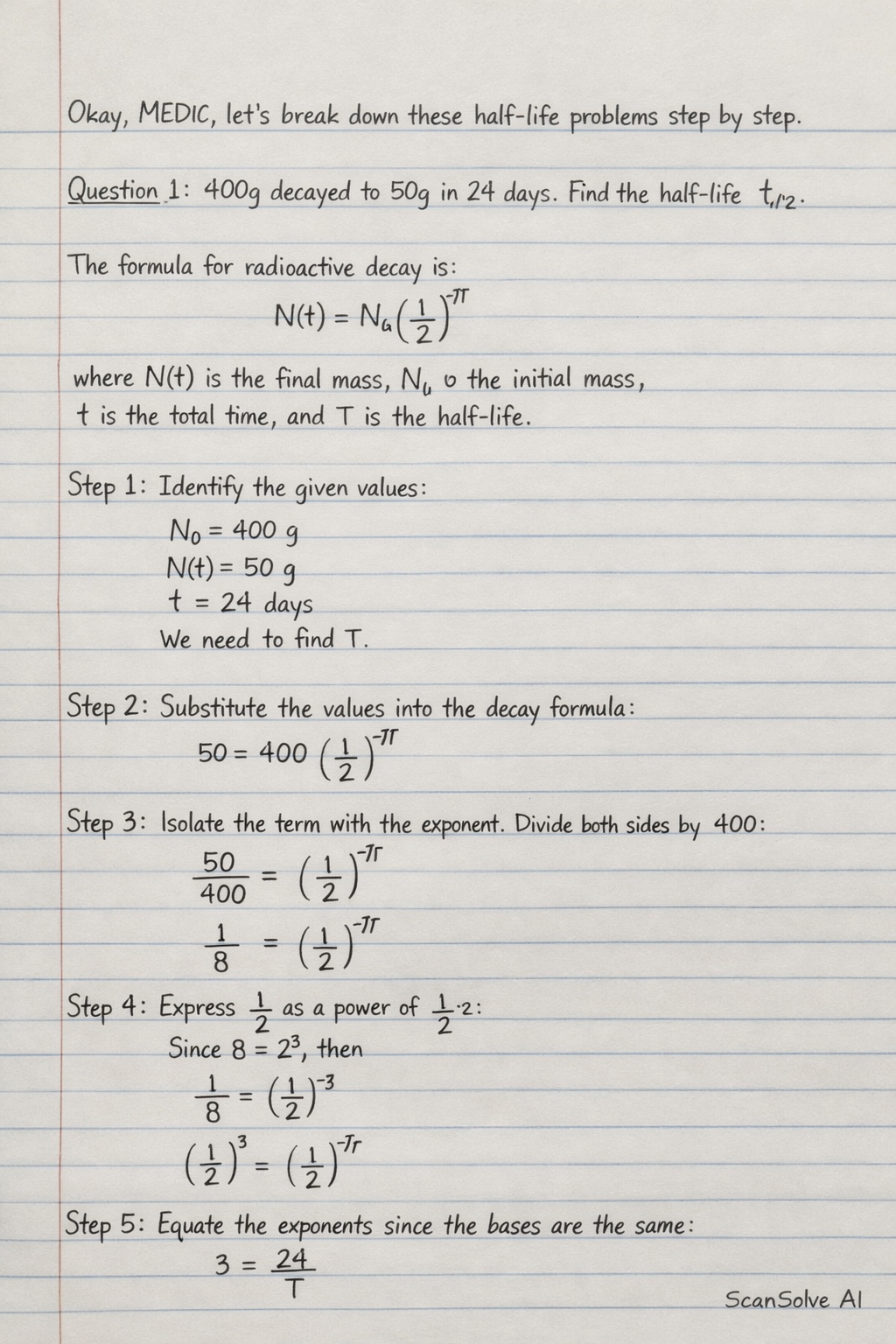
Okay, MEDIC, let's break down these half-life problems step by step.

Part 1· 6 steps

400g decayed to 50g in 24 days. Find the half-life t12t_{\frac{1}{2}}.

The formula for radioactive decay is:

N(t)=N0(12)tTN(t) = N_0 \left(\frac{1}{2}\right)^{\frac{t}{T}}

where N(t)N(t) is the final mass, N0N_0 is the initial mass, tt is the total time, and TT is the half-life.

  1. Identify the given values.

    N0=400 gN_0 = 400 \text{ g}
    N(t)=50 gN(t) = 50 \text{ g}
    t=24 dayst = 24 \text{ days}
    We need to find TT.

  2. Substitute the values into the decay formula.

    50=400(12)24T50 = 400 \left(\frac{1}{2}\right)^{\frac{24}{T}}
  3. Isolate the term with the exponent.

    Divide both sides by 400.

    50400=(12)24T\frac{50}{400} = \left(\frac{1}{2}\right)^{\frac{24}{T}} 18=(12)24T\frac{1}{8} = \left(\frac{1}{2}\right)^{\frac{24}{T}}
  4. Express 18\frac{1}{8} as a power of 12\frac{1}{2}.

    Since 8=238 = 2^3, then 18=(12)3\frac{1}{8} = \left(\frac{1}{2}\right)^3.

    (12)3=(12)24T\left(\frac{1}{2}\right)^3 = \left(\frac{1}{2}\right)^{\frac{24}{T}}
  5. Equate the exponents since the bases are the same.

    3=24T3 = \frac{24}{T}
  6. Solve for TT.

    T=243T = \frac{24}{3} T=8 daysT = 8 \text{ days}

    The half-life is 8 days\boxed{8 \text{ days}}.


Part 2

16 years16 \text{ years}

A substance has half-life = 4 years. Original mass = 256g. After how many years will only 16g be left? Find tt.

The formula for radioactive decay is:

N(t)=N0(12)tTN(t) = N_0 \left(\frac{1}{2}\right)^{\frac{t}{T}}
  1. Identify the given values.

    T=4 yearsT = 4 \text{ years}
    N0=256 gN_0 = 256 \text{ g}
    N(t)=16 gN(t) = 16 \text{ g}
    We need to find tt.

  2. Substitute the values into the decay formula.

    16=256(12)t416 = 256 \left(\frac{1}{2}\right)^{\frac{t}{4}}
  3. Isolate the term with the exponent.

    Divide both sides by 256.

    16256=(12)t4\frac{16}{256} = \left(\frac{1}{2}\right)^{\frac{t}{4}} 116=(12)t4\frac{1}{16} = \left(\frac{1}{2}\right)^{\frac{t}{4}}
  4. Express 116\frac{1}{16} as a power of 12\frac{1}{2}.

    Since 16=2416 = 2^4, then 116=(12)4\frac{1}{16} = \left(\frac{1}{2}\right)^4.

    (12)4=(12)t4\left(\frac{1}{2}\right)^4 = \left(\frac{1}{2}\right)^{\frac{t}{4}}
  5. Equate the exponents since the bases are the same.

    4=t44 = \frac{t}{4}
  6. Solve for tt.

    t=4×4t = 4 \times 4 t=16 yearst = 16 \text{ years}

    The time elapsed is 16 years\boxed{16 \text{ years}}.


Part 3

8192 g8192 \text{ g}

Half-life = 3 hours. 512g left after 12 hours. Find the Original mass N0N_0.

The formula for radioactive decay is:

N(t)=N0(12)tTN(t) = N_0 \left(\frac{1}{2}\right)^{\frac{t}{T}}
  1. Identify the given values.

    T=3 hoursT = 3 \text{ hours}
    N(t)=512 gN(t) = 512 \text{ g}
    t=12 hourst = 12 \text{ hours}
    We need to find N0N_0.

  2. Substitute the values into the decay formula.

    512=N0(12)123512 = N_0 \left(\frac{1}{2}\right)^{\frac{12}{3}}
  3. Simplify the exponent.

    512=N0(12)4512 = N_0 \left(\frac{1}{2}\right)^4
  4. Calculate the value of (12)4\left(\frac{1}{2}\right)^4.

    (12)4=1424=116\left(\frac{1}{2}\right)^4 = \frac{1^4}{2^4} = \frac{1}{16}
  5. Substitute this value back into the equation.

    512=N0×116512 = N_0 \times \frac{1}{16}
  6. Solve for N0N_0.

    Multiply both sides by 16.

    N0=512×16N_0 = 512 \times 16 N0=8192 gN_0 = 8192 \text{ g}

    The original mass was 8192 g\boxed{8192 \text{ g}}.

Was this helpful?

Try one yourself

A new problem that tests the same skill.

Still stuck on this one?

Ask a follow-up, and the answer starts from this question.

Got a different question?Ask your own question
Handwritten step-by-step solution preview

Handwritten Step-by-Step Solution

Get this as a handwritten image on WhatsApp — like a tutor wrote it for you.

Try on WhatsApp