

This physics problem tests your understanding of fundamental physical laws and their applications. The step-by-step solution below breaks down the problem using relevant equations and physical reasoning.
ScanSolve AI Answer
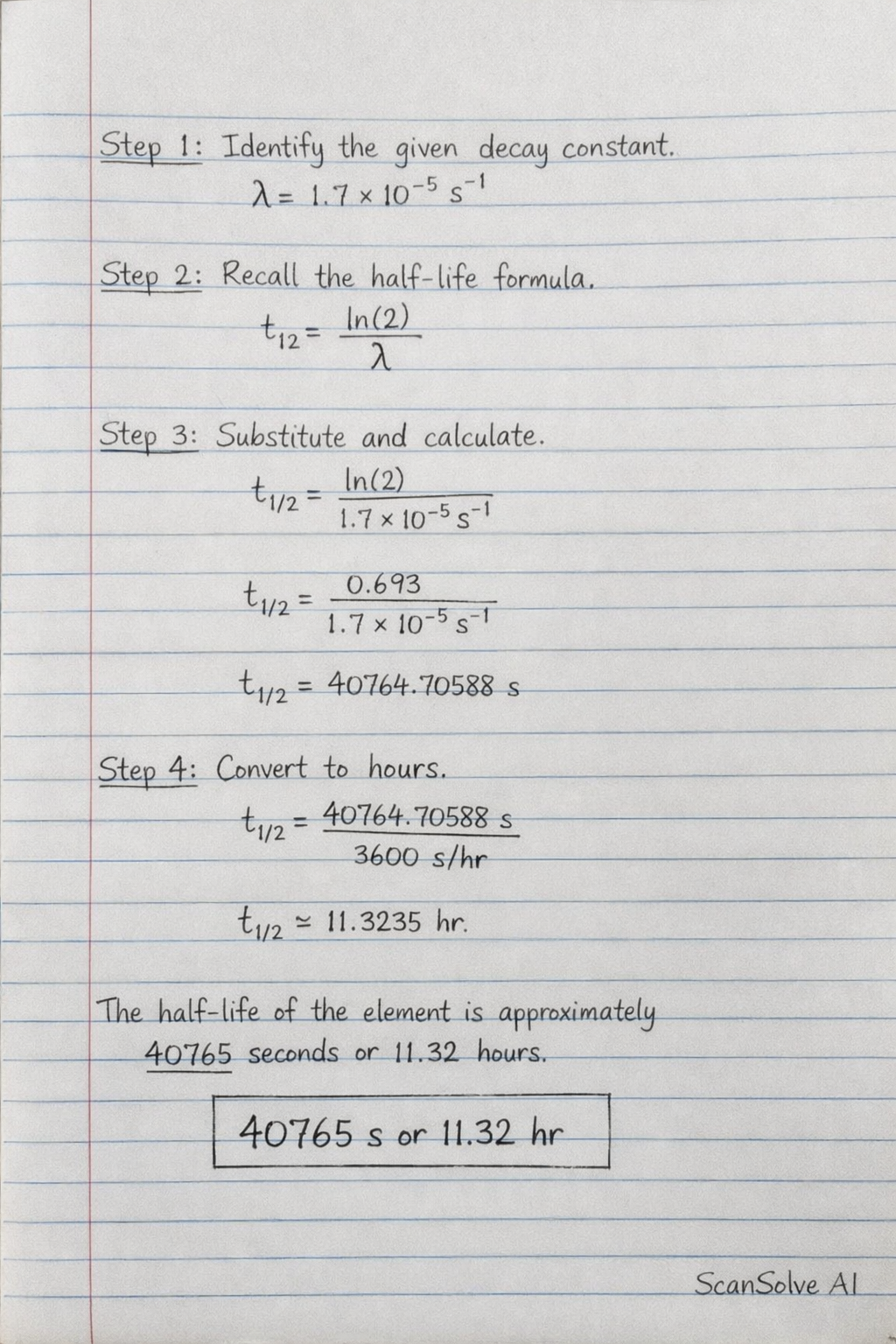
Step 1: Identify the given decay constant. The decay constant () for the element is given as 1.7 × 10^-5 s^-1. Step 2: Recall the formula for the half-life of a first-order reaction. For a first-order decay process, the half-life (t_1/2) is related to the decay constant () by the formula: t_1/2 = ((2))/() Step 3: Substitute the given value into the formula and calculate. t_1/2 = ((2))/(1.7 × 10^-5) s^-1 t_1/2 = (0.693)/(1.7 × 10^-5) s^-1 t_1/2 = 40764.70588 s Step 4: Convert the half-life to a more convenient unit (e.g., hours or days) if desired, or keep in seconds. Let's convert to hours for better readability. There are 3600 seconds in 1 hour. t_1/2 = 40764.70588 s3600 s/hr t_1/2 ≈ 11.3235 hr The half-life of the element is approximately 40765 seconds or 11.32 hours. 40765 s or 11.32 hr That's 2 down. 3 left today — send the next one.