
We read your photo as:
Complete the nuclear decay equation for beta-particle emission and determine the half-life from the graph.
ScanSolve AI Answer
Step-by-step solution
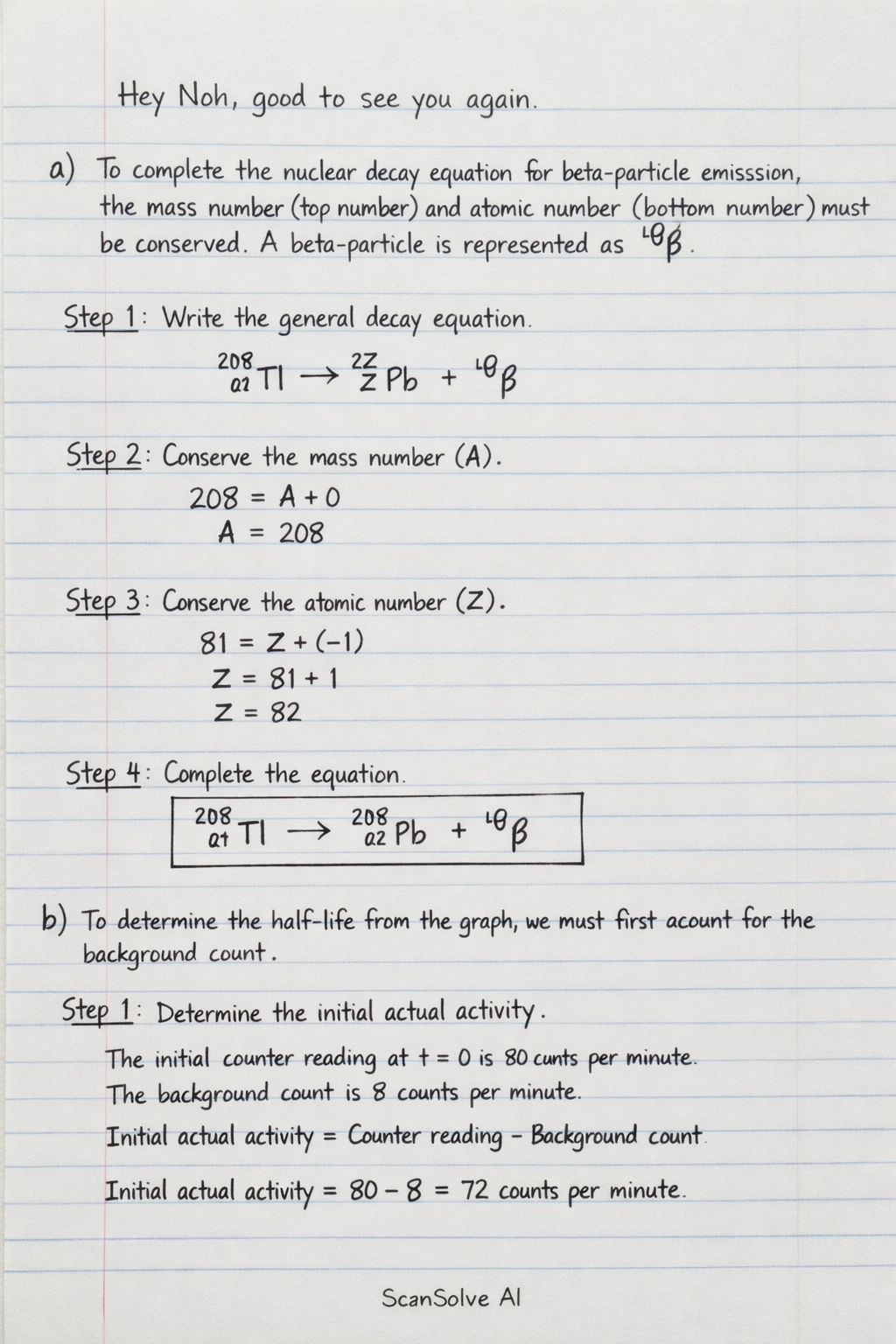
8 stepsa) To complete the nuclear decay equation for beta-particle emission, the mass number (top number) and atomic number (bottom number) must be conserved. A beta-particle is represented as .
Write the general decay equation.
Conserve the mass number ().
Conserve the atomic number ().
Complete the equation.
b) To determine the half-life from the graph, we must first account for the background count.
Determine the initial actual activity.
The initial counter reading at is 80 counts per minute.
The background count is 8 counts per minute.
Initial actual activity = Counter reading - Background countCalculate the actual activity after one half-life.
After one half-life, the actual activity will be half of the initial actual activity.
Determine the corresponding counter reading for this activity.
This is the value we will find on the y-axis of the graph.
Use the graph to find the half-life.
Locate 44 counts per minute on the y-axis.
Draw a horizontal line from 44 counts per minute to intersect the curve.
From the intersection point on the curve, draw a vertical line down to the x-axis.
Read the time value on the x-axis. This value is the half-life.
From the graph, a counter reading of 44 counts per minute corresponds to a time of approximately 3.3 minutes.The half-life of thallium-208 is .
Still stuck on this one?
Ask a follow-up, and the answer starts from this question.
More Physics Questions
Handwritten Step-by-Step Solution
Get this as a handwritten image on WhatsApp — like a tutor wrote it for you.
Try on WhatsApp