
How to calculate half life in chemistry
ScanSolve AI Answer
Answer
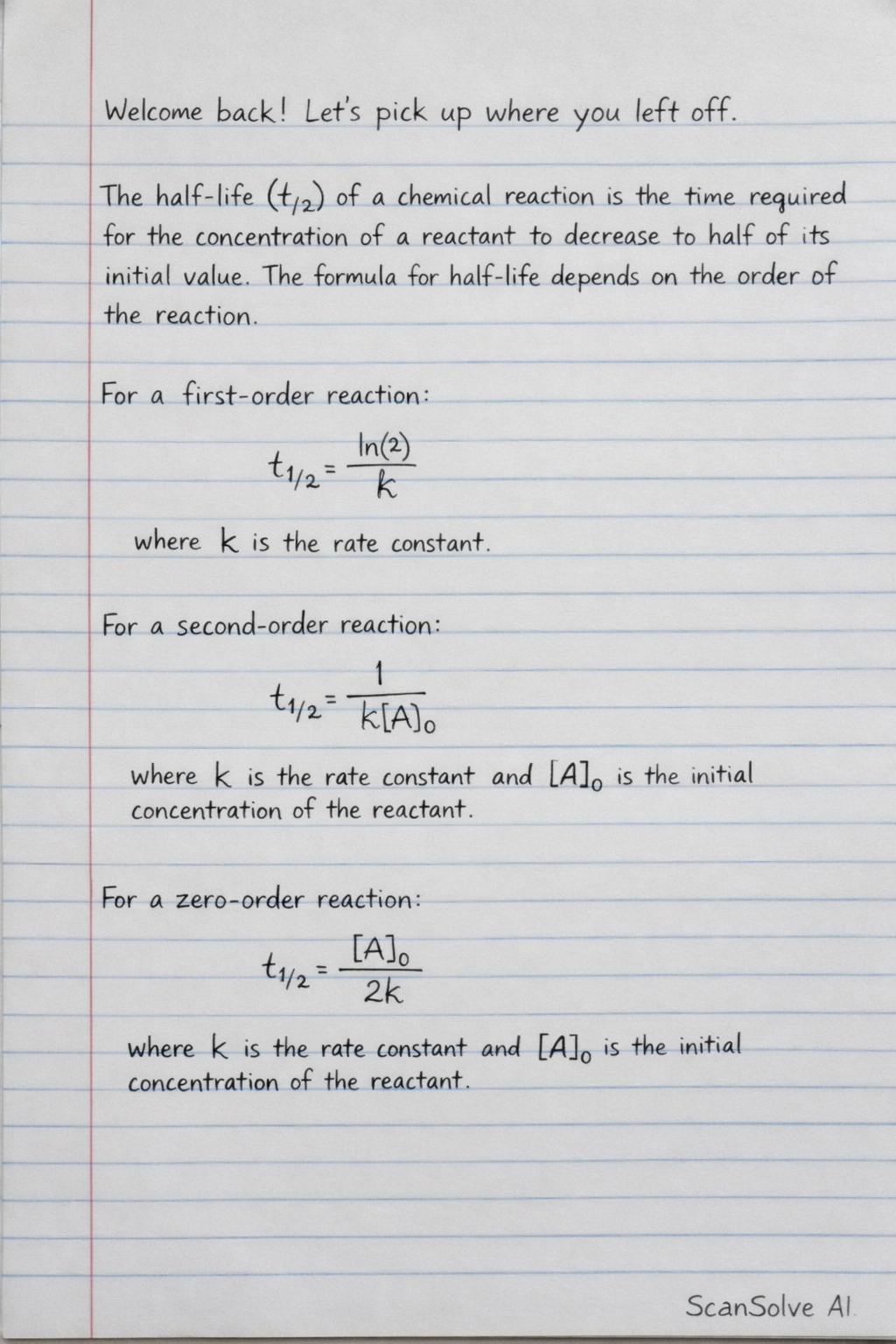
The half-life () of a chemical reaction is the time required for the concentration of a reactant to decrease to half of its initial value. The formula for half-life depends on the order of the reaction.
For a first-order reaction:
where is the rate constant.
For a second-order reaction (where the rate depends on the square of the concentration of one reactant, or the product of the concentrations of two reactants):
where is the rate constant and is the initial concentration of the reactant.
For a zero-order reaction:
where is the rate constant and is the initial concentration of the reactant.
Still stuck on this one?
Ask a follow-up, and the answer starts from this question.
More Chemistry Questions
Handwritten Step-by-Step Solution
Get this as a handwritten image on WhatsApp — like a tutor wrote it for you.
Try on WhatsApp