
We read your photo as:
A 100g sample of steam at 100°C is passed into 500g of water at 20°C. Calculate the final temperature of the mixture. (Specific heat capacity of water = 4200 J/kg K, Latent heat of vaporization of ste
ScanSolve AI Answer
Answer
Step-by-step solution
4 stepsLet's knock this out.
26.
State the principle of calorimetry.
Heat lost by steam = Heat gained by water.
We need to consider two phases for the steam: condensation and cooling of the condensed water.
Let be the final temperature.Calculate the maximum heat that can be gained by the water to reach .
The initial temperature of water is . If the final temperature is , the change in temperature for water is .
Given:- Mass of water () =
- Specific heat capacity of water () =
Heat gained by water () to reach :
Calculate the maximum heat that can be lost by the steam if all of it condenses and cools to .
This involves two parts:
- Heat lost by condensation of steam at to water at ().
- Heat lost by the condensed water (originally steam) from to ().
Given:
- Mass of steam () =
- Latent heat of vaporization () =
Heat lost by condensation:
Compare the heat values to determine the final temperature.
The heat released by just the condensation of all the steam () is greater than the heat required to raise the temperature of the water to ().
This means that the water will reach , and not all the steam will condense. The excess heat from the steam (if it were to cool further) is not absorbed by the water because the water itself reaches the boiling point of the steam. Therefore, the final temperature of the mixture will be .To confirm, the mass of steam required to condense to bring the water to is:
Since is less than the available of steam, the water will reach , and some steam will remain uncondensed at .
The correct option is C.
27.
Good insulators are materials that trap air, which is a poor conductor. Air is an excellent thermal insulator because its molecules are far apart, reducing the frequency of collisions needed for heat transfer by conduction. Many insulating materials, like fiberglass, foam, or wool, work by trapping pockets of air.The correct option is B.
Try one yourself
A new problem that tests the same skill.
Still stuck on this one?
Ask a follow-up, and the answer starts from this question.
More Physics Questions
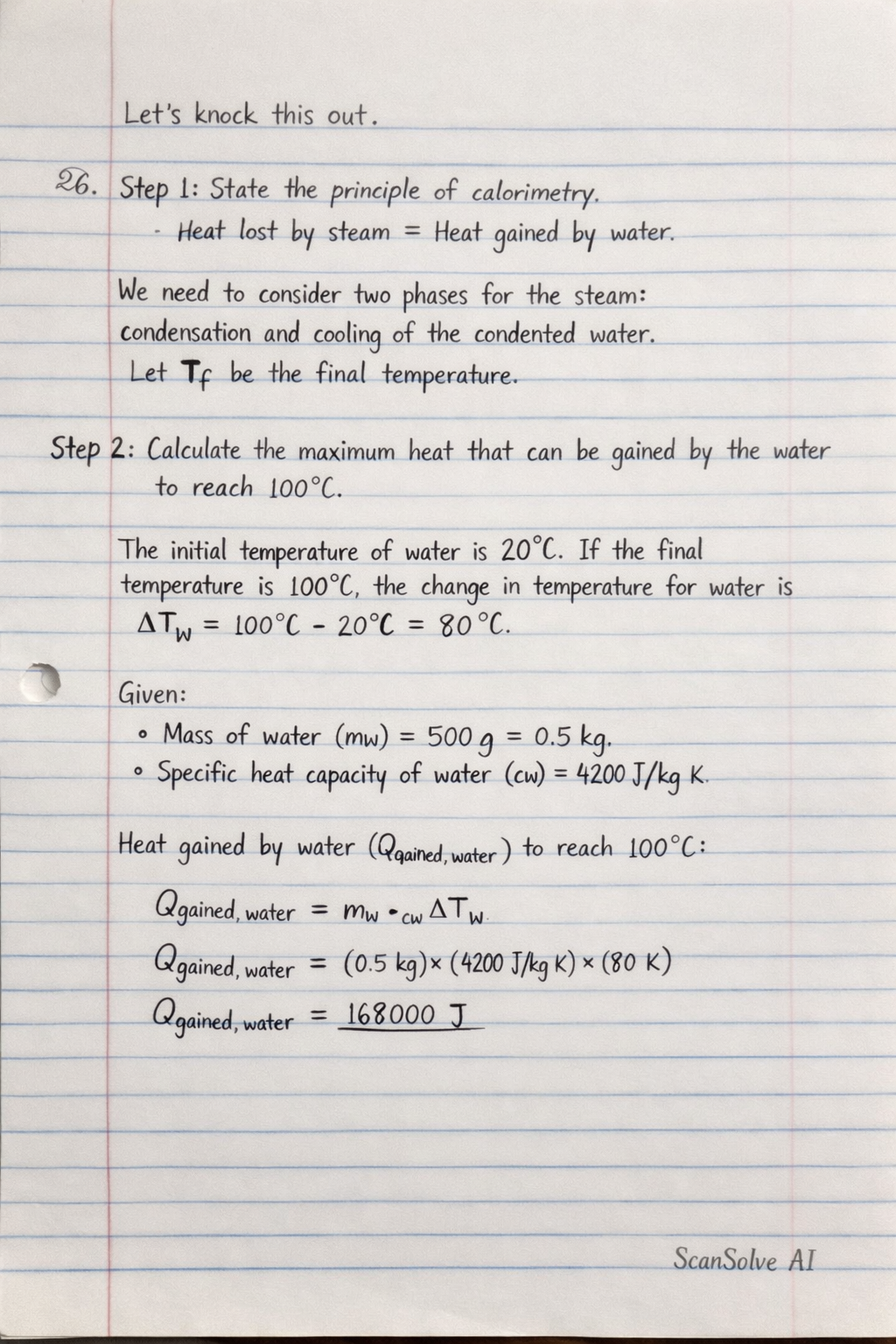
Handwritten Step-by-Step Solution
Get this as a handwritten image on WhatsApp — like a tutor wrote it for you.
Try on WhatsApp