We read your photo as:

A 16 µF capacitor is charged at a constant current of 4 µA for 2 min. Calculate the final p.d. across the capacitor and the corresponding charge in coulombs.

Physics

ScanSolve AI Answer

Step-by-step solution

9 steps

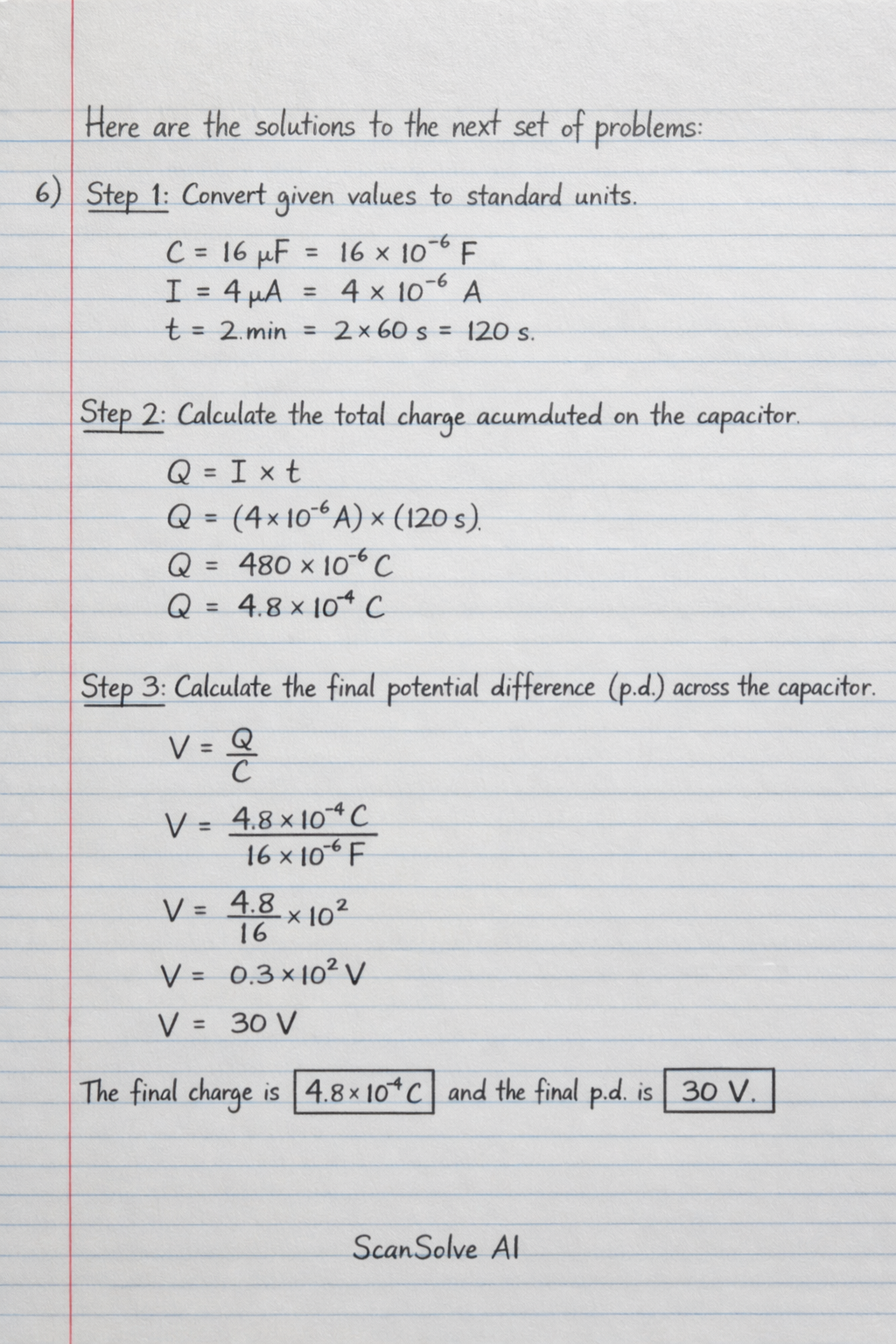
Here are the solutions to the next set of problems:

6) A 16 μF capacitor is charged at a constant current of 4 μA for 2 min. Calculate the final p.d. across the capacitor and the corresponding charge in coulombs.

  1. Convert given values to standard units.

    Capacitance C=16 μF=16×10−6 FC = 16 \, \mu F = 16 \times 10^{-6} \, F.
    Current I=4 μA=4×10⁻⁶ AI = 4 \, \mu A = 4 \times 10^{-6} \, A.
    Time t=2 min=2×60 s=120 st = 2 \, \text{min} = 2 \times 60 \, s = 120 \, s.

  2. Calculate the total charge accumulated on the capacitor.

    The charge QQ is given by Q=I×tQ = I \times t.

    Q=(4×10⁻⁶ A)×(120 s)Q = (4 \times 10^{-6} \, A) \times (120 \, s) Q=480×10−6 CQ = 480 \times 10^{-6} \, C Q=4.8×10⁻⁴ CQ = 4.8 \times 10^{-4} \, C
  3. Calculate the final potential difference (p.d.) across the capacitor.

    The voltage VV is given by V=QCV = \frac{Q}{C}.

    V=4.8×10⁻⁴ C16×10−6 FV = \frac{4.8 \times 10^{-4} \, C}{16 \times 10^{-6} \, F} V=4.816×10(−4−(−6)) VV = \frac{4.8}{16} \times 10^{(-4 - (-6))} \, V V=0.3×10² VV = 0.3 \times 10^{2} \, V V=30 VV = 30 \, V

    The final charge is 4.8×10⁻⁴ C\boxed{4.8 \times 10^{-4} \, C} and the final p.d. is 30 V\boxed{30 \, V}.

    7) A steady current of 10A flows into a previously uncharged capacitor for 1.5 ms when the p.d. between the plates is 2 kV. Find the capacitance of the capacitor.

  4. Convert given values to standard units.

    Current I=10 AI = 10 \, A.
    Time t=1.5 ms=1.5×10⁻³ st = 1.5 \, ms = 1.5 \times 10^{-3} \, s.
    Potential difference V=2 kV=2×10³ VV = 2 \, kV = 2 \times 10^{3} \, V.

  5. Calculate the total charge accumulated on the capacitor.

    The charge QQ is given by Q=I×tQ = I \times t.

    Q=(10 A)×(1.5×10⁻³ s)Q = (10 \, A) \times (1.5 \times 10^{-3} \, s) Q=15×10−3 CQ = 15 \times 10^{-3} \, C Q=0.015 CQ = 0.015 \, C
  6. Calculate the capacitance of the capacitor.

    The capacitance CC is given by C=QVC = \frac{Q}{V}.

    C=0.015 C2×103 VC = \frac{0.015 \, C}{2 \times 10^{3} \, V} C=0.0152×10⁻³ FC = \frac{0.015}{2} \times 10^{-3} \, F C=0.0075×10⁻³ FC = 0.0075 \times 10^{-3} \, F C=7.5×10⁻⁶ FC = 7.5 \times 10^{-6} \, F C=7.5 μFC = 7.5 \, \mu F

    The capacitance of the capacitor is 7.5 μF\boxed{7.5 \, \mu F}.

    8) A direct current of 10A flows into a previously uncharged 5 μF capacitor for 1 ms. Determine the p.d. between the plates.

  7. Convert given values to standard units.

    Current I=10 AI = 10 \, A.
    Capacitance C=5 μF=5×10⁻⁶ FC = 5 \, \mu F = 5 \times 10^{-6} \, F.
    Time t=1 ms=1×10⁻³ st = 1 \, ms = 1 \times 10^{-3} \, s.

  8. Calculate the total charge accumulated on the capacitor.

    The charge QQ is given by Q=I×tQ = I \times t.

    Q=(10 A)×(1×10⁻³ s)Q = (10 \, A) \times (1 \times 10^{-3} \, s) Q=10×10−3 CQ = 10 \times 10^{-3} \, C Q=0.01 CQ = 0.01 \, C
  9. Calculate the potential difference (p.d.) between the plates.

    The voltage VV is given by V=QCV = \frac{Q}{C}.

    V=0.01 C5×10−6 FV = \frac{0.01 \, C}{5 \times 10^{-6} \, F} V=0.015×10⁶ VV = \frac{0.01}{5} \times 10^{6} \, V V=0.002×10⁶ VV = 0.002 \times 10^{6} \, V V=2000 VV = 2000 \, V V=2 kVV = 2 \, kV

    The potential difference between the plates is 2000 V\boxed{2000 \, V} or 2 kV\boxed{2 \, kV}.

Was this helpful?

Still stuck on this one?

Ask a follow-up, and the answer starts from this question.

Got a different question?Ask your own question
Handwritten step-by-step solution preview

Handwritten Step-by-Step Solution

Get this as a handwritten image on WhatsApp — like a tutor wrote it for you.

Try on WhatsApp