

This physics problem tests your understanding of fundamental physical laws and their applications. The step-by-step solution below breaks down the problem using relevant equations and physical reasoning.
ScanSolve AI Answer
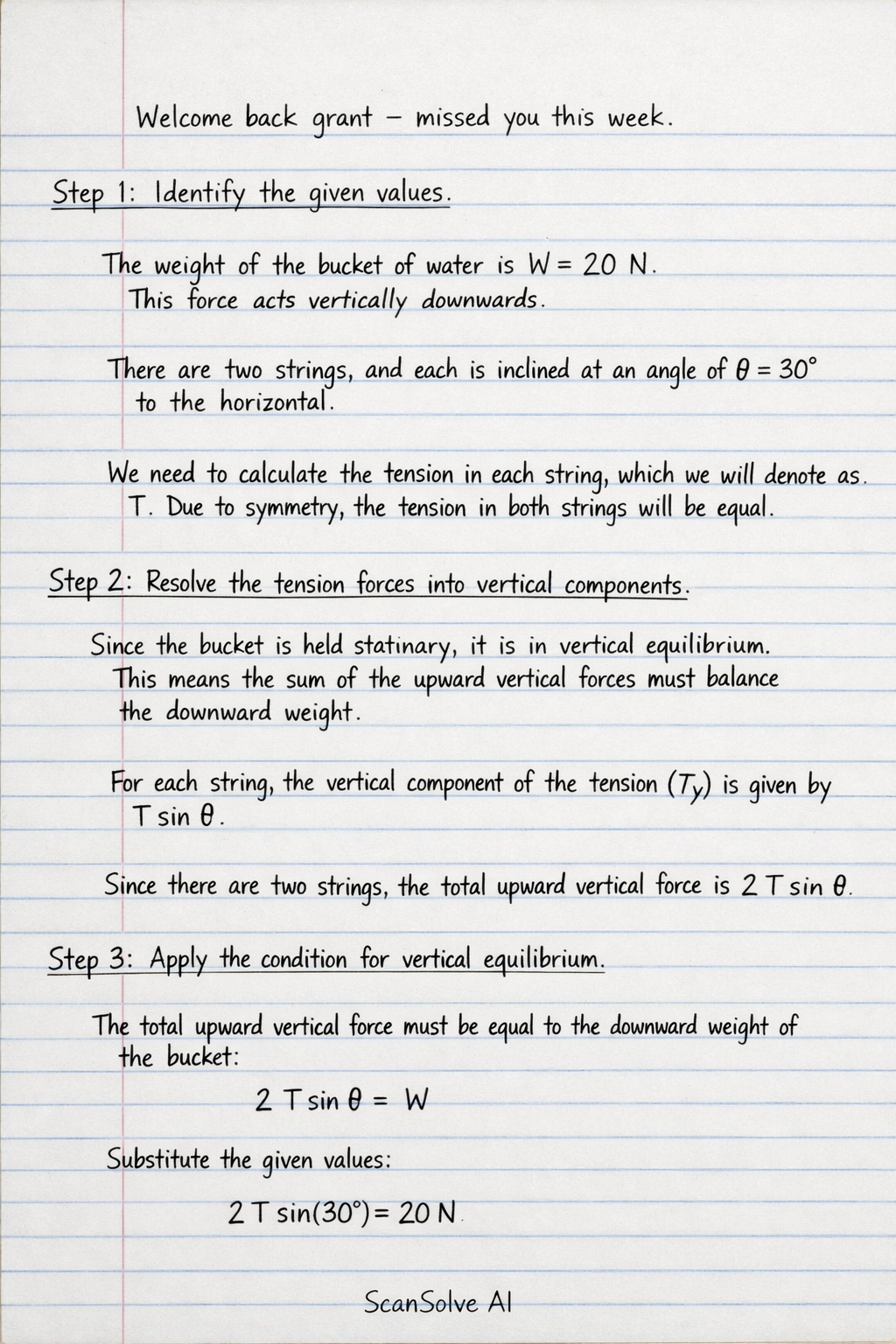
Welcome back grant — missed you this week. Step 1: Identify the given values. The weight of the bucket of water is W = 20 N. This force acts vertically downwards. There are two strings, and each is inclined at an angle of = 30^ to the horizontal. We need to calculate the tension in each string, which we will denote as T. Due to symmetry, the tension in both strings will be equal. Step 2: Resolve the tension forces into vertical components. Since the bucket is held stationary, it is in vertical equilibrium. This means the sum of the upward vertical forces must balance the downward weight. For each string, the vertical component of the tension (T_y) is given by T . Since there are two strings, the total upward vertical force is 2 T . Step 3: Apply the condition for vertical equilibrium. The total upward vertical force must be equal to the downward weight of the bucket: 2 T = W Substitute the given values: 2 T (30^) = 20 N Step 4: Solve for the tension T. We know that (30^) = (1)/(2) or 0.5. 2 T ((1)/(2)) = 20 N T = 20 N The tension in each string is 20 N. What's next?